
Exclusive Q&A by Brad Balfour, Arts Editor
Thanks to actor Michael Mellamphy, who plays the Postman, I was turned on to this unassuming yet touching new musical, “Parcel from America,” set in Ireland of the 1950s. “Parcel…” tells the story of a two young boys and a lonely widow in a remote parish in the west of Ireland, and the importance of one special parcel that changes the lives of the entire community, carrying them all into the true heart of Christmas.
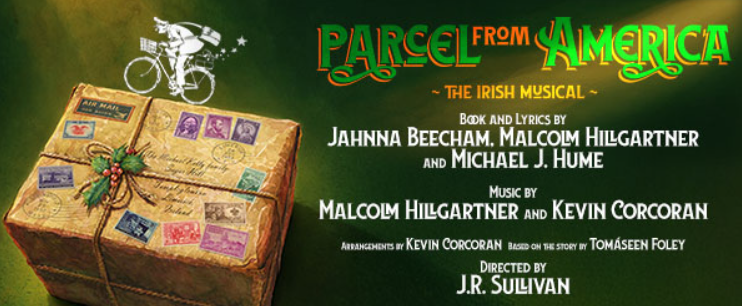
The musical features a book and lyrics by Jahnna Beecham, Malcolm Hillgartner, and Michael J. Hume, with music by Hillgartner and Kevin Corcoran. The production is directed by J.R. Sullivan, with music director and arranger Corcoran and choreography by Barry McNabb.
Adapted from a tale by acclaimed Irish storyteller Tomáseen Foley, this new Irish musical will made its New York premiere this fall with previews beginning October 28; it will celebrate an official opening on November 4, and has a limited run through November 22, 2026 at Theatre Row (410 West 42nd Street).
Inspired by the history of Irish emigration and the cherished parcels filled with gently used clothing and much-needed dollars sent by loved ones from across the Atlantic, this musical celebrates the old Irish adage that “it is only in the shelter of our neighbors that we all can live,” a theme that rings especially true in these fraught times.
Though I came to the performance late, I so enjoyed the show that I did this interview to encourage other to make the musical before it ends.
Three of the the principal creators –Jahnna Beecham, Malcolm Hillgartner, and Kevin Corcoran — answered question via email explaining the show’s origins and its possible. Check it out asap because it will be come a seasonal return.
Q: Talk about how you three collaborated.
The “Parcel” Team: We began working on this show in 2018 and through the intervening years have had to be creative in how we manage our collaborative efforts. As much as possible, we’ve tried to be in the same room for the initial exploration of plot and song ideas. So Jahnna and Malcolm have spent extensive amounts of time in Ireland and Kev has likewise come to the US to do the same. But those meetings together, productive as they have been, are just the tip of the collaborative iceberg. Countless exchanges of drafts and demos back and forth across the Atlantic, punctuated with ZOOM calls and letters, not to mention workshops in Dublin, Chicago, Oregon and New York with our director Jim Sullivan and actors from Ireland and the US brought us across the finish line, such as it is. We’re still revising moments and scenes as we go, and will probably do so until a publisher tells us to stop.
Q: Tell me the story of where did all this began?
The “Parcel” Team: More than 20 years ago, Malcolm and Jahnna heard Tom tell his story at a small community center in southern Oregon. His haunting, bittersweet tale of a lonely widow, a young boy, and a singular Christmas parcel that changed their lives, and the lives of their families and village forever, stuck with us. It was only in late 2018 we were able to option the rights to the story with Michael J. Hume and our work began in earnest. The addition of composer/arranger Kevin Corcoran completed the team and it’s been a roller coaster ride ever since.
Q: Why do you think this story which included the impact of Irish immigration in those days resonates?
The “Parcel” Team: Tom Foley likes this quote from Tolstoy: “If you want to be universal, tell the story of your own village.” We have found that to be true with “Parcel from America.” Although specific to the experience of the Irish diaspora, this story touches everyone. I remember vividly a couple from Bosnia coming up after a performance in Dublin with tears in their eyes. “This is our story. We lived this in our community.” It reinforces the truism that people, no matter where they come from, or whatever their hardships may make them suffer, remain at their core decent and kind, and often willing to extend a helping hand to a neighbor, or even a stranger, at great sacrifice to themselves, and that these essential human values remain something all of us should cherish and nurture. They reveal the best in our common humanity. And in these fraught times that’s a message that bears repeating.
Q: How did you decide on the title?
Parcel” Team: It came with the territory, as it was what Tom Foley titled his story in the first place.
Q: Talk about the casting process.
Parcel” Team: We were fortunate that we were able to bring along to this New York production several of our core actors from the Dublin premiere. Filling out the rest of cast required six days of auditions, viewing hundreds of candidates, winnowing the list down to about 60 possibles, then calling them back for a closer look. It was a very hard process.
The quality of the actors called back for one last look was so good, it made the final decision on each character agonizing. So it often came down to indefinables. Did the actor look like a man who worked with his hands? Did the adult actor auditioning to play one of the kids — who are supposed to be 12-14, — appear young enough? [The actual actresses are in their early 20s] The show has a lot of vocal harmony so finding voices that blended was a challenge as well. The process took a lot of patience.
Q: How did you find the the theater?
The “Parcel” Team: We looked at venues all over Manhattan but finding the combination of location, size of theatre, and an opening in the schedule was daunting. At times we thought we’d be at Sheen Center in Greenwich Village; the York on the Upper East Side. All fell through for various reasons and we were about to throw in the towel when our producer Andrew Levine found Theatre Row on 42nd Street and miracle of miracles, it was available. We grabbed it.
Q: Why the 1950s? What made sense about that era?
The “Parcel” Team: The post-WWII era in Ireland was particularly hard on the Irish economy and even more so on the isolated rural communities in the west. Times were tough, jobs were scarce, and the mercurial climate (always a struggle for farmers in any year) was worse than usual. The challenges the family faced in their daily struggles to get by only made the sacrifice they ultimate make to save their neighbor more moving.
Q: You employed some very clever stage design to create the sense of a village. What did it take to make that work?
The “Parcel” Team: Theatre Three at Theatre Row has some unique challenges as a stage. It’s quite wide but very shallow, only 21 feet deep from the lip of the stage to the back wall. Likewise there is very little room in the “wings”— when an actor exits stage left, they go straight into the dressing room corridor. On stage right, they exit directly in a stair well. Crossovers require the actor going down those stairs on either side and crossing under the stage, so timing is critical.
One of the challenges designer Harry Feiner had to meet was giving the audience a sense of openness, while managing at times 12 performers on a small piece of real estate. Just finding room to fit the band on stage was like a game of Tetris. Director Jim Sullivan had to navigate all those hurdles through his staging of the scenes.
Q: How much did you draw from previous productions?
A great deal. The initial script was drafted in 2018. At each step of the way—an first table read in Dublin and a staged reading at Irish Theatre Chicago in 2019; another staged reading in Oregon in 2021; the premiere production at Smock Alley Theatre in Dublin in 2022; an industry reading in NYC in 2025—new discoveries were found, revisions were made, some songs were revised or cut, others added. It’s an incremental process but always building on the work that came before.
Q: Do you hope to take this to Broadway?
The “Parcel” Team: That’s a heavy lift. This Off Broadway show costs about $900,000 to produce. That’s a small fraction of the average cost to produce a Broadway musical, which average these days around $22-27 million dollars. So a commercial producer with deep pockets (or access to deep pockets) will have to step forward and take on any commercial Broadway production. And we have mixed feelings about going to Broadway, anyway.
Broadway musicals rely a lot on flashy spectacle and “Parcel from America” is a quiet, intimate story that might not transfer well to the great scale and scope of a Broadway show. The immediate future of Parcel from America may lie in its being published and licensed to regional theaters around the country as a wonderful holiday show. That’s the end result we’re actively pursuing now.