
By Paddy McCarthy
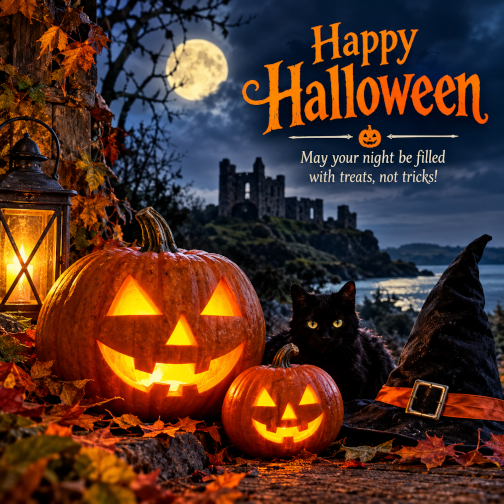
I wish you and all our readers a wonderful Halloween filled with happiness, fun, and plenty of treats!
I hope you will enjoy my history of Halloween in my Out&About in this week’s issue as much as I am bringing it to you. Here is a history of Halloween that I want can share with all of our readers. It explores the ancient Irish origins of the celebration, the traditions that travelled from Ireland to America, and how Halloween became the holiday we know today. The story is especially interesting because Halloween has deep roots in Ireland, going back more than 2,000 years to the ancient Celtic festival of Samhain.
As Halloween approaches each October, children dress up in costumes, families carve pumpkins, and homes and streets are decorated with ghosts, witches and jack-o’-lanterns. For millions of people, Halloween is a time for fun, sweets and a little fright. But behind the costumes and celebrations lies a fascinating history that reaches back more than 2,000 years to Ireland, where the ancient Celtic festival of Samhain laid the foundations for many of the Halloween traditions we know today.
Long before Halloween became a popular celebration in America, the ancient Celts of Ireland observed Samhain, pronounced SOW-in. The festival marked the end of the harvest season and the beginning of winter, traditionally associated with November 1.
For farming communities, this was an important turning point in the year. Crops had been gathered, livestock were brought in from the fields, and people prepared for the long, dark winter months ahead. Samhain was one of the four major seasonal festivals in the ancient Irish calendar. It marked the transition from the lighter half of the year to the darker half, and it was a time when communities gathered to celebrate, share food and observe traditional customs. The ancient Celts also believed that Samhain was a time when the boundary between the world of the living and the world of spirits became less distinct. According to traditional beliefs, the spirits of the dead could return to visit their former homes, while fairies and other supernatural beings might roam the countryside. These beliefs were part of the folklore and spiritual traditions of the time. People responded with gatherings, fires, disguises and customs intended to protect their households and welcome the changing season. The National Museum of Ireland documents many of these customs, which remained part of Irish rural life for generations.
Bonfires became an important feature of Samhain celebrations. People gathered around fires as part of seasonal festivities, and fire was associated with protection and the transition into winter.
People sometimes darkened their faces or wore unusual costumes, partly in keeping with beliefs about spirits and supernatural visitors. Over the centuries, these customs helped shape the spooky atmosphere that has become such a familiar part of Halloween. Today’s skeletons, ghosts, witches and monsters may look very different from the disguises of ancient Ireland, but the tradition of dressing up has a long history. It is important to remember that we do not have a complete contemporary record of exactly how every ancient Samhain celebration was conducted. Much of what we know comes from later writings, folklore and historical research.
The name Halloween developed through the influence of Christianity. November 1 became known as All Saints’ Day, a Christian feast honoring saints. The evening before was called All Hallows’ Eve. Over time, this name was shortened to Hallowe’en and then Halloween. November 2 became All Souls’ Day, a day traditionally associated with prayers for the dead. As Christian observances and older seasonal customs came together, Halloween developed into a celebration that combined religious traditions, Irish and other Celtic folklore, community gatherings and popular beliefs about spirits. The result was a holiday that continued to evolve through the centuries while retaining strong connections to the ancient observance of Samhain.
One of Halloween’s most popular traditions is trick-or-treating, when children dress in costumes and visit neighbors to ask for sweets. Its history is more complicated than a single ancient custom, but several traditions contributed to the practice. In medieval Ireland and Britain, people participated in customs involving food, prayers and remembrance of the dead.
One such tradition, known as soiling, involved people visiting homes and receiving small cakes in exchange for prayers for deceased family members. In Ireland and Scotland, another practice known as guising involved people dressing in disguises and visiting homes, sometimes singing songs, reciting verses or performing in exchange for food. These customs are among the historical influences on modern trick-or-treating. The familiar American version, with children knocking on doors and receiving individually wrapped sweets, developed much later.
One of the most recognizable symbols of Halloween is the jack-o’-lantern, but the tradition did not begin with pumpkins. In Ireland, people traditionally carved faces into turnips and other root vegetables, sometimes placing a light inside. The frightening faces were associated with Halloween folklore and were believed to help ward off unwanted spirits. The custom is often connected with the Irish legend of Stingy Jack, a character said to have tricked the Devil and ultimately been condemned to wander without a permanent home, carrying a burning coal inside a hollowed-out turnip. The story survives in several versions and belongs to folklore rather than documented history. When Irish immigrants brought their Halloween traditions to North America during the nineteenth century, they encountered pumpkins, which were larger and easier to carve than the turnips they had used at home. The pumpkin jack-o’-lantern gradually became one of Halloween’s most recognizable symbols
Halloween in Ireland was also a time for traditional foods, games and family gatherings. One of the best-known Irish Halloween foods is barmbrack, or báirín breac, a fruit bread traditionally associated with the season. In some traditional versions, small objects were baked into the bread to symbolize possible fortunes. A ring might represent marriage, while other objects were associated with different predictions about the future. The meanings varied between families and local traditions.
Children and adults also played games involving apples, nuts and other harvest foods. Some games were used for amusement, while others were associated with predicting future romance or marriage. These customs reveal that Halloween was not simply a night of fear. It was also a social occasion, bringing families and neighbors together at the end of the agricultural year.
Halloween’s journey across the Atlantic is an important part of its history. During the nineteenth century, large numbers of Irish people emigrated to the United States, particularly during and after the Great Famine of the 1840s. They carried their language, music, stories, religious traditions and seasonal customs to their new homes. Halloween traditions became part of Irish-American community life and gradually spread more widely throughout the United States.
Over time, American celebrations incorporated new customs, elaborate costumes, parties, neighborhood activities and commercial products. Pumpkins became more prominent, and trick-or-treating developed into the familiar children’s activity seen today. By the twentieth century, Halloween had grown into a major American celebration.
From the United States, its modern commercial style spread internationally, while older traditions continued in Ireland and other countries.
Ireland continues to celebrate Halloween with a mixture of traditional customs and modern festivities. Families gather for food and games, children wear costumes, communities organize events, and bonfires and seasonal festivals feature in some areas. Storytelling, folklore and Irish supernatural traditions remain an important part of the celebration.
The festival has also become an opportunity to celebrate Ireland’s cultural heritage, with events exploring Samhain, ancient seasonal customs and the country’s rich storytelling tradition.
For many Irish people, Halloween is a reminder that the holiday is not simply a modern invention centered on sweets and costumes. It has a long and layered history connected to the seasons, the harvest, the dead and the stories passed from one generation to another. A tradition that continues to bring people together.
From the ancient festival of Samhain to today’s pumpkin-filled porches and trick-or-treating children, Halloween has traveled a remarkable journey through history. Its origins reflect the lives and beliefs of ancient Celtic communities. Its development shows how older customs blended with Christian observances, while Irish emigration helped carry the celebration across the Atlantic and into popular culture around the world. So, when we light a jack-o’-lantern, dress up in costume or share Halloween treats, we are participating in a celebration whose roots reach deep into Ireland’s past.
Ireland’s contribution to Halloween is a wonderful part of its cultural legacy — a reminder of how the traditions, folklore and imagination of one country helped shape a celebration now enjoyed by millions around the world.
Happy Halloween to all our readers, their families and friends. May the season bring plenty of fun, happy memories and a little Irish magic! From all of us here at The Irish Examiner USA. We hope you all will have a very enjoyable time this Halloween as much as we will and I will see you all again next week when I am Out&About again…