
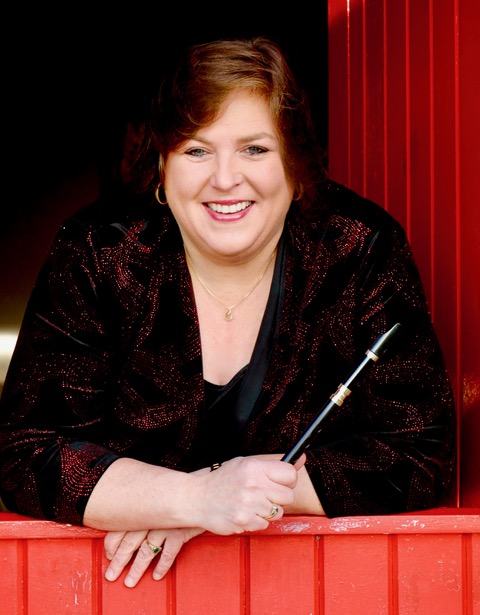
 I just got news from a great friend of mine Mary Reed about another good friend and that is the one and only Joanie Madden of that super group Cherish the Ladies. It all happened last Tuesday when the National Endowment for the Arts (NEA) announced its newest class of National Heritage fellows: nine individuals and groups who represent the richness and breadth of America’s folk and traditional arts. This year’s class of fellows includes artists and creators from African-American, Mexican-American, Native, Filipino, Irish-American and Puerto Rican backgrounds, whose array of mediums span many kinds of music, ribbon and lace work, tap dance and filmmaking. Several musicians and groups were inducted among this year’s honorees. The best-known are the Mexican-American band Los Lobos, from Los Angeles, who are cited for having “the East Los Angeles sonic landscape for nearly a half century,” and the Irish-American flute and whistle player Joanie Madden from Yonkers, NY, who is the founder of the group Cherish the Ladies. This woman never stops and I am saying that in a professional way as she is just fabulous in all that she does.
Joanie Madden is recognized as one of the most influential women in Irish music worldwide, with an accomplished career as a composer, recording artist, and performer. One of the great flute and whistle players of her generation—and steeped in a generations-long musical tradition that she proudly champions to audiences around the world—she is a leading presence in the advancement of traditional Irish music, from its community grassroots to its modern presentation in the international concert hall.
I am now going to give you a little history of one of the greatest flutists I have seen in my lifetime and I have seen quite a few: She was born in the Bronx, New York and Madden’s musical passion was ignited by her father, Joe Madden of County Galway Ireland, an accordion player and well-known bandleader in New York’s Irish-immigrant community. The family home was a vibrant musical space, and she spent her early childhood completely immersed in the practice. She began learning the tin whistle from Jack Coen (NEA National Heritage Fellow, 1991), and would often enthusiastically practice in school by tapping the notes on a wooden pencil held to her mouth. She advanced through the competitive music circuit, becoming the first American to win the Senior title at the All-Ireland Fleadh Cheoil (Festival of Music) on the tin whistle in 1984.
Her “Songs of the Irish Whistle” albums (1996, 1999) are among the most successful whistle albums ever sold. Described as “virtuosic” by her peers, Madden’s playing is praised for being uniquely expressive, ranging from jubilant upbeat reels to meditative ballads and slow airs. Rather than playing with the wooden flute, which is standard amongst traditional Irish musicians, she plays on silver flutes more common with classical musicians. This affords a greater range of playing capability while paradoxically complicating the common ornamentations of traditional Irish playing, creating her distinct style.
In 1985, Madden began leading what is now one of the most commercially and critically successful music groups in Irish traditional music. Cherish the Ladies, the first all-female troupe of its kind, has gained international fame and has notably achieved honorable status within the symphony hall environment. In continuing the family tradition of bandleading, Madden has become an immensely respected figure. Her multidimensional understanding of music is informed by decades of casual Irish traditional music sessions, or seisiúns, professional production work, and a broad understanding of Irish cultural practice, including dance. This, with her vibrant charisma and heartwarming sincerity, has instilled among fellow artists a unique level of trust in her leadership and direction, while preserving a genuine sense of collaboration and partnership.
Madden continues to bear the mantle of tradition-keeping through regular educational engagements, including ethnomusicology-focused bus tours through Ireland and cruises offering Irish workshops and dance lessons. She leads workshops at the storied Catskills Irish Arts Week in Durham, New York, and has served as director of Augusta Heritage Celtic Music Week in Elkins, West Virginia. She actively mentors’ flute and tin whistle students and has proudly coached three All-Ireland champion-winning tin whistle musicians. I am sure we will get a chance to see and hear Joanie perform soon with her group Cherish the Ladies now that this pandemic is subsiding at last and almost under control. We here at The Irish Examiner would like to personally to say congratulations to Joanie Madden and keep it going.
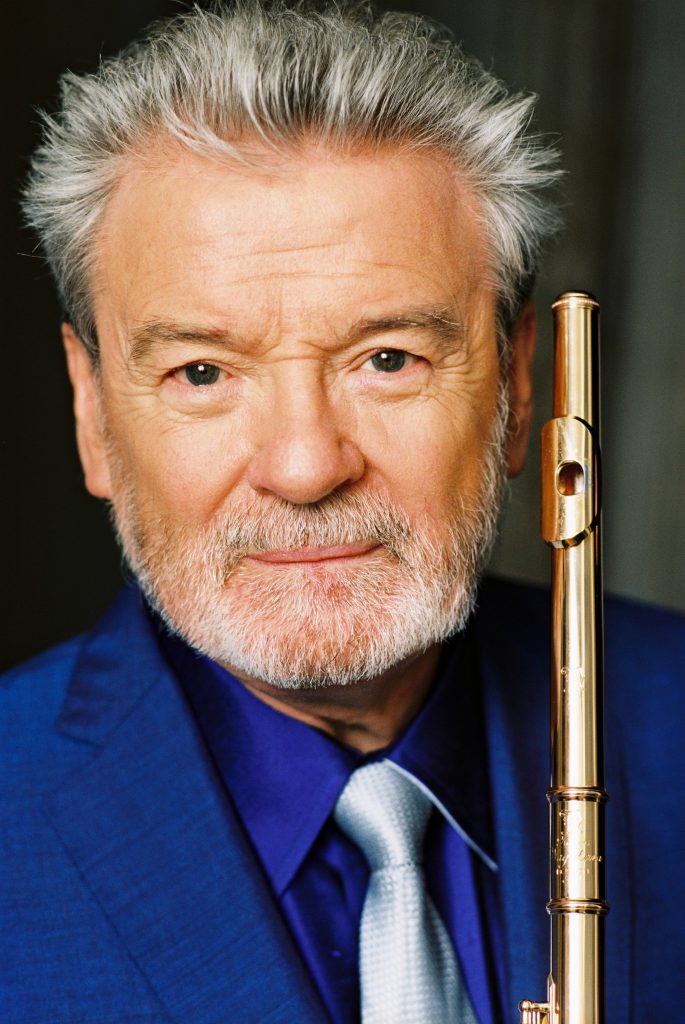 Now that I just introduced one of Irish American’s greatest flute players, I am now going to introduce one of the world’s greatest flute players that I know Joanie admires very well. Yes, none other than James Galway. James is an Irish virtuoso flute player from Belfast, nicknamed “The Man with the Golden Flute”. He established an international career as a solo flute player. In 2005, he received the Brit Award for Outstanding Contribution to Music at the Classic Brit Awards.
Galway was born in North Belfast as one of two brothers. His father, who played the flute, was employed at the Harland and Wolff shipyard until the end of the Second World War and spent night-shifts cleaning buses after the war, while his mother, a pianist, was a winder in a flax-spinning mill. Surrounded by a tradition of flute bands and many friends and family members who played the instrument, he was taught the flute by his uncle at the age of nine and joined his fife and drum corps.
At the age of eleven Galway won the junior, senior, and open Belfast flute Championships in a single day. His first instrument was a five-key Irish flute, and at the age of twelve or thirteen, he received a Boehm instrument. He left school at the age of fourteen and worked as an apprentice to a piano repairer for two years. He subsequently studied the flute at the Royal College of Music under John Francis and at the Guildhall School of Music under Geoffrey Gilbert. He then briefly studied at the Paris Conservatoire under Gaston Crunelle. While in Paris, he asked for lessons from the celebrated French flute player Jean-Pierre Rampal, who offered him advice on his playing, but felt he was already too good a flute player to need lessons from either Rampal or the conservatory.
He left Paris to take up his first orchestral flute-playing job at Sadler’s Wells Opera in London. He went on to spend fifteen years as an orchestral player. In addition to Sadler’s Wells, he played with Covent Garden Opera, the London Symphony Orchestra and the Royal Philharmonic Orchestra. He auditioned for the Berlin Philharmonic Orchestra under Herbert von Karajan and was principal flute in the orchestra from 1969 to 1975. To Karajan’s surprise and dismay, after a period of some disagreement, Galway decided that he would leave to pursue a solo career.
In addition to his performances of the standard classical repertoire, he features contemporary music in his programs, including new flute works commissioned by and for him by composers including David Amram, Malcolm Arnold, William Bolcom, John Corigliano, John Wolf Brennan, Dave Heath, Lowell Liebermann and Joaquín Rodrigo. The album “James Galway and The Chieftains in Ireland” by Galway and The Chieftains reached number 32 in the UK Albums Chart in 1987. Galway still performs regularly and is one of the world’s best-known flute players. His recordings have sold over 30 million copies.
In 1990, he was invited by Roger Waters to play at “The Wall – Live in Berlin” concert, held in Potsdamer Platz; he played Pink Floyd’s songs “Goodbye Blue Sky” and “Is There Anybody Out There?”. Galway performed for the Academy Award-winning ensemble recording the soundtracks of Peter Jackson’s The Lord of the Rings film trilogy, composed by Howard Shore. In June 2008, he was inducted into the Hollywood Bowl Hall of Fame along with Liza Minnelli and B.B. King.
He performs on Nagahara flutes, as well as some Muramatsu Flutes. Conn-Selmer produces his line of flutes, “Galway Spirit Flutes”. Galway is president of Flutewise, a global charitable organization that supports young flute players, run by Liz Goodwin. In 2003 he formed the Music Education Consortium together with Julian Lloyd Webber, Evelyn Glennie, and Michael Kamen to pressure the British Government into providing better music education in schools. He is an Ambassador for the National Foundation for Youth Music, a UK charity. He was made an Officer of the Order of the British Empire (OBE) in 1977, and was knighted in 2001, the first wind player ever to receive that honor. He is a National Patron of Delta Omicron, an international professional music fraternity.
In December 2013 Galway launched First Flute, an online interactive series of lessons for beginning flute students of all ages. He received the 2014 Gramophone Lifetime Achievement Award.
Galway has been married three times. His first marriage, to a Frenchwoman, produced a son. He married his second wife, Anna (Annie) Renggli, a daughter of a well-known Swiss architect, in 1972, and moved from Berlin to Lucerne, Switzerland, her hometown. The couple had twin daughters and a son.
In 1978 he recorded for her an instrumental version of John Denver’s “Annie’s Song”. It peaked at No. 3 in the UK Singles Chart. After their divorce, he moved to Meggen, Switzerland, a village next to Lucerne, where he resides now with his third wife, the American-born Jeanne Galway (née Cinnante), whom he married in 1984.
They often tour together, playing duets. In addition, they give master classes. Galway is a devout Christian who visits various types of churches while travelling (as long as they are not modern and “happy-clappy”) and prays before his concert performances. He also wears a cross pendant, about which he says, “It’s not jewelery. It’s something that reminds me of what I should be doing and how I should be behaving.”
In August 1977, Galway was run over by a speeding motorcycle in Lucerne, breaking his left arm and both legs and required a four-month hospital stay. He has the eye condition nystagmus, and is a patron of the Nystagmus Network, a charity that supports people with the condition. In December 2009, he fell down a flight of stairs at his home, fracturing his left wrist and breaking his right arm.
Appearing on The Nolan Show in June 2015, Galway stated that he views his national identity as Irish. He was critical of the actions of the Northern Irish government during his childhood, and singled out prominent Unionist figures such as Ian Paisley for fostering the division that led to The Troubles. His comments were criticized by prominent Unionist politicians, among them Sammy Wilson.
Describing Northern Ireland as “the British-occupied part of Ireland,” Galway further elaborated he would like “Ireland to be Ireland” and that when people ask him where he comes from, he says “Ireland” and when asked if he is Irish, he replies affirmatively.
James’s younger brother George Galway is a jazz musician (clarinet, flute, and saxophone) and teacher based in Manchester, England. George’s elder child and James’s nephew, Martin Galway, is a musician known for his work on Commodore 64 computer game music in the 1980s.
Now where would you read about two of the greatest Irish flutists on the same page? Well yes, only in The Irish Examiner USA, now isn’t that something?