
Feature by Brad Balfour
Through his film, “Springsteen: Deliver Me from Nowhere,” veteran director Scott Cooper chronicled rock superstar Bruce Springsteen’s personal and professional struggles during the conception of his 1982 album “Nebraska.” With that album, Springsteen had veered away from the music and professional trajectory of his career at the time — when he had his first No. 1 global hit ,”Hungry Heart.” But Bruce being Bruce, he does things his way. Filtered through his own personal dramas and traumas, he had to make “Nebraska” to exorcise various personal demons and add a unique recording to his catalogue.
At this career juncture, Springsteen, who had been plagued by his doubts and various mental concerns, was determined to find a way through by creating this tortured set of songs and release them in a demo-styled format. In doing so, The Boss tackled his emotion stress through this music and a change of scenery.
In doing so, he ultimately inspired a 2023 book by Warren Zanes, “Deliver Me from Nowhere: The Making of Bruce Springsteen’s Nebraska” about creating the album. It ultimately led to this cinematic excursion which is a very different take on the traditional music biopic. Former actor Cooper had made the switch to directing with 2009’s “Crazy Heart,” starring Jeff Bridges who won the Best Actor that year as well as Best Original Song.
Through “Springsteen: Deliver Me from Nowhere” acclaimed director Cooper re-wrote the script on music films by taking a dark desolate look inside a man known for making anthemic, sometimes joyous, music about the common man and everyday people. Though Cooper’s insightful film led to some criticism, it has broken through during the awards season ever since it was first screened at the Telluride Film Festival and also anchored New York Film Festival 2025 as the spotlight gala feature.
With lead Jeremy Allan White taking on the difficult challenge of portraying such a prominent public figure, (especially at this difficult time in his life), he has accrued praise from the Boss himself. The film also stars Jeremy Strong as manager Jon Landau, Paul Walter Hauser as the engineer who recorded the album, Stephen Graham as Springsteen abusive yet loving father and Odessa Young as the woman he tried to bond with during this alienating phase in his life.
The film was theatrically released in the United States by 20th Century Studios in October 2025. Though film received mixed reviews, the performances by White and Strong have received praise and has achieved a Golden Globe nom for White.
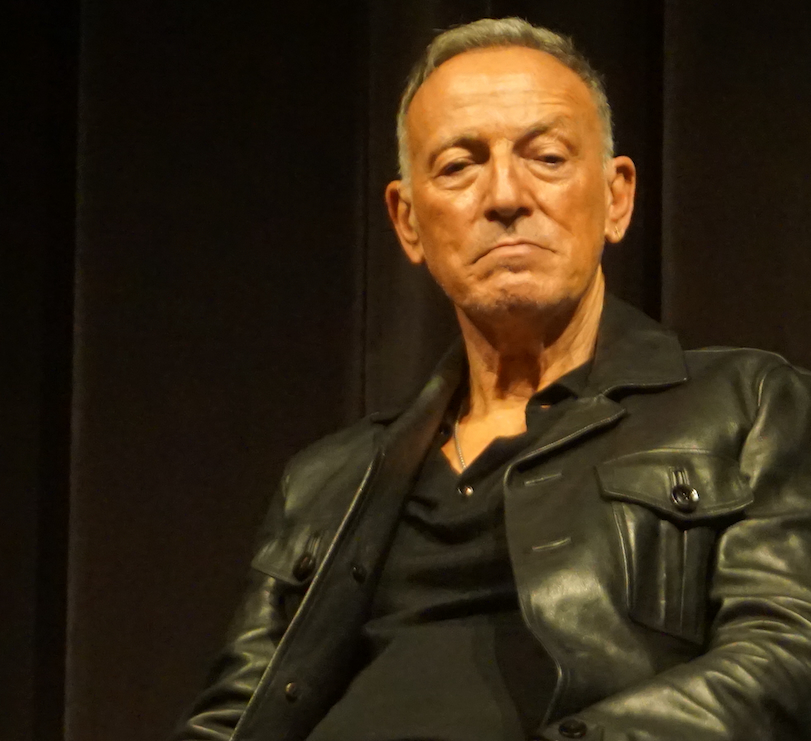
This Q&A was culled from a talk held after the film screened recently at MoMA during its Contender series. Originally booked with Landau and Cooper attending, Springsteen made a surprise appearance and offered lots of comment on the film.
Q: At the heart of this film is the great collaboration between Bruce Springsteen and Jon Landau. Talk about working with these gentlemen to tell your version of their story.
Scott Cooper: It’s rare that you get to tell a story in which the subjects are still alive. It was such a gift because you can only read so much about Bruce Springsteen or watch so many YouTube videos or read Bruce’s wonderful autobiography. Of course, I was well aware of Jon as a legend, a myth, as well. Quite frankly, Bruce was on a tour when I was writing the screenplay, but he made himself available to me.
Sometimes, I would fly out and meet him when he was performing. I was on the phone with him constantly and with Jon, and they enriched the experience, not only on a personal level, but in terms of the material in ways that I never would have imagined before. I assumed that I wouldn’t have access to both of them. Most importantly, I’ve grown to love them. They’ve become such a big part of my life. As it relates to the two Jeremys, I think they are two of the finest actors of their generation. They are both incredibly committed.
As it relates to Jeremy White, taking on a part like Bruce Springsteen, when so many people have ownership over Bruce and what they mean to him, Bruce is beloved. It probably would have been easier for Jeremy White had it been the “Born in the USA” or “Born to Run” story. It’s decidedly not that. But I can’t speak highly enough of my collaboration with both Jeremys and certainly Jon and Bruce.
Q: Jon and Bruce, you were involved with this almost from the outset. Do you remember the advice that you may have given to Scott or Jeremy Strong or Jeremy Allen White when you were starting this project?
Bruce Springsteen: I think the only thing we knew was [that] we didn’t want to make a conventional biography. That was first and foremost. We needed to type a picture that we wanted to make, and I kept telling Scott there were a couple of studios that were aligned and helped produce the picture, and we chose one. I said, Scott and Allen, they know the kind of picture we want to make, right? It’s not going to be like this or that or a classic music biopic. They’re really sure about the kind of picture we’re going to make. And Scott said, yeah, they know, they know, they know, they know.
I have to give 20th Century Studios a lot of credit because they backed us 100 percent and truly loved the picture. We were on board from the minute Scott and I and Warren Zanes and Jon sat down and discussed the possibility of making the picture. Scott was such an open and generous collaborator that he deeply involved us right from the very beginning. He’d come up with a script, and we had a concept for the kind of picture that we wanted to make.
It was limited in scope. It was not going to be some big spectacle. It was going to be a quiet, character-driven drama, basically, about creativity and your personal life. And that’s the picture that Scott described that he wanted to make on the first day that we met is the picture you guys just saw on the screen, so I’m very proud of that.
Jon Landau: Scott has forgotten about this, but Scott flies out to Barcelona while he’s working on the script and mapping out budgets and so forth with the wonderful producers that we had. You know, all this stuff with the taxes in different states and cities and benefits.
[Man from audience]: Rebates.
Jon Landau: Rebates. The producers put poor Scott up to it. He sits down with us in Barcelona, and says, “Now, it’s not my idea, but he said, we could make this movie in Pittsburgh…”
Bruce Springsteen: I said, “Are you out of your fucking mind?”
Scott Cooper: It’s never my idea. Bruce says, “Give me Bob Iger’s phone number.” Anyway, that was the shelf life of that idea for 20 seconds. But the reality was that it just was a very seamless process from the beginning. It was a very joyful experience. We’ve done a number of these panels, and usually we’ve got the two Jeremys with us, who were both working on the Mark Zuckerberg movie. They’re not here. It was a great life experience, I think, for me and I think for all of us.
Q: This film premiered back in late August in Telluride, How was that moment for you, to experience it with an audience for the first time?
Bruce Springsteen: Well, I’m being played by Jeremy Allen White, so that makes it pretty easy. He says, damn, when did I get so good looking? I’ve had experience, obviously, I’ve seen myself on film before, and it’s always a hideous experience for most people. It’s very similar to when you look in the mirror, you always think you look better than you do, and then your aunt takes a photo of you somewhere, and it’s horrible. You get used to it. Then Scott made such a beautiful picture, it was really, it was adorable.
Jon Landau: Well, our beautiful daughter Kate, she saw the film, which she loved, and she said later that she was thinking of trading me in for Jeremy Strong. Jeremy was so much fun, and he really is, you know, the thing about all of the actors, and I really came to understand what I, I’m reading one of the drafts of the script, and I think I know a fair amount about film, and I used to spend in the 70s an incredible amount of time right here, watching retrospectives of King Vidor and silent film, educating myself about film. So I had the notion that I know a little about it.
I’m reading the script, and I’m sitting with Scott, and I said, geez, you know, the dialogue here is a little sparse. I mean, I’m not sure, is this character saying enough? And he said, John, this is the script. Next we bring in the actors. You know, and, you know, it was like, it was interesting, well, anyway. Still learning. But the acting, Scott’s gift with actors, and what I said before, it’s like if you look at the film, every big part, everybody who walks on the screen makes an impression.
You know, the bartender in the Chinese, in the Chinese restaurant scene, he just has that one line, he’s a very nice man, you know, but you’re not going to forget him, you know, and he’s an actor’s director, and I think that’s, and I think our actors just thrive, you know. The great Stephen Green, what an incredible presence, and this guy, he just walks on the set, there’s nobody with him, he’s in character for the whole time, easy, relaxed, just an absolute master. He’s just fabulous and a fabulous person.
Man: Yeah, Gaby Hoffman.
Jon Landau: and Gaby Hoffman, who played Adele, and I had the privilege of knowing both Douglas and Adele, they’re rendered beautifully in the film, and honestly, and accurately, you know, without going for a sort of fake mimicry or anything like that. Jeremy Strong got all involved in the exact clothing and this and that, but that’s all tools, his performance is totally internal. It’s coming from the inside, that’s what I like about it, yeah.
Q: Scott, because there’s also technical marvels in this film, and actually, it’s centered around one, which is the sound design, right, and the authenticity of sound becomes not only an important thing as you’re observing the film, but it’s an important plot point, and it was an important, as we learned, element in creating Nebraska. Talk to us, and a win for team analog, you know, which we very much are here, strategies on getting that sound right.
Scott Cooper: Sound in general is one of the most important elements of any film, but when you’re trying to tell a story about Bruce Springsteen in search of a very specific, imperfect sound, it becomes vital, and I remember Bruce saying to me as I was writing the screenplay, he said, here I am standing in the power station recording studio, which is just down the street, and I’m in the best recording studio in the world, and we’re only making it worse, and all I wanted was to replicate that sound in my bedroom.
Well, that sounds easy, but then when you’re carrying a tape around without a case, that you recorded on a four-track recorder in your bedroom, and you’ve mixed it down through an Equiplex, and then mixed it down through a boombox that was in the boat when a wave took it out, and made the sound speed actually slower.
All of that made “Nebraska” what it is and Bruce Springsteen wanted to replicate that sound. So that was a real challenge, to make sure that the audience understood when it was too clean, when it sounded too perfect, and when it sounded too distorted. So thankfully, I have one of the best sound design teams in the world, led by Paul Massey, who’s more or less the gold standard when it comes to mixing music movies. I hope that you found that we were able to articulate that in a way that replicated what Bruce was searching for, and what he wasn’t hearing when he was most despairing.
Q: Bruce, did what Scott was able to accomplish through his writing, and ultimately the way he directed Jeremy break true to you, sound true to you?
Bruce Springsteen: Oh yeah, we collaborated along the way, and knew that I co-steamed Jeremy on The Bear. I knew that he had a strong internal life that the camera read very well, and that that was at the center of the picture. So by the time we got on the set, they’d been filming.
I was on tour in Canada, but Jeremy came completely prepared, and really delivered what we all hoped he would, which was real, he really captured the internal conflicts that I was experiencing at that age in my life.
I was saying earlier, you know in your 20s you can kinda scoot by with anything, you know, the 20s is sort of like “gee, I’m on the road, I’m not working nine to five, I’ve got my buddies with me who are staying at the Holiday Inn, it doesn’t get any better than that.”
Life is simply good, and your problems, well they’re annoyances, and you know so, but by the time you’re in your early 30s for some reason, I don’t know if it’s your own body, your biological clock, or whatever it is, but for some reason I started to go, “Okay, I’m a guy that knows exactly what he’s doing for three hours.”
As to the other 21, I’m completely clueless. I just have no idea how to live a regular life, which didn’t bother me in my 20s because I didn’t want one, but once I got into my 30s, I did want one. I wanted a home, I wanted a partner, I envisioned children at some point. I realized I had no ability or skills whatsoever in attaining these things, and if I got close to them, I would immediately ruin them. Jeremy just understood those kinds of inner conflicts and just portrayed them beautifully on the screen. He just did a wonderful job and I’m very grateful for him.
Q: We’re certainly grateful for you in allowing him to show that vulnerability. you told a beautiful story in Telluride about a real life situation that Bruce Springsteen was able to help you with in your personal life. It brings home that gift to humanity.
Scott Cooper: Well, there were a couple of them because my father to whom I’ve dedicated the film introduced me to Bruce Springsteen through “Nebraska” and the day before I started shooting the film, I got the sad news that my father had passed away. Bruce was one of the first people to call me and say, “hey, do you think we should push [back the] production?
I said, “No, no, I think actually my dad wanted me to carry on and his spirit will push me through.” Then we get to the last week of shooting… In fact, it was the day when we shot the Cincinnati Born to Run end of the tour where Jeremy was performing for the first time or the first time we’d seen the film.
I got the call that my house, like many others in Los Angeles, had just burned in a fire. I took a few minutes over in a dark corner and knew that my wife and daughters and puppies were heading to a hotel so that they were safe. Bruce, of course, finds me and says, “Scott, why don’t you take the girls and the dogs and move them into my house?” So often you’re told not to meet your heroes because they’ll invariably disappoint you. Well, in every regard, Bruce Springsteen has exceeded my expectations.
Bruce Springsteen: The key to that story though is that I said, “Why don’t you move everybody into my house — for two weeks?” [Everyone laughs].
[Man in the audience]: And then the managers sent them the bill…
Jon Landau: I know we’re wrapping up but this came to my mind that, as you can tell, we participated all the way along in the process. [But] we never asked for or had any official standing. We weren’t producers. We were sort of friends on the project. We certainly had a lot of ideas and Scott was great at accepting some of them and he was equally clever at deflecting them.
We’d seen rough cuts and different things as it went along and finally the two of us sat in a Disney screening room downtown just the two of us to watch the director’s cut. Bruce more than me is a note taker, but we both had our little books out and watched. We were making notes of things we wanted to talk about. We got to the end and the lights came up and he had nothing in his book and I had nothing in mine.