
Photo: Brad Balfour
Feature by Brad Balfour, Art Editor
After Emmy Award presenter Stephen Colbert got a rousing ovation, Seth Rogen took the first award of the night, Lead Actor in a Comedy Series for Apple TV+’s “The Studio” — his first. The show led the field at last weekend’s two-night Creative Arts Emmys. Rogen later picked up a second Emmy directing The Studio, shared with Evan Goldberg.
“The Studio” premiered at SXSW on March 7, 2025, and debuted on Apple TV+ with its first two episodes released on March 26, 2025. Though it may be too “insider-ish” for some, the show struck the right note for those awarding Emmys. And maybe, in this time of such political discord, a comedy about the insular world of the film and media business might just be the right show to view.
This American satirical cringe comedy TV series was created by Rogen, Evan Goldberg, Peter Huyck, Alex Gregory, and Frida Perez. Besides beings its producer and co-writer, Rogen also stars as Matt Remick, an embattled Hollywood studio head struggling to balance corporate demands with his own passion for producing quality films.
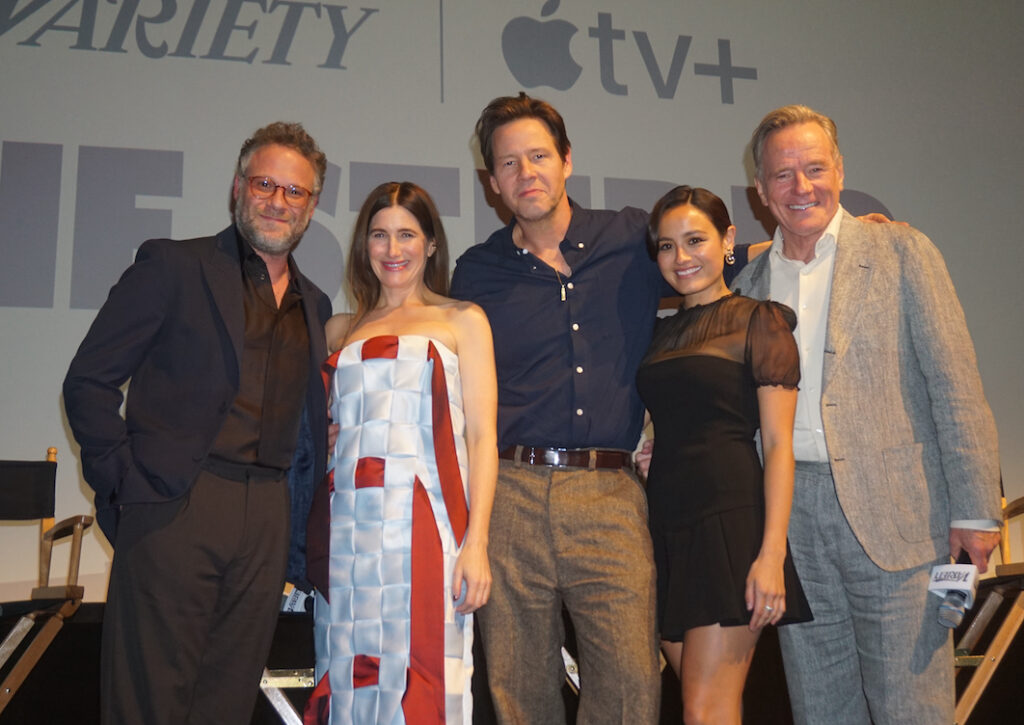
In addition, Ike Barinholtz, Chase Sui Wonders, and Kathryn Hahn who all play supporting roles, joined Rogen at an event in March after the show had debuted. Barinholtz plays Sal Saperstein, Continental’s vice president of production and Matt’s close friend. Wonders plays Quinn Hackett, Matt’s former assistant who he promotes to junior executive. Hahn, as Maya Mason, is Continental’s head of marketing. And Bryan Cranston plays Continental’s CEO Griffin Mill.
Canadian actor and filmmaker Rogen is primarily known for his comedic leading man roles in films and on television. He has often collaborated with his writing partner, Evan Goldberg, and filmmaker and producer Judd Apatow. Rogen has received various accolades including these Primetime Emmy Awards and nominations for a Golden Globe, and a Screen Actors Guild Award.
The series was released on Apple TV+ with the first two episodes on March 26, 2025. The series has been renewed for a second season.
Praised for its direction, cinematography, humor, and sharp satire of the film industry, the series quickly earned critical acclaim. Viewers and critics alike have highlighted its extensive use of long takes, as well as for featuring high-profile celebrity cameos in every episode. In its first season, the show earned 23 nominations at the 77th Primetime Emmys, making it the most-nominated comedy debut in history and tying the record for the most nominations for a single comedy season. It went on to win nine Emmys from those nominations, breaking the record for most Creative Emmy wins for a Comedy Series. The season also received the Television Critics Association Award for Outstanding Achievement in Comedy.
A Canadian actor and filmmaker, Rogen is known primarily for his comedic leading man roles in films and on television He has often collaborated with his writing partner, Evan Goldberg, and filmmaker and producer Judd Apatow. Rogen has received various accolades including these Emmy Awards and others as well as nominations for a Golden Globe Award, and a Screen Actors Guild Award.
The following discussion between Rogen and fellow cast members was captured when the special screening was held earlier this year.
Q: What was your first job in the industry? When was the first time you felt you could call yourself an actor or a writer? Did you ever work as a PA on a set or behind the scenes? Let’s start with Seth.
Seth: I’m from Vancouver, so I was an extra in a television show called “The Odyssey,” which was a weird trippy show where there was a world in a kid’s mind or some shit like that. What I remember is that there was a big crowd scene. I was maybe 11 years old and there were hundreds of little kids. It was a big crane shot and was a huge shot with all these hundreds of kids. It took an hour — hours for them to set up and they said action and all the kids ran out and I heard someone go, “cut” and they go, “One kid was looking right into the lens of the camera.”
Oh no. Literally the AD flew through the entire crowd and came up to me. He was like, “You just ruined this whole shot. Don’t look into the camera like that.” But I literally did. I was just staring at it like, wow. Crazy. It was a very elaborate setup. Yes, I did ruin it.
Kathryn: I grew up in Cleveland and got cast as the character of Jenny in a local television show called “Hickory Hideout.” It was me and two puppets. Nutso P. Squirrely and Shirley. So when Shirley or myself as Jenny needed [to ask a] a question, we would knock on the tree house. Know-it-owl would show up and we could ask him questions. He always had the answer.
Seth: Oh, Know-it-owl. That is poor word play, It’s shoddy word play.
Ike: I was like 22. I was living in Amsterdam and there was a famous Dutch director named Dick Maas who had a famous Dutch movie, and he was remaking his own film of a haunted elevator called “Down.” Because I was a native English speaker, I got cast in it. It was me and Edward Hermann in a scene together. Really cool. The director came to me and gave me my first note ever. He goes, “You are very stupid, but maybe you should do something more stupid” and then he just walks away. Thank you.
Seth: You’ve been taking that note ever since.
Chase: I was a day player on a Judd Apatow movie, actually, which I was later cut from. I was cut from that movie but I sang a lot because Judd’s movies are notoriously very long.
Seth: You’re the first thing ever cut from his movie! [chuckles]
Chase: Later on, when I had a conversation with Judd, he was like, “I discovered you. I’m the reason you’re in demand so much today.” Much like what you said, I was discovered by Judd Apatow.
Bryan: I guess for me it was daytime television. I had a recurring role on General Hospital when I was about 23 years old with Demi Moore and John Stamos [panel chuckles]. I thought these two are going nowhere [more chuckles]. It was fun. It was weird.
Q: Do they remember that you did that? Did they ever bring it? I assume you guys run into each other.
Bryan: At our age we just look at each other and go, “Meh”. [audience laughs]
Q: Start at the beginning Seth. You and Evan Goldberg created a show that is both hilarious and horrifying. How much is this based on your own experiences in the industry? Why is now the right time to tell the story?
Seth: Yeah, disturbingly based on real experiences that we’ve had in the industry and or that people we know have had. Yeah, we’ve been working for some 25-odd years now and we’ve been writing and producing, so we’ve really seen all sides of production.
As an actor I see that side and yeah, it is genuinely an industry we love. Though honestly, it’s written from the perspective of people we can’t deny. Our dreams have come true because of this industry in many ways, but it’s also so fucking frustrating and aggravating. You constantly see people make choices that are confounding and contrary to their own love of film.
The real revelation we had was that a lot of these people who make movies and work in studios themselves love film but are constantly making choices that make things worse. That actually was shown to us when we were very young. We were in a meeting getting notes from a studio executive, Steve Asbell, he runs Fox now and he looked at me and Evan and said, I got into this because I love movies and now it’s my job to ruin them. We never forgot that and it really made us sympathize with those people.
Then I just had the idea one day of like, “Oh, what’d be funny maybe is a show where I run a movie studio. We can put our experiences in it and my own fear that I’m ruining the things that I’m working on. That I’m letting down my idols and that no one wants me around.” I went and visited the set of a movie we were producing the other day and I could not have felt bored like my character does: no one wants me here. I’m absorbing too much attention. They should be focusing on the scene. People keep offering me coffee and shit. So it was an amalgam of things we had experienced as my own fears and neuroses of my role in the industry basically. Yeah.
Q: It is savage about the industry, but it’s also a loving tribute. People love movies and appreciate that angle.
Seth: The biggest misconception about studio people is that they are just money-grubbing monsters who don’t care about art at all. Even sadder than that, they love art but are constantly having to choose money-grubbing monsters who don’t care about art. It’s an incredibly conflicted job. They’re constantly having to do things that disappoint themselves and that are antithetical to their own love of cinema.
That’s something we recognized from a very young age. I remember the first time I met Amy Pascal, I was like, “Oh, she knows more about movies than anyone I’ve ever met and she has to.” She has to argue with David Fincher and she has to win that argument.
It was very inspiring to see how much she loved film, but it was equally disheartening at times to see how much she had to disregard that love of film for her own self-preservation. Everyone who works at every studio is faced with that choice 10 times a day. “Do I do what’s right for movies? Or do I do the thing that’s less likely to get me fired ultimately?”
Q: What attracted you to the roles and how were you attracted to the characters? They all feel like they have some basis in reality. Kathryn? Maya’s brutally frank, but she’s really good at her job. Is she based on anyone you’ve encountered?
Kathryn: Not specifically, but there is definitely a Maya that we’ve met, a version of Maya for sure. We always laugh that she definitely has a girl at Saks who meets her at lunch and just gives her outfits with as many labels as possible, which are worn all at once but I agree with you. There’s definitely [truth to her.] She works really hard, and talks about her work life. She has no private life. We don’t think she has a family.
Seth: No one on the show has a family. [audience laughter] No one on the show does. Ike’s divorced with two kids who don’t like it. You find that out later in this season.
Q: Spoiler alert.
Seth: We talked to a lot of heads of marketing in the studios.
What was interesting is that a lot of them saw themselves as more creative than the production executives … that they actually make stuff. They’re like, “We make trailers. We make commercials.” But the production people just talk to other people who make stuff. They’re like, “We’re in an editing room, actually cutting material together.”
It was a really funny perspective that I had honestly never thought of, but we infused that into the character. She used herself to be a much more viable creative entity than she is in the show, which is very much based on real life.
Q: She gets some awesome looks in this show. That’s a compliment. But you have a gift for characters like Sal. You make him relatable, even likable, even though he’s a Hollywood suit. I think we all know a Sal or two. What interested you about this role in working with Seth?
Ike: Seth called me a while ago and was like, “Hey, I’m doing a show.” And I said, yes. He goes, “It’s about Hollywood.” Yes, yes. He goes, “It’s like Larry Sanders. I said, “Fucking yes!” I’d worked with him and Evan before. I love those guys and there’s something irresistible about doing stuff in this world. I really do love Larry Sanders and I love “The Player.” I love that world and with every conversation we have, it becomes crazier and crazier. “Oh, Catherine O’Hara is doing it.” And “I think we’re going to get Kathryn Hahn and Bryan Cranston.” I was like, what is happening? It was a real joy and I like playing with their id individually and call it a show. That’s very fun for me.
Q: Chase? What about your character Quinn? What’s your dynamic with Seth and Ike as Matt and Sal. In a future episode these two go at it. It’s amazing that you’re drawn to really outstanding ensembles. Was that part of what attracted you to the role?
Chase: I mean, absolutely. I did a callback with Seth and he was like, “Okay, you did the scene. Now let’s just break.”
Seth: These impressions are derogatory! [audience laughs]
Kathryn: But we entered the rip zone. I’ll spare you [his] voice, but he made funny jokes and then I got the part. It was funny because when I was doing Quinn’s character, yelling and screaming at Seth’s character, the women on set — a lot of them came up to me and said, “You’re talking like I wish I could talk to my boss.” I’m like, “Your boss is Seth.”
Seth: I’m right here. You wish you could just fuck me off? [audience laughter]
Q: She might be the most of what we would aspire to be. And Bryan, after all your accomplishments, you can still surprise us.
Bryan: That I’ve sunk this low? [laughter]
Seth: You think we’d have to convince him to do something like that.
Q: Griffin is a really interesting character because he’s kind of absurd, but he also genuinely strikes fear in the hearts of these people.
Bryan: He does? I’ve seen from his eyes out and Griffin Mill. Did we catch that?
Q: That’s the Tim Robbins character from [Robert Altman’s film] “The Player.” Do you consider him a spiritual relative?
Bryan: He’s my spirit animal. Tim Robbins is; Griffin is. When Seth and I were talking about it, I said like Ike was saying, “I just want to do this!” When you read this first script, it was so funny –– laugh out loud funny –– that I thought, “Oh man, I’ve got to do this. I would love to do this.” And of course then my big question was, “How much?!” [audience laughter]
Ike: Exactly. Well it’s Apple!
Q: It’s very daring because you are really kind of the villain here. You make Martin Scorsese cry. Well, you technically make him cry.
Seth: You make me roll downhill to me and pass it on. Thank you.
Bryan: You protect me from seeing Martin Scorsese crying and I appreciate that.
Q: In addition to the great cast we have here, talk about the rest of the amazing cast and some of the guest stars you’ve assembled. You have Martin Scorsese and Sarah Polley, and I did a tease of upcoming guest stars. There’s a great episode where Ron Howard is exposed as the monster that he is.
Seth: Yes. Ron Howard’s a terrible man. Don’t believe what you’re hearing. He’s a monster.
Q: Someone was finally willing to say it.
Seth: Exactly. Someone had to.
Q: It’s very impressive how some of these big names were willing to make fun of themselves, even if not in the most flattering way. Did you cast these roles with the people in mind? Or was there anyone who said that’s too far?
Seth: We really wrote ourselves into corners. We would write like Martin Scorsese. We would write exactly, because they also occupy very specific types of roles within the story. The Sarah Polley thing: it’s like it has to be someone who’s prestigious, who’s won an Oscar, hopefully someone you believe is a studio head. We wanted there to be no suspension of disbelief when it came to the people I was interacting with and my attitudes towards them. We didn’t want the audience to be like, “Well, the studio wouldn’t be that excited about working with that person.”
Ike: Oh, that’s exactly how to impress Gary Busey. [laughter]
Seth: Exactly. That’s how we did the Entourage movie. This is the most celebrity-packed film of all time! There’s Gary Busey. I don’t know about that. [signature Rogen laugh] Can you believe the life we’re living in here?
Ike: Oh, my god. Pauly Shore.
Seth: Pauly Shore and Gary Busey at one party! You really made it. I swear these are A-list celebrities, trust us. There’s Carrot Top! [audience laughter] We didn’t want that. So yes, it was really hard to get and mostly people get the joke and are very happy to make fun of themselves. We had to make the roles appealing and we had to really make sure that they were characters in the show rather than people who were window dressing. And even Charlize who has one line, we were like, “It’s a funny line, we promise it’ll work. It’s a good joke.”
I’m amazed at all the people who agreed to do this and there’s an episode set at the Golden Globes, which was very challenging because we had to fully recreate the Golden Globes. There’s like 25 famous people in the episode and it was very stressful and I had to convince Aaron Sorkin to win a lifetime achievement award and he’s like, “Aren’t I too young to win a lifetime achievement award?”
“Maybe, but in the world of our show you’re a little older than you are — aren’t you? He agreed to do it, thank God. There was a lot of that. But, in general, I am so flattered at all the people who agreed to be on the show.
Q: Talking about how realistic the series is and knowing you’ve probably drawn some inspiration from real people. Was anyone sort of worried how this might affect your standing in the industry? If executives recognize Sal, are they going to…
Ike: I think if the show is bad, I would be worried, but I think it’s really good. So now I hope they see it.
Bryan: I’ll be of retirement age.
Seth: The whole time. He was like, you guys are going to have to deal with the shit storm after this! I’ll be in Martha’s Vineyard. [audience laughter]
Q: Do some people think that they recognize themselves and you’re like no, that actually wasn’t you.
Kathryn: There are some people. I have actually had someone come up and say, come on (*wink). I was like, it really isn’t? Because they wrote something really specific. I just keep saying I play the part and then know secretly who’s in there.
Q: This show is very specific, but it’s also impressive at how universal it is as well. It’s a workplace comedy, it’s a horror show. Are you surprised by the universal deal of it?
Seth: In fact, we really went out of our way to make sure the episodes had comedic concepts that were universal. For example, not everyone understands how complicated it is to shoot a runner and why that would be disruptive if you were on set. But I think everyone can understand wanting to be a part of something … and feeling like maybe people don’t want to be a part of that thing and the pain that is associated with that.
We spent a lot of time working on the personal stakes for the characters in each episode and making sure they were universal feelings. And this idea in the pilot of, I just want to do a good job and I want to make something good … but I feel pressured to make something bad instead. I think that that is something that is very relatable to people. So we really made sure every episode as “inside” as it was, had a character story that was hopefully as relatable as anything. Yeah.
Q: There’s an upcoming episode where you try to date a normie, someone not in a business. You’ll all relate to this episode.
Seth: I try to date a pediatric oncologist. And I get in a big conflict at a fundraising gala for Cedars Sinai where none of the doctors view what I do as important as what they do. They really demean the entertainment industry. It drives my character insane that people don’t appreciate art. And that although doctors save lives, I feel that artists make life worth living, which is very much based on my own insanity.
I’ve been at these fundraisers and the doctors love to shit on people in the entertainment industry. They take great pleasure in demeaning people in our line of work, as they should, but I’ve gone home after. Those fucking doctors. They do [think they’re] so important. If they only knew how hard it was to make that trailer actually represent the film! [chuckles]
Q: The scripts for the show are so sharp and creative, but you also have this stable of comedic geniuses, clearly. Was there any improvising on the set?
Ike: She improvised the line. Steve Buscemi is the worst case scenario. [audience laughter]
Seth: The camera pans from her to us all at the conference table. Ike has a look of shock on his face.
Kathryn: I was like, why did you keep that in there?
Seth: Oh no. Even though the show is shot in a way where it is these long takes, we were always balancing the rigidity of the long take with this spontaneity of improv. I would tell people, if you think of something, say it just, if it’s bad, it’s going to fuck up the whole take. If you really believe in it, then go for it. I would trust everyone to be their own personal barometer of that basically.
Q: Didn’t you feel like once we knew where the camera was and then you knew how much time you had that the camera was on, you try to slip something there? Bryan, your character gets to be the most un-aged. He can say anything he wants. Is it freeing to get that out?
Bryan: Oh, you know…
Seth: I believe (that) was the pitch you had. [audience laughing loudly]
Bryan: Ultimately, I’m not proud of that. But that’s an indication of how free it was. You create an atmosphere where you’re encouraging your artists to be able to say anything, do it. Go, go, go. And it was so much fun, that I think we all had a terrific time. I got to say also, and maybe it’s an age thing, but at a certain point in your career, I just don’t want to work with assholes!
These people are so great to work with and so much fun. It was a really tight knit group and we were all kind of hanging out in hotel rooms. There was no “Go to your trailer!” We’re all just kind of hanging out and waiting to do the next take and someone would throw something out and would make us laugh and it was just so much fun. I hope that we get a second season and I can come back and just be an idiot. [applause]
Seth: The last two episodes are like a Bryan Cranston Tour de Force, and if you’re a weekend to Bernie’s fan, you’ll particularly enjoy it.
Ike: That’s a very big clue.
Q: The Best physical comedy.
Ike: His body’s incredible, his physical comedy body.
Seth: He’s lean, but very strong. I just mentioned your body in three minutes. I’m obsessed with you. I’m in love with you.
Q: At the same time you are improvising. You’re under the risk of laughing and ruining the take. Who’s the biggest offender when it comes to that?
Ike: To laugh during takes? Seth. He’ll also laugh if something’s funny, but also if someone has clearly flubbed the line and is still trying to pretend like they didn’t. Seth will just start going (makes funny noise)
Kathryn: He’s so generous because instead of getting mad and yelling, he’ll just go…
Q: Does everyone have a Seth Rogen laugh in their stable?
Bryan: (Does the impression)
Q: That was good. You really did a good job.
Bryan: I don’t want to do it again, now.
Q: Jokingly this show has been called a documentary, but it really does capture this industry so well. Talk about finding that balance because sometimes truth is stranger than fiction. Was there anything you wanted to include but you were just like people will never believe that even if it was true?
Seth: Yes, for sure. Yeah, definitely. Just because something happened in real life, it does not make it accessible to everybody. And I found that very early on. So yeah, the lunacy of the industry is truly beyond belief at times. And the things that are said at these rooms are truly outside the realm of things anyone should ever say. I think we included pretty much everything we wanted to and part of our job is to translate it into a digestible, believable episode.
There’s an episode about trying to cast the Kool-Aid movie that comes later in the season where we cast Ice Cube as the Kool-Aid man. And we start to really worry that it’s racist, that we cast Ice Cube as the Kool-Aid man. The conversations surrounding it are almost verbatim … insane conversations that I’ve heard about casting things that aren’t even real. Like the alien, what race is the alien? Should the alien be a certain race? It’s an alien. I think we actually tried to bridge the gap between how crazy things are and turning them into actual episodes. But there’s a few things we’ve heard people say that you’re like, we can’t even put that in the show.
Q: Let’s see this Kool-Aid Man movie.
Seth: It seems good. We worked hard on that pitch. I worked harder on that fake Kool-Aid pitch than some actual movie pitches. It’s better than some real movies. [audience laughter]
Q: The first episode has dropped on Apple already. Are you already getting some sort of feedback if people let you know because of this show, I knew it would be good, but I’m really impressed at how much critics adore it too. It is universally beloved.
Ike: I had two current studio heads text me early this morning, being like, “Brutal”. It’s so great. I was crying. I was laughing. But it’s very accurate. I think we’ve gotten a lot of those.
Seth: I’ve been reached out to by almost every head of every major studio throughout the day today and it’s a lot of like, “this is great, but very traumatic” [audience laughing]
Q: Are you putting them up for it to be in Season 2?
Seth: I want to get them all. I want to get everybody.
Ike: Just email [CEO] Tim Cook at Apple.
Seth: exactly. If you aren’t anyone’s friends with Tom Rothman [chairman and CEO of the Sony Pictures Motion Picture Group], shoot me an email.