
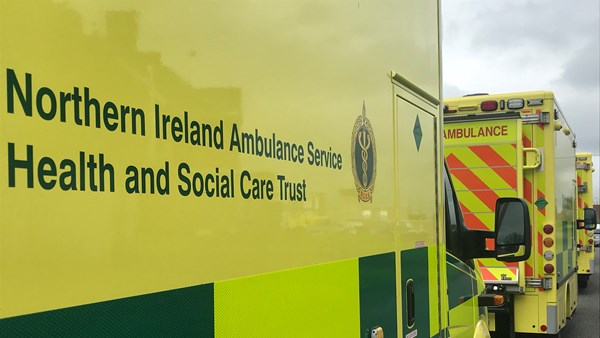
 An ambulance shortage in Northern Ireland that has required crews from across the border to plug service gaps has not impacted critical call-outs, a medical chief has insisted.
Two ambulances from Ireland’s National Ambulance Service worked in Northern Ireland over the weekend – one in Newry on Friday and one at Altnagelvin hospital in Derry on Saturday.
While reciprocal arrangements allow for cross-border co-operation between ambulances services, it is usually for critical incidents, rather than to cover shifts due to staff shortages.
Normal staffing levels at the Northern Ireland Ambulance Service (NIAS) have been down 20% over the weekend.
The NIAS has blamed the situation on a number of factors, including increased demands on the service, longer turnaround times at hospital, staff vacancies, rostered annual leave and sickness absence.
Voluntary crews from the St John Ambulance and private sector operators in Northern Ireland were also used to help cover call-outs over the weekend. Shortages were again expected on Sunday night.
NIAS medical director Dr Nigel Ruddell apologized for delays in services but he insisted critical call-outs had not been impacted.
“We strive to make sure that is only happening in cases where there is less of an absolutely time-critical need,” he told the BBC on Sunday.
“I am not aware of any cases of immediately life threatening problems which have suffered as a result of any significant delays, because we are prioritizing those cases and directing the resources we do have to those over and above the cases which realistically do not have the time-critical element.”
He added: “We are recognizing the pressures we faced this weekend, we have been looking at all options to increase our cover and that included getting one ambulance into Newry station on Friday night and last night we had an ambulance up in Altnagelvin station and both of those ambulances came from the National Ambulance Service of Ireland and we are very grateful for their support.
“Our staff are tired, they have shown a great deal of dedication throughout this time and we have relied far too long on good will from them providing extra cover through over-time and we recognize that.”
Dr Ruddell said the NIAS was on a mission to recruit and train new staff, highlighting that proposals had be put to Stormont’s Department of Health designed to address the staffing problems.