
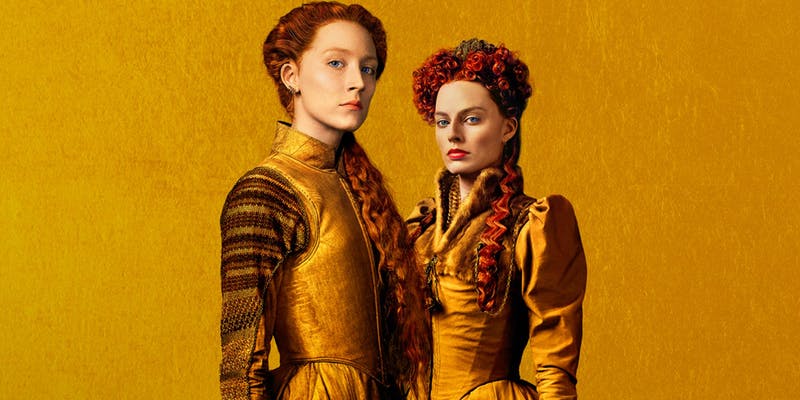
 Mary, Queen Of Scots
director: Josie Rourke
cast: Saoirse Ronan, Margot Robbie, Jack Lowden, Joe Alwyn, Gemma Chan, Martin Compston, Ismael Cordova, Brendan Coyle, Ian Hart, Adrian Lester, James McArdle, David Tennant, Guy Pearce
By Brad Balfour
It’s tough enough to unravel the modern American political system and government. But just try to make sense of what’s happening in current-day Britain: that’s far more trying. Even worse, try to make sense of the palace intrigues of Elizabethan England’s day.
Hidden from general scrutiny — with no internet or social media to broadcast the ensuing dramas, betrayals and power struggles — the 1569 conflict between Mary Stuart (Saoirse Ronan) and cousin Queen Elizabeth I (Margot Robbie) was carefully detailed in John Guy’s biography, “Queen of Scots: The True Life of Mary Stuart.” From that historical drama, screenwriter Beau Willimon has fashioned a filmic telling, directed by first-time feature director Josie Rourke. She’s been a longtime veteran of serious, high-art theater and Shakespearean drama in her role as the recent Artistic Director of London’s prestigious Donmar Warehouse.
In “Mary Queen of Scots”, Rourke explores the tragic turbulence encountered by the young Catholic, Mary Stuart. Having been Queen of France at 16 and widowed at 18, the beautiful but out-of-place royal contender returns to her native Scotland to reclaim her position as its monarch. England’s Protestant ruler, Queen Elizabeth I, is threatened not only by Mary’s rightful challenge to her rule but also by her Catholicism.
Rivals in power, love, and legitimacy, these two female aristocrats — always embattled in a masculine world — must not only fend off men’s intrusions but sexual assaults. They must also play the marriage game to counter threats to their independence by producing a male heir.
Racing to see who gets pregnant first in order to birth an heir, both have difficult choices to make — with Mary even more threatened by being usurped. Determined to rule, she asserts her claim to the English throne, questioning Elizabeth’s sovereignty. Though the film centers primarily on about a year’s time, both courts have been imperiled for many years. And both women had wrestled for their thrones throughout. That’s just a shallow outline of the underlying nastiness and political wrangling that unfolds in both the film and the actual historical timeline.
Interwoven throughout this intricate drama are scenes that lavish attention to the medieval ambience. Even if one is utterly confused as to who’s doing what to whom and why, the look and feel of the film envelopes the viewer. The literally arm’s length struggle between the two women and the men surrounding them takes a while to have its effect … but a sense of impending doom pervades the entire depiction.
Without seeing this film, it would be hard to understand the implacable cultural landmines these two queens had to navigate. One thing’s for sure: Protestant cleric John Knox (David Tennant) spews such virulence against Mary that he makes today’s partisan attacks seem downright pacific. But in the context of this female-centric cinematic exploration, the movie challenges viewers to comprehend what women once had to overcome. It makes one appreciate the tremendous effort it’s taken to get some women into their leadership positions of today in light of the incredible roadblocks of the past.