
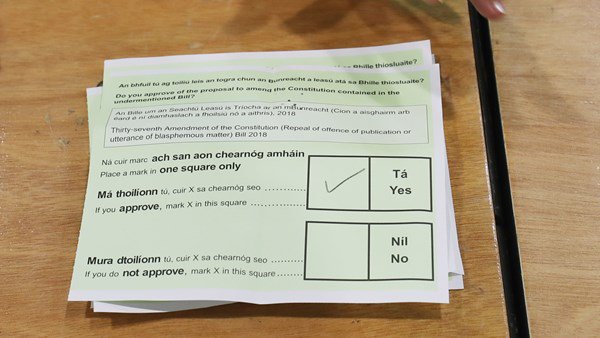
 Taoiseach Leo Varadkar has hailed the blasphemy referendum as a small step towards creating a 21st century constitution.
The result, which was announced late last night, hours after Michael D Higgins was formally re-elected president, saw almost 65% of the electorate back change.
A total of 951,650 (64.85%) people voted for the change, with 515,808 (35.15%) opposing the move.
The Taoiseach said: “It is very much part of an ongoing campaign in many ways to reform our constitution, to make it a 21st century constitution or a 21st century Republic.”
He placed the public poll among a series of reforms beginning in the 1960’s when the state removed the special place of the Catholic Church from the constitution and including enshrining marriage equality and giving women the right to choose abortion.
“This is the next small step in what is a very big deal, which is the reform of our constitution, so the next set of referenda are penciled in for May.”
Nobody has been prosecuted for the offence in Ireland since 1855, in connection with an alleged case of Bible-burning.
It was included in anti-defamation legislation passed by the Government in 2009.
Blasphemy was defined as publishing or uttering something “grossly abusive or insulting in relation to matters sacred by any religion, thereby intentionally causing outrage among a substantial number of adherents of that religion”.
Anybody found guilty could face a 25,000 euro fine.
Comedian Stephen Fry fell foul of the law in 2015 when he gave a television interview during which he was asked what he would say to God.
He told RTE: “Bone cancer in children, what’s that about?
“How dare you create a world with such misery… it’s not right, it’s utterly, utterly evil.
“Why should I respect a capricious, mean-minded stupid God who creates a world so full of injustice and pain?”
A viewer complained to the gardai, who launched an investigation but Fry was never charged with blasphemy.
The way the law is framed make it difficult to sustain a prosecution.
Over recent years Ireland has voted to repeal a series of restrictive social laws including allowing for divorce, same-sex marriage and, earlier this year, early stage abortion in what Mr Varadkar termed a “quiet revolution”.
Changing the law to remove blasphemy has enjoyed widespread backing from church and politicians, with the exception of some Islamic leaders in Ireland.
Countries to maintain blasphemy laws include Pakistan, where former international cricketer-turned politician Imran Khan has defended Pakistan’s strict blasphemy laws.