
Exclusive Q&A by Brad Balfour, Arts Editor
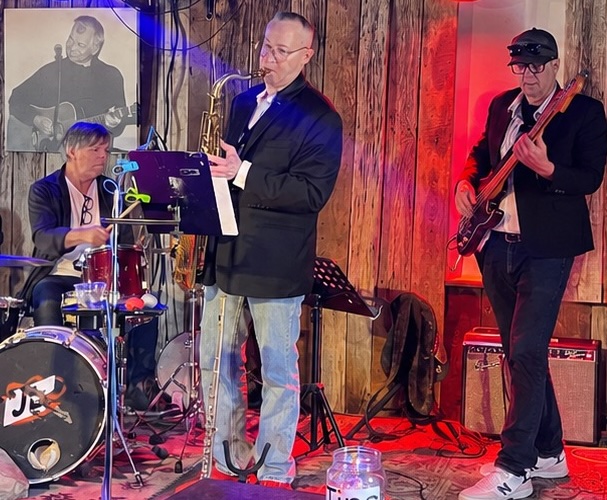
Just as one doesn’t think about the Irish in Nashville, the same goes for finding a jazz scene in that Country Music Town. Nonetheless, Jay McGuerty –– a recent newcomer to the popular city –– is of Celtic descent. He’s an accomplished jazz musician, equally skilled on saxophone and flute. In order to remedy the lack of jazz heard there, he formed a trio with Aaron Lindstrom on bass and Peter Young on drums and percussion. So he is bringing his rich and articulate instrumental voice to town.
The Cool Riffs have recently started playing at local clubs, including Kimbros. McGuerty also plays a sideman in other bands, but it’s with The Cool Riffs that he plans to make his mark locally at first. All this will culminate in their debut full-album release coming mid-June with a huge party for local audiences to enjoy and be documented.
According to Jay, this will culminate in a tour and further performances locally, with talks of a residency already underway. Ultimately, the 60-something hopes to make a tour of Europe, ideally landing in Ireland where he has hasn’t yet been.
Q; Talk about your earliest recollections of music?
Jay McGuerty: Listening to George Gershwin’s “Rhapsody in Blue” on an old 78, with the stylistic, technical and brilliant clarinet opening. TV theme songs, The Beatles, Brazilian Samba, the Belwin band book “Method 1.” I had a moment in a senior high school Dixieland Band. Then some hectic years and I lost all interest. When I left home I told my Dad, “Sell my instruments; I’ll never play them again.”
Q: Well, obviously, that didn’t happen. When did you begin identifying with jazz and blues and why?
Jay McGuerty: I backed into music unintentionally. After what I will call “an event,” I started playing again. I played in a lot of garage band level projects and “rock wars” events. Blues is what we played most. When I would hear jazz, I always wanted to take some of those jagged pieces of moving harmony and use them in a blues riff. What started out as learning jazz to play blues turned the other way around, but not conventionally.
I was too young to know what I was listening to but my Dad played a lot of Wes Montgomery, Stan Getz, Dave Brubeck (with saxophonist Paul Desmond), Ella Fitzgerald [and so on]. When I lived in Brazil I walked past the bar where “The Girl From Ipanema” was written on my way to the beach. Later, listening to Curtis Amy cross over from jazz to the Doors on “Touch Me” and Fred Lipsius’s “Blues Part 2” were heavy jazz influences for me.
Q: How did you choose your instrument?
Jay McGuerty: My father’s fondness for clarinet made it a first choice. Later my dad got me an alto sax.
Q: It’s great that your dad was supportive. but how was your family?
Jay McGuerty: Everyone’s life (famous or unknown) has a lot of a story. There are large chunks of my family history that are missing. I moved around a lot, attending three high schools in three countries.
Only recently did I learn that my father had been “abandoned” by his biological mom. On my father’s side, there was a family of 11 boys in poverty in New York’s Hells Kitchen, abandoned and left in orphanages. The older boys got out and, over time, got the younger ones out.
On my mom’s side (of Scottish descent), I know nothing. Mom’s name was Sara, but she went by her middle name, Elizabeth.” That’s it. She was from humble means in rural Virginia. I was one step away from homeless in Columbus, Ohio. We were living in a raggedy old car. Then, we lived in a 105-year-old house — in the attic with no heat in coldest winter in Colorado’s history, with 17 days under -10º. I slept under layers of blankets with a hair dryer. My meals consisted of olives and maraschino cherries in the bars and the deli cheese plate. The supermarket would put it out in the afternoon as the wives shopped for dinner. I would get as much as a quart of gasoline out of this one gas station at night from people that did not pull the handle one last time after the pump stopped.
One day as I was driving, I realized I could just take a highway exit and keep driving. I had nothing; my wallet, gas in the tank, and a sax were all I had. Everything else material –– friends, family, career –– had been stripped away. My life was threatened and I had to leave Columbus, Ohio. I got enough money to finally fill my car. It had been so long since I’d filled my tank that the gauge was rusted on “E”.
Q: Where were you born, and how did that affect you?
Jay McGuerty: I was born in Knoxville, Tennessee. I spent most of my time exploring the woods and creeks in Oak Ridge ,and then our family moved to Brazil. Brazilian Portuguese is a beautiful melodic language. My ear wanted to hear and reproduce that language and get the phonetics right so I’d lose my American accent. I used that same “ear” which helps me play what I am surrounded with. I remember hanging out at the beach one day and struck up a conversation with some random strangers. In those days it was common that if they realized you were American, they would ask you questions. But this time they didn’t.
When I left, I realized that being tanned and not having spoken any English [for a long time], it’s possible they didn’t realize that I was American. The musicality of the language and the intricate, fascinating samba rhythms I was exposed to clearly show up in my music now.
Q: Does leading a jazz band have different responsibilities than, say, being in a rock band?
Jay McGuerty: Reading, writing and providing charts is a bigger deal in jazz than rock. Just as there are some truths about the temperament of bass players, drummers, and guitar players, dealing with jazz minds often requires more thought and precision. They are like the engineers of music — the only thing missing is the pocket protector.
Q: How would you distinguish playing the sax from other instruments?
Jay McGuerty: The sax is thought to sound the most like the human voice. The sax allows for manipulation and sustainment of harmonics and overtones combined with alternate and faux fingerings that can give expressive alterations of tone and the color of the sound.
Q: How did this band come together?
Jay McGuerty: Naming the project “The Cool Riffs” is meant to capture the feel of the Jazz scene of the ‘60’s. Riff” is a common musician vocabulary, a simple building block. Coming from no formal training, I write what comes to me. My work doesn’t follow many norms of classic jazz, though it retains some core elements like playing on jagged intervals and harmonic movement.
The Cool Riffs [TCR] is the product of a SoCal sound, Brazilian rhythms and blues. Using the multiple voices of flute, baritone and tenor sax, accompanied by percussion and bass. Aaron’s sense of humor whimsically finds its way into his bass, often taking the groove to places in the moment that fit and make you laugh. Drummer Peter Young has a unique way of playing a mixture of jazz on the hi-hat and ride and rock on the toms; the snare does double duty for both. His other job is to herd Siggy (Aaron) and me.
Q: How is playing jazz in Nashville? Are there venues with big audiences?
Jay McGuerty: We’re just getting started. We’ve only played out once. It’s a very different scene from San Diego. Understood. I prefer to keep this more about music than my background. Perhaps, some of the way that I studied music on my own and how that led to some unconventional compositions.
Q: Well, Talk about your history as a musician.
Jay McGuerty: Here is a brief history of my musical journey…. I moved around a lot and when I moved to a new town, I learned to play sax along with the radio or a favorite album. One night, someone knocked on my door and invited me to play in the band, “Amy & The Boys” in Columbus Ohio. We played the OSU High St. circuit (Ruby’s, Staches, Browns, Bernies Bagels, IP Lounge.) This was early ‘80s. There were some recordings and a video of originals but no album.
I moved to Washington, DC and joined “AJ & The Heart Shockers.” That was a funk band with some originals and, again, recordings but no album. We played The Roxy, Bayou, 715 Club, Grog’s and appeared on Gannett Media Channel 9 — a local version of SNL.
Later I moved to San Diego and joined “City Fish” which was a cover rock blues band. We played Silver Fox, Blind Mellon’s, and Wong’s Dragon Palace. Then I was in Kirn Kounty, an all-indie original band that recorded one album, “Wondering Around,” released on Sound Cloud. We played college campus clubs like Belly Up Tavern, Taxi’s, and El Tecolote. Family and work related travel sidelined me for the next 10 years.
Finally. it was time to start my own band, “Coastal Groove”. In 2022, I released two songs on Spotify — “Drifter” and “Dirty Bari” called “Riding The Groove”. Then I joined Manzanita Blues and recorded some tracks on their album, “Gamblin On The Groove” which was released in 2025. When I moved to Nashville, I changed the band’s name to “The Cool Riffs.” I met Aaron and Peter and completed two more recordings, “iGroove” and “Mushroom Man.” Three more tracks are in final recording prep –– “CoCo Colada”, “Cruisin 101” and “Night Cat.” All seven will be released in a June album titled “iGroove.” We are playing at Kimbros (Blue Note gig in the works). A video shoot is planned for a couple of the songs and a release pool party this June.
I am at a disadvantage here just starting out in Nashville. And time with Aaron and Peter is difficult to schedule. I am also playing every Sunday at Kimbros Jazz Brunch with a rotating collection of musicians.
Q: Living or dead, who would you like to jam with?
Jay McGuerty: It would be a tossup between Curtis Amy and Fred Lipsius. When I hear them play, I can glimpse their thoughts and emotions.
Q: Have you ever visited Ireland? do you know what county your family is from?
Jay McGuerty: I’ve never been there but I’m told we are from Sligo.
Q: If you haven’t, where would you like to go? If you did, would you like to play there?
Jay McGuerty: Of Course, Yes!