
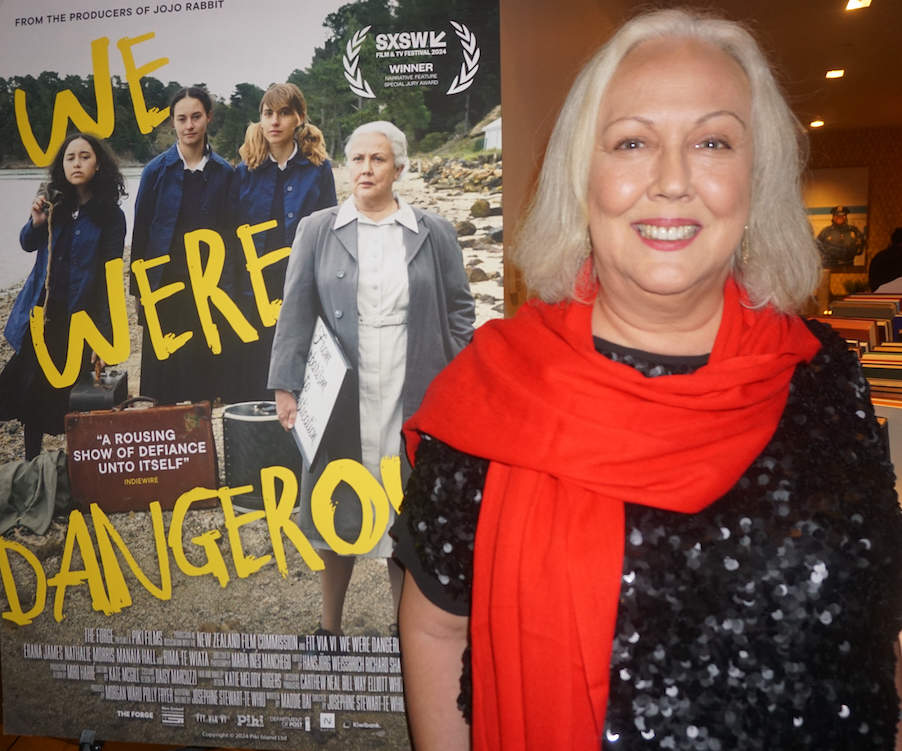
Exclusive Q&A By Brad Balfour
Though the nation of New Zealand may seem like a far-off isolated place, disconnected from much of the world, it is in fact a fount of creative filmmaking, and a major global cinematic center. Much of that is thanks to filmmaker Peter Jackson whose mega blockbusters such as the Lord of the Rings Trilogy and WETA, his special effects company, have had such an enduring impact.
Then there’s Oscar-winning actor/director Taika Waititi of partial Maori descent who has had the further effect of spotlight his country and his tribal connection. The Māori are Polynesian tribespeople who arrived in New Zealand more than a thousand years ago. Today, Māori culture is a vibrant part of the island nation (actually three islands), with over 700,000 Māori there. They’re known for elaborate face tattoos and a ritual warrior dance called the Haka.
Now, a recently released film from New Zealand, “We Were Dangerous,” spotlights a concern with the mistreatment of indigenous and other outliers showcased by several other films such as the recent award winning documentary “Sugarcane,” “The Magdalene Sisters,” and “Rabbit Proof Fence.” Each film has addressed the terrible ways that native people or wayward youth have been treated in the past.
In the film, it’s 1954 and Māori teenager Nellie (Erana James) is sent by her family to Christchurch to live with a relative after her hometown’s meatworks closes down. Unable to find her relative, Nellie befriends another female Māori teen named Daisy (Anaia Hall) who has escaped several foster homes after experiencing abuse. After being arrested for shoplifting, the two girls are sent to the Te Motu School for Incorrigible and Delinquent Girls.
The Matron (Rima Te Wiata), a devout Māori woman who has grown up in a Christian orphanage, attempts to reprogram the girls into subservient housewives and mothers. The Matron believes that the British brought Christianity to civilize the Māori people. They are joined by a third girl — a more middle class and educated one — who had been caught by her father with another girl.
But it’s a tough, if not futile, act to try and reprogram these girls. As they resist in direct and not so direct ways, the Matron gets more severe. The girls react with an escape attempt —one that may or may not succeed.
In her directorial debut, Josephine Stewart-Te Whiu — with a screenplay by Maddie Da — chose many of her cast from local people. But it also stars noted actress Rima Te Wiata, and up-and-comer Erana James, who make their presence felt. Wiata is a well-known British-born New Zealand singer, comedian and stage, film and television talent. She’s also notable for a career in Australia, especially her long-running recurring role as Janice Reid in 204 episodes of the soap opera, “Sons and Daughters.” Te Wiata also released a self-titled jazz album and toured with the New Zealand Symphony Orchestra.
The aforementioned Waititi and Carthew Neal serve as its executive producers. The film had its world premiere at South by Southwest on March 8, 2024 where it won the Special Jury Award for Filmmaking in 2024. It was released in New Zealand on August 22, 2024. Now, this May, it’s getting a New York release at Village East and national distribution beyond.
Q: You’ve been working a lot in New Zealand. How was it to come to the States and premiere a film here?
Rima Te Wiata: It’s a real honor to be invited over here. We’ve been to LA, premiered there, and then did the preview in New York. Unfortunately, I only had one day in LA and one night. Then I had to fly to New York and now I’ve got to go again. I went to MoMA and Central Park, which was fantastic, but I’ve got to leave later— way too soon.
Q: This isn’t just about New Zealand or Australia. What’s been done to aboriginal people and young rebellious women in those days was terrifying. When you got this job, did you look into it?
Rima Te Wiata: I knew that we’ve always had abuse in our systems. You’ve had it here. It happens everywhere in systems that are supposed to be protecting people. There usually is abuse unless you’ve got your eyes open.
Q: The phenomenon of native, aboriginal people, or people who were poor and not part of the system — especially if they violated the social norms which were very rigid by our standards today — were sent to places like this school.
Rima Te Wiata: It depends on how fortunate you were with your upbringing and whether you needed to go to these places where they thought they had to reform you from being a delinquent. Actually, I went to a very strict school. I knew these types of people, but I never got into that sort of thing.
Q: Was it a Catholic school?
Rima Te Wiata: No, it wasn’t. It was a Christian school in London, a state school. I was born over there [in London], even though my parents are New Zealanders.
Q: Your father was an opera singer. What did your mother do?
Rima Te Wiata: She was an actress and a writer.
Q: You’re of Maori descent?
Rima Te Wiata: Dad was Maori and mum was Pakeha, which is a white New Zealander. You’d be Pakeha if you came over.
Q: As a kid growing up in England, you weren’t a wayward youth going around sleeping with boys?
Rima Te Wiata: I was only a little weenie girl. It was prior to being eight. Once you hit puberty, that’s it. It happens in every single country. You have to keep your eyes open and not fully trust people who seem to be angelic. Keep your eyes open and make sure that they’re not telling fibs.
Q: In playing this role, what did you learn about the mentality of a woman like her?
Rima Te Wiata: I talked to a number of people who had gone through being abused in these facilities. I learned from that. A lot of people came up afterwards and said, I’ve got a couple of people last night saying I went to a Catholic one. They were exactly like my character. Exactly like that. It seems to be an international personality type.
I didn’t want to play her from the perspective of being a smart aleck, judging my character. I had to find reasons why she was like that. I could have empathy because every character feels, when you’re playing a character, that they’re doing the right thing. That’s what makes it disquieting.
Q: There was a flashback suggesting she was abused when she was younger. The flashback informs the audience and creates a degree of sympathy for her.
Rima Te Wiata: I wanted them to have a little wrestle with that because I knew everybody would hate her.
Q: Even though there’s not a much of a glimpse of the men of that era in this film, it’s terrible to think of what men did to women. Talk about your own thoughts about the men of that era.
Rima Te Wiata: The men of that era? They’re also parroting what they’ve been taught. It’s unfortunate, isn’t it, if people have been taught that. Then that’s what they think is the right thing. Even though it’s ghastly, it’s actually quite funny. Some of the lines in this film are quite funny. They’re just so sexist, it’s unbelievable. They’re saying it so straight.
Q: Did this give you a different perspective on your own Maori history and experience?
Rima Te Wiata: It did. Watching my character who had really obeyed the system that she’d grown up in, because we decided that she’d gone through a foster care program. My character, that’s what she went through. She’s never been out of an institution. She’s just gone straight back into the system once she left it to become a teacher and a matron. She’s never been in the real world. She’s only known that world. She’s been obedient her whole life and is a tyrant who doesn’t realize she is in.
Q: It’s the old cycle of, if you’ve been abused, you abuse others.
Rima Te Wiata: Not all the time, though, I don’t think it’s true of absolutely everyone. Q: Depending on the level of isolation. In her case, she was very isolated for many years. The institution also exaggerates the abuse you might experience because of the fact that you were isolated from many other options or opportunities.
Rima Te Wiata: That’s right. Isolation from options and opportunities is what keeps people caught in the cycle because they’re not meeting others who’ve with different perspectives on life.
Q: You come from a Maori background. Have you experienced some level of prejudice, even though you don’t appear to be Maori? No tattoos?
Rima Te Wiata: I have. [laughs]
Q: Oh really? You do? Not the face tattoo.
Rima Te Wiata: No, no, no. No moko, the sort of traditional moko.
Q: Do you speak the Maori language?
Rima Te Wiata: A little bit. I’m not fluent.
Q: Do you feel a degree of the pride in having been through it all and now being able to express your Maori history and Maori background in a different light.
Rima Te Wiata: In terms of film in New Zealand, we’ve had a lot of different angles and different stories about Maori history. It’s been amazing.
Q: Do you think it’s compensation for the lack in New Zealand itself? They didn’t have a lot of focus on Maori history and education until more recently.
Rima Te Wiata: Not really. There wasn’t really a big focus on it. Not that I remember from when I was at school, high school there.
Q: You’ve seen films like “Once Were Warriors” and “Whale Rider” and all that. Do you think that there’s enough compensation for the years of neglect and second class citizenship?
Rima Te Wiata: No, we want more. But you can learn that. I can see you enjoyed that bit. [laughs]
Q: I did enjoy that bit, where the girls do a Maori chant. I related it to where there was a haka done somewhere in sports that was really…
Rima Te Wiata: [We do that] In rugby before matches. [laughing]
Q: How have attitudes changed in New Zealand in terms of the relationship between the white and Maori communities?
Rima Te Wiata: It depends where you are in the country, your community size and how people relate in different areas as a whole while looking at the entire country, which is of course in these two different islands.
Q: Where are you from the north or the south?
Rima Te Wiata: I live in the North Island and there’s a South Island. Then there’s a tiny little island down the bottom called Stewart Island. So, it’s actually three islands. It depends where you are in the country. We’ve got racial tension in our country. Definitely. Quite a lot of problems.
Q: Of course, the Maori community is the disenfranchised one. It doesn’t get enough money or education even to this day.
Rima Te Wiata: That’s sometimes seen by the other side as you can’t spoil them. You can’t, all that sort of thing. You get this tension that’s always there. I’ve noticed even being here, it just feels much lighter. Even on the subway yesterday I went, wow, this is really … it doesn’t feel discontented. People don’t feel discontent. You can’t sense it.
Q: We have more languages and people in one subway train than 90% of the countries around the world or the United States for that matter.
Rima Te Wiata: It’s so many different cultures that people just go on.
Q: Were all the girls, all the actors, of Maori descent?
Rima Te Wiata: Not all of them.
Q: The one girl that was, of course, the daughter of the doctor –– she wouldn’t be. But it seems strange that she got thrown into this crowd and she adapted fairly well.
Rima Te Wiata: She did. [chuckling] But she was a bit naughty, wasn’t she? She had a propensity for being naughty.
Q: She could have sucked up to you and won you over. But she realized that that wasn’t going to satisfy her in the end.
Rima Te Wiata: No. Also she realized that she’d become very unpopular with the other girls, but it was community casting. We had the three lead girls who are women, even though they are sort of girls in the story.
Q: They’re teens in the movie but most of them were not teens, I guess. Except the young couple.
Rima Te Wiata: The youngest one, she turned 14 during the shoot. And the others were community cast. So that means you go out and you audition girls from around the region where you are shooting.
Q: Did you spur a whole new group of actors? Are they all planning on becoming actors now?
Rima Te Wiata: They actually really want to get into different areas of [filmmaking] not just acting. Some of them want to learn how to be a DOP. They want to be, yeah, all these different things. They want to get into costume. They learned a lot of things while they were watching what everybody does. Like, “Gee, I’d really enjoy doing that.” They’ve decided to take courses on those things.
Q: The lead girl in the film, Erana James, is 26. She was born in New Zealand, but spent a lot of time working in Australia.
Rima Te Wiata: She’s been working in Australia for quite a while now.
Q: You were supposed to be so opposed to each other. Did you ever get a chance to bond with her?
Rima Te Wiata: I already knew her from a different show. That was good. We get on very well.
Q: There was an element to this beyond just the Maori versus Pakeha. This was also older women versus younger women. How was it to negotiate that? You’re dealing with a whole crew of younger actors. How did they relate to you, and what did they ask you?
Rima Te Wiata: First-time actors as well, a lot of them. I wanted to keep things fresh, and so did the director. The director and I talked to each other about it. We thought it was better that I didn’t get too friendly with them because they’d become too familiar and not get the little jumps of fright that they might need when I suddenly shout out of the blue. I was allowed to improvise some little bits, and you could see that they’re really, really focused. They actually don’t know what I’m going to say. Yeah. That kept them off guard.
Q: Afterwards, were they looking at you as a role model?
Rima Te Wiata: I think they respected me. They’d seen me on other things. I was in this film [directed by Waititi], “Hunt for the Wilderpeople,” which they’d all said was their generation’s thing. They go, “Oh man, you are Auntie Bella. Wow.” But once they got over that, they were fine. In New Zealand, that’s who I am. I’m just Auntie Bella.
Q: Pretty much you can walk down the streets in Auckland?
Rima Te Wiata: No, not without someone going, “Hey, Auntie Bella. Waaa!”
Q: You’re based in Auckland now? Auckland is on the northern island. And Christchurch is the southern island?
Rima Te Wiata: Yes, that’s right. Have you been to New Zealand?
Q: No, but I did interview Peter Jackson for “King Kong.” I guess Jackson is like the Steven Spielberg or Martin Scorsese of New Zealand.
Rima Te Wiata: He’s our Steven Spielberg. That’s right.
Q: He’s that, but he’s also an indie director. He did the movie with the two young women early on in his career. He did several independent films, and also did a horror film.
Rima Te Wiata: “Heavenly Creatures” is fantastic.
Q: He covers all of the ground. There are new directors, like your director? Talk about meeting her.
Rima Te Wiata: Josephine Stewart-Te Whiu is amazing.
Q: She’s also Maori?
Rima Te Wiata: Yes, she is. She just had a baby. That’s why she’s not here.
Q: How did you connect with her and your experience with her?
Rima Te Wiata: I actually find her an extraordinary young director. This is her first feature film. But when I went for the read-through of the first draft, which I was invited to do. I just went and read it. I hadn’t got the part.
Q: You didn’t have to do an audition?
Rima Te Wiata: I did in the end. I did two auditions to get [the role]. It’s fair. But this was just a read of the whole script with people who were just offering to do it. I must say that the others weren’t in it in the end, but you’ve got to have a read to hear what it sounds like.
Q: You had met her before you got cast but you hadn’t known her from outside? What did she do before this? She was in the film world, obviously.
Rima Te Wiata: She made a short film and was an actress as well. She’d been writing and wrote a play which I had read. Actually. it hadn’t been staged. But I read the play and thought it was really good.
Q: You’re a star in New Zealand. You came to New Zealand before you started this, but did you go back to London to do anything? You were a theater star, aren’t you, in New Zealand?
Rima Te Wiata: No. You’re making me out to be a lot bigger than I am. I’ll let you do that [more cackling].
Q: You’ve been a theater director as well. Are you going back to doing theater, or do you want to make another film?
Rima Te Wiata: I’m doing theater at the moment. Actually. I’m doing “Murder on the Orient Express,” the Agatha Christie murder mystery. It’s now a play being adapted by Ken Ludwig.
Q: Maybe you’ll have a chance to come to New York and do it here. Did you ever think about moving to New York and getting parts here?
Rima Te Wiata: Well, that’d be amazing, wouldn’t it?
Q: You have to have something created that casts a New Zealand woman.
Rima Te Wiata: How the hell do you go about doing that? If you know how to do that, you can tell me later.
Q: Has this opened up your eyes about coming back to New York?
Rima Te Wiata: I’m furious that I haven’t got more time here. There’s so much to see and do, and it’s a very, very exciting city. And just being here for such a short amount of time is driving me crazy. I want to squash everything in, but you can’t.
Q: Do you think there’ll be a chance they’ll bring you back if this gets on a streamer and goes from being in a theater?
Rima Te Wiata: I don’t know. You’ll have to ask. No, you tell them. Tell them that. Bring her back for the streamers.
Q: The big hope is getting people to see the film. I don’t know how hard it is to get them to see a film from New Zealand, but there is a certain caché to that.
Rima Te Wiata: It’s been really good. People have really responded extremely well.
Q: You won awards at South by Southwest?
Rima Te Wiata: Josephine did for the film. She won the Special Jury Award for Filmmaking 2024.
Q: That’s fantastic. South by Southwest is one of the most important festivals in the United States, one of the top 10.
Rima Te Wiata: That’s right. Pretty amazing for your first feature to get that.
Q: This is an important trend that they’re trying to reveal. In the age of Trump, this needs to be done even more. I’m sure as a New Zealander, you and the Maori, you definitely aren’t on the side of….
Rima Te Wiata: We watch with awe what happens in America. It’s just extraordinary all the time. Good and bad.
Q: I’m sad that both of us miss the big protest (Hands Off – April 5). I was not feeling well earlier in the day.
Rima Te Wiata: I saw bits of it on the news and went, ‘My God, it’s all happening while I’m here. It is crazy.”
Q: You’ve done this film and it’s opened up your eyes. Did you look at other films that deal with the same subject? You could be a nurse Ratched from “One Flew Over the Cuckoo’s Nest.”
Rima Te Wiata: Updated. That’s right. Louise Fletcher was [the actress] It’s incredible.
Q: Do you have further thoughts on your experience? You didn’t go to South by Southwest. Was New York’s screening the first experience you had to meet Americans who [saw the film]?
Rima Te Wiata: We went to LA first.
Q: Talk about your experience with people seeing this and not knowing that this had happened elsewhere.
Rima Te Wiata: They [gave] really, really positive feedback. It was fantastic. I saw that it doesn’t matter with our little film that we shot around Governor’s Bay in the South Island, this tiny little area. I just couldn’t believe that it resonates with people. The story travels through and still gets through to people despite our strong New Zealand accents and idiosyncratic things. People just get it. It’s fantastic.