
Review by Brad Balfour
Film: “Oppenheimer”
Writer/director: Christopher Nolan
Cast: Cillian Murphy, Emily Blunt, Matt Damon, Robert Downey, Jr., Florence Pugh, Benny Safdie, Michael Angarano, Josh Hartnett, Casey Affleck, Rami Malek, Kenneth Branagh, David Krumholtz, Matthew Modine, David Dastmalchian, Tom Conti, Olivia Thirlby, Dane DeHaan, Danny Deferrari
Director Christopher Nolan’s “Oppenheimer” offers a sort of cure for the summer slam-bang of a “Mission Impossible” or the bawdy dumbness of “No Hard Feelings.” This hefty epic not only grapples with important social issues, it manages to do so without force-feeding an audience the complex intellectual puzzles that have driven Nolan’s previous films such as “Tenet,” “Interstellar” and “Inception.”
The puzzles are here in “Oppenheimer,” but they’re more of a socio-political or psychosexual nature. Written and produced by Nolan as well, this three-hour movie is based on “American Prometheus,” the 2005 biography by Kai Bird and Martin J. Sherwin. Grounded in solid research and storytelling, it unveils the drama of theoretical physicist J. Robert Oppenheimer’s pivotal efforts to develop the first nuclear weapons as part of the Manhattan Project. He was appointed as its leader — though with much controversy given his leftist past.
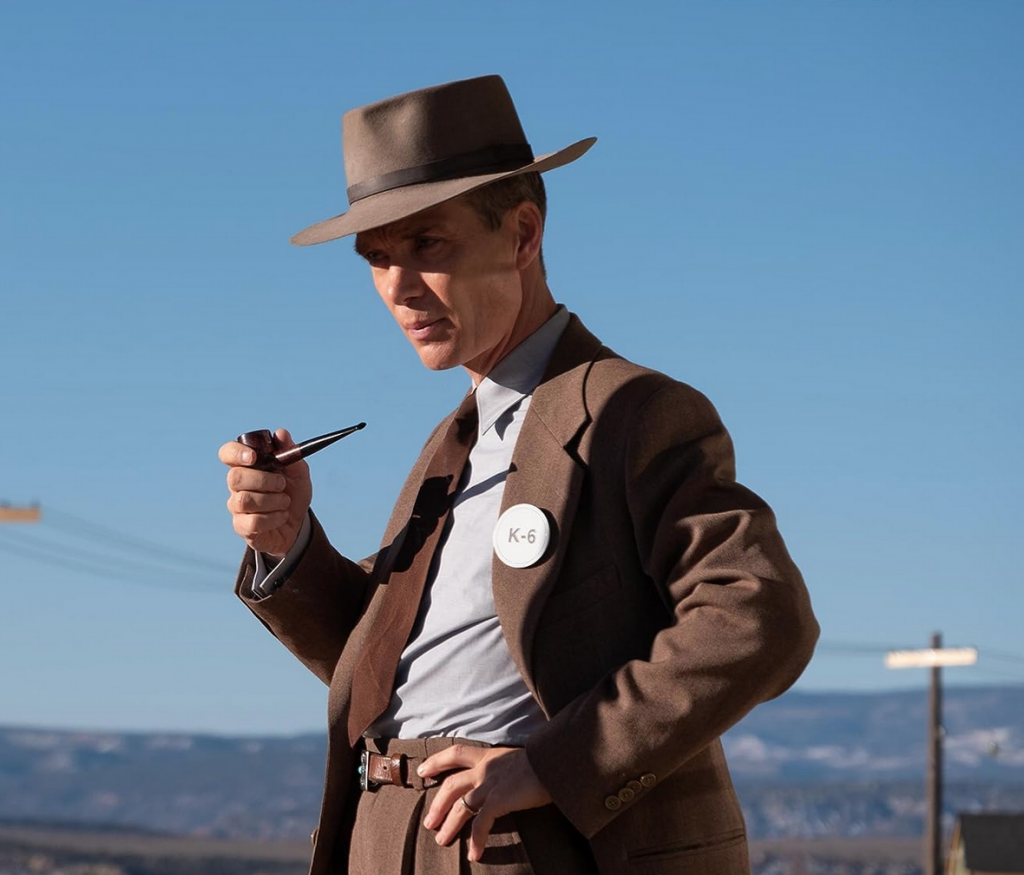
Nolan tells the broad tale of who Oppenheimer was and the process of the bomb’s creation, plus much of the science and politics behind it. But it’s the film’s star –- Irish actor, Cillian Murphy –- who gives ample life to the title character. Through his eyes and micro-movements, the 47-year-old spotlights the deeply felt conflicts that the New York born, German-Jewish scientist wrestled with. Oppenheimer was a fascinating character with many dimensions to his life. Even at its length, the film only hints at all his interests — Eastern religions, women, smoking, the countryside and horses — while also showing that this incredibly cerebral man wasn’t just some wimpy scientist. Despite his reservations he plunged into overseeing the bomb’s creation because, as a Jew, he detested Hitler and his Nazis and wanted to make sure the Allies had the completed the bomb before they did. Ironically, it was used on Japan well after Germany surrendered in May, 1945.
What’s remarkable about Murphy’s acting is not only his stare but how his seemingly blank visage manages to convey so much throughout the film. Oppenheimer wasn’t the cold intellectual he seemed to be at the beginning. With his wife at his side, biologist/botanist Katherine “Kitty” Oppenheimer — tautly and intensely played by Emily Blunt — his many contradictions are illuminated.
The Britisher has taken an iconic American figure, now largely forgotten, and made him relevant by selecting aspects of his life that connect him and his story to urgent contemporary concerns. These include the war in Ukraine and the present threat of nuclear weapons by Mr. Putin. Oppenheimer’s views reflected the conflict that a moral man must feel in a world of amorality and lying. His ideas about patriotism versus global responsibility provide the central paradox of the film.
Oppenheimer was the face that the world linked to the creation of the bombs dropped on Japan. But behind him were the many scientists who ushered in the Atomic Age, the Cold War and the threat of nuclear annihilation. All of this is powerfully brought to the foreground.
The film has an incredible supporting ensemble which includes Matt Damon, Robert Downey Jr., Florence Pugh, Josh Hartnett, Casey Affleck, Rami Malek, and Kenneth Branagh among others. There are so many important characters to the real story that Nolan was forced to find a balance between managing many of them, each with their backstories, and excising others.
And given all the ballyhoo nowadays about sex scenes, especially those with real nudity, this film offers some genuine comfort in showing them with their awkwardness and unintentional humor. Academy Award nominee Pugh — playing Oppenheimer’s young lover, the psychiatrist Jean Tatlock — skillfully makes the sex scenes feel real and heartfelt while showing the awkwardness of them. She’s not trying to look like a porn star but, instead, like a real woman in the throes of passion and need. And these scenes show Oppenheimer as the cad he was.
It’s only after the war, in the last third of the film, that Nolan makes the controversial decision to tell the story of Oppenheimer being railroaded by rightwing forces which prompted his top-level security clearance being rescinded. There were many personalities in play during this sequence, but it’s Robert Downey Jr. as Lewis Strauss — a founding commissioner of the U.S. Atomic Energy Commission — who provides the film’s villain.
Anyhow, despite being such a talky film, it moves breezily along thanks to fine editing and the effective use of dramatic moments. Though I’m not always a fan of films which employ flashbacks and shifts between past and present, Nolan does a effective job at exploiting the contrasts between sequences with the use of color versus black & white. The film gets a little disjointed at times — being rife with certain off-kilter elements — but Nolan always does weird things with pacing, especially in his sci-fi films.
As for the visuals, they’re strong and dynamic. They range from the beautiful vistas of Los Alamos to the explosion of hellfire and damnation. Nolan has met the challenge of showing the atomic bomb’s release in a way that makes it almost a mystical moment. The scene of its test was far less bombastic and more visually contemplative.
One weak element of the film was Tom Conti playing Albert Einstein. For such a seminal and historic figure to behave in such a plodding way seemed only to diminish the important scenes in which he and Oppenheimer interact.
For those who see the movie, this may be the only time they read, hear or think about all the issues it addresses and the people behind them. Knowing that, Nolan carefully chose what he does and doesn’t show. The director has structured the film around his belief that a lot of Oppenheimer’s life needs to be known by the public today. Compared to something relatively forgettable such as “Indiana Jones” or “Transformers,” this is an important and award-worthy film. While a bit too long, it’s a true epic loaded with complex notions about values worth considering.