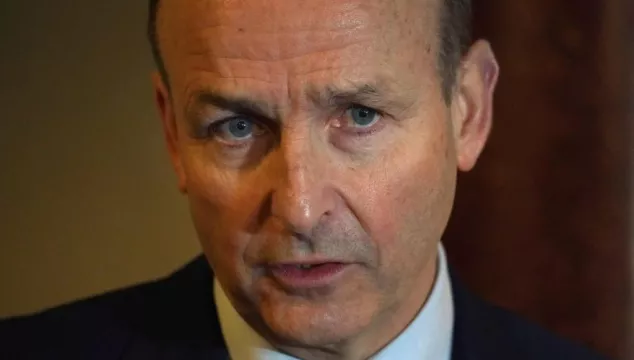
Taoiseach Micheál Martin has said “no one party should have a veto” over the future of Stormont.
Mr Martin was responding to comments by DUP leader Jeffrey Donaldson, who said his party would have difficulty reforming a Stormont executive after the upcoming Assembly election if issues with the Northern Ireland Protocol were not resolved.
Mr Martin said the DUP should have awaited the outcome of UK-EU negotiations on the protocol, and that people in Northern Ireland want to see elected representatives take their seats.
Speaking in Dublin on Friday, Mr Martin said: “No one party should have a veto over whether the Executive exists or continues on, and likewise with the Assembly.
“I believe that decision is very damaging to politics itself, and to people’s trust in politics.
“Because people, when they elect public representatives, I think there’s a fair expectation from the public that those political representatives would serve in the Assembly or in the Executive, and do what they campaigned to do.
“We know there’s many issues – Women’s Aid are out today, for example, on a range of issues to do with violence against women that’s currently going through the Assembly.
“That can still be legislated for and in my view should be legislated for.”
Mr Martin said the DUP should have awaited the outcome of UK-EU negotiations before making a decision.
He said European Commission vice-president Maros Sefcovic had shown “good faith” and “responded quickly” to concerns over the Northern Ireland Protocol.
“It’s not the European Union’s fault that this has gone on so long in respect of the talks around the resolution of issues pertaining to the protocol and the trade agreement,” Mr Martin said.
“Those discussions are now continuing between the European Union and the United Kingdom.
“The conclusion of those should have been awaited, in my view.
“A lot of progress has been made. And a lot of advances were made by the European Union side, and they’re still prepared to engage with the United Kingdom and those talks are continuing.”
He said he did not see the forthcoming Assembly elections becoming a “referendum” on the future of the Protocol, saying people in Northern Ireland want to see the “bread and butter issues” addressed.
“They want political representatives to take their seats, follow through, pass the legislation, represent people on the issues that people want to be represented on.
“There is an emerging center ground in Northern Ireland that want politics to change to those issues, the bread and butter issues matter to people in Northern Ireland, just as they do in the Republic and across Europe.
“In that respect, I think we’ll see whether the UK talks conclude in the next while. That could be important as well.
“There will be those who try to make it into that type of referendum. But I think for far too long, that has been a sort of feature of the electoral cycle in Northern Ireland.
“I think bread and butter issues do matter to people in Northern Ireland.”