
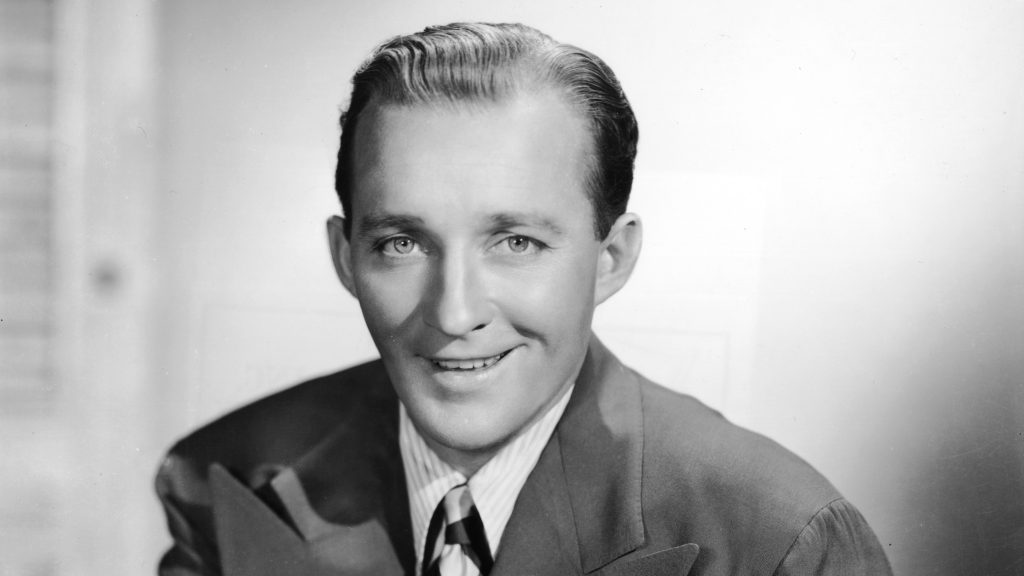
Welcome to our regular music and entertainment guide, brought to you by Paddy McCarthy for your reading enjoyment
It would not be Christmas if I did not include the man who is known as the ‘Voice of Christmas’. For the last seven generations Bing Crosby has been top of the charts with his famous rendering of “White Christmas”. Last week I featured Mariah Carey another Irish-American who also has a Christmas hit song since 1994 with “All I Want for Christmas is You”. The reaction to last week’s issue of The Irish Examiner USA was just fabulous. So that is why I am following up on again one of the greatest crooners in history, Bing Crosby.
Crosby recorded “White Christmas”, a song that was written by Irving Berlin and became a hit song for Crosby in 1942 as the film also won Academy Award for best original song. We should all be very proud as again he’s an Irish-American. There’s no stopping us now, so here we go with a nice history on Bing and you will also read how he got his nick name Bing.
Crosby was born in Tacoma, Washington, in a house his father built at 1112 North J Street. In 1906, his family moved to Spokane in Eastern Washington state, where he was raised. In 1913, his father built a house at 508 E. Sharp Avenue. The house sits on the campus of his alma mater, Gonzaga University. It functions today as a museum housing over 200 artifacts from his life and career, including his Oscar. He was the fourth of seven children: brothers Laurence Earl ‘Larry’, Everett Nathaniel, Edward John ‘Ted’ and George Robert ‘Bob’; and two sisters, Catherine Cordelia and Mary Rose. His parents were Harry Lowe Crosby, a bookkeeper, and Catherine Helen ‘Kate’ (née Harrigan). His mother was a second generation Irish-American. His father was of Scottish and English descent; an ancestor, Simon Crosby, emigrated from England to New England in the 1630s during the Puritan migration to New England. Through another line, also on his father’s side, Crosby is descended from Mayflower passenger William Brewster.
On November 8, 1937, after Lux Radio Theatre’s adaptation of “She Loves Me Not”, Joan Blondell asked Crosby how he got his nickname: You’re going to love this when you read all about it here the words from Crosby himself : “Well, I’ll tell you, back in the knee-britches day, when I was a wee little tyke, a mere broth of a lad, as we say in Spokane, I used to totter around the streets, with a gun on each hip, my favorite after school pastime was a game known as ‘Cops and Robbers’, I didn’t care which side I was on, when a cop or robber came into view, I would haul out my trusty six-shooters, made of wood, and loudly exclaim bing! bing!, as my luckless victim fell clutching his side, I would shout bing! bing!, and I would let him have it again, and then as his friends came to his rescue, shooting as they came, I would shout bing! bing! bing! bing! bing! bing! bing! bing!” Blondell replied: “I’m surprised they didn’t call you ‘Killer’ Crosby!” Now that was from the lips of the man himself.
As it happens, that story was pure whimsy for dramatic effect; the Associated Press had reported as early as February 1932—as would later be confirmed by both Bing himself and his biographer Charles Thompson—that it was in fact a neighbor—Valentine Hobart, circa 1910—who had named him ‘Bingo from Bingville’ after a comic feature in the local paper called The Bingville Bugle which the young Harry liked. In time, Bingo got shortened to Bing.
In 1917, Crosby took a summer job as property boy at Spokane’s Auditorium, where he witnessed some of the acts of the day, including Al Jolson, who held him spellbound with ad-libbing and parodies of Hawaiian songs. He later described Jolson’s delivery as “electric”.
Crosby graduated from Gonzaga High School (today’s Gonzaga Preparatory School) in 1920 and enrolled at Gonzaga University. He attended Gonzaga for three years but did not earn a degree. As a freshman, he played on the university’s baseball team. The university granted him an honorary doctorate in 1937. Today, Gonzaga University houses a large collection of photographs, correspondence, and other material related to Crosby.
The first multimedia star, he was one of the most popular and influential musical artists of the 20th century worldwide. He was a leader in record sales, radio ratings, and motion picture grosses from 1926 to 1977. He made over 70 feature films and recorded more than 1,600 songs. His early career coincided with recording innovations that allowed him to develop an intimate singing style that influenced many male singers who followed, such as Perry Como, Frank Sinatra, Dean Martin, Dick Haymes, Elvis Presley, and John Lennon. Yank magazine said that he was “the person who had done the most for the morale of overseas servicemen” during World War II. In 1948,American polls declared him the “most admired man alive”, ahead of Jackie Robinson and Pope Pius XII.
In 1948, Music Digest estimated that his recordings filled more than half of the 80,000 weekly hours allocated to recorded radio music. Crosby won the Academy Award for Best Actor for his performance in “Going My Way” (1944) and was nominated for its sequel, “The Bells of St. Mary’s” (1945), opposite Ingrid Bergman, becoming the first of six actors to be nominated twice for playing the same character. In 1963, Crosby received the first Grammy Global Achievement Award. He is one of 33 people to have three stars on the Hollywood Walk of Fame, in the categories of motion pictures, radio, and audio recording. He was also known for his collaborations with friend Bob Hope, starring in the “Road to…” films from 1940 to 1962.
Crosby influenced the development of the postwar recording industry. After seeing a demonstration of a German broadcast quality reel-to-reel tape recorder brought to America by John T. Mullin, he invested $50,000 in California electronics company Ampex to build copies. He then persuaded ABC to allow him to tape his shows. He became the first performer to prerecord his radio shows and master his commercial recordings onto magnetic tape. Through the medium of recording, he constructed his radio programs with the same directorial tools and craftsmanship (editing, retaking, rehearsal, used in motion picture production, a practice that became industry standard. In addition to his work with early audio tape recording, he helped finance the development of videotape, bought television stations, bred racehorses, and co-owned the Pittsburgh Pirates baseball team, during which time the team won two World Series (1960 and 1971).
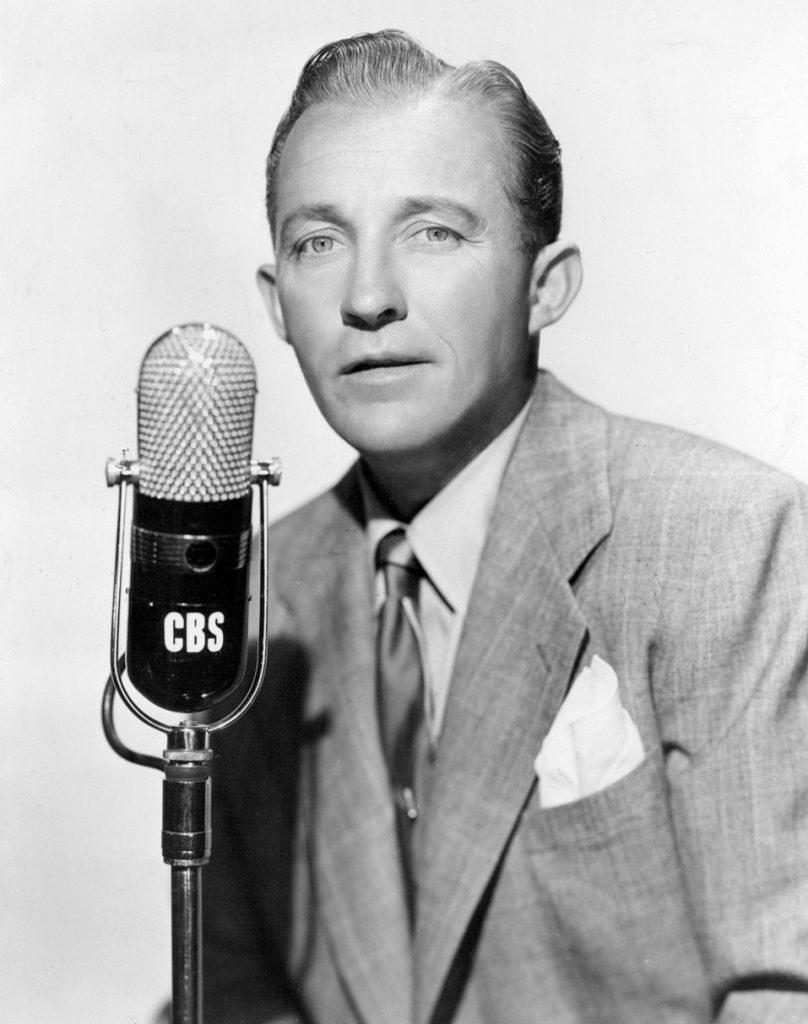
The biggest hit song of Crosby’s career was his recording of Irving Berlin’s “White Christmas”, which he introduced on a Christmas Day radio broadcast in 1941. A copy of the recording from the radio program is owned by the estate of Bing Crosby and was loaned to CBS Sunday Morning for their December 25, 2011, program. The song appeared in his film “Holiday Inn” (1942). His record hit the charts on October 3, 1942, and rose to No. 1 on October 31, where it stayed for 11 weeks.
A holiday perennial, the song was repeatedly re-released by Decca, charting another sixteen times. It topped the charts again in 1945 and a third time in January 1947. The song remains the bestselling single of all time. According to Guinness World Records, his recording of “White Christmas”, has sold over 50 million copies around the world. His recording was so popular that he was obliged to re-record it in 1947 using the same musicians and backup singers; the original 1942 master had become damaged due to its frequent use in pressing additional singles. In 1977, after Crosby died, the song was re-released and reached No. 5 in the UK Singles Chart. Crosby was dismissive of his role in the song’s success, saying “a jackdaw with a cleft palate could have sung it successfully.”
In 1923 Crosby was invited to join a new band composed of high-school students a few years younger than himself. Al and Miles Rinker (brothers of singer Mildred Bailey), James Heaton, Claire Pritchard and Robert Pritchard, along with drummer Crosby, formed the Musicaladers, who performed at dances both for high school students and club-goers. The group performed on Spokane radio station KHQ, but disbanded after two years. Crosby and Al Rinker obtained work at the Clemmer Theatre in Spokane (now known as the Bing Crosby Theater).
Crosby was initially a member of a vocal trio called The Three Harmony Aces with Al Rinker accompanying on piano from the pit, to entertain between the films. Crosby and Al continued at the Clemmer Theatre for several months often with three other men – Wee Georgie Crittenden, Frank McBride and Lloyd Grinnell – and they were billed The Clemmer Trio or The Clemmer Entertainers depending who performed.
In October 1925, Crosby and Rinker decided to seek fame in California. They traveled to Los Angeles, where Bailey introduced them to her show business contacts. The Fanchon and Marco Time Agency hired them for thirteen weeks for the revue “The Syncopation Idea” starting at the Boulevard Theater in Los Angeles and then on the Loew’s circuit. They each earned $75 a week.
As minor parts of “The Syncopation Idea” Crosby and Rinker started to develop as entertainers. They had a lively style that was popular with college students. After “The Syncopation Idea” closed, they worked in the Will Morrissey Music Hall Revue. They honed their skills with Morrissey. When they got a chance to present an independent act, they were spotted by a member of the Paul Whiteman organization.
Whiteman needed something different to break up his musical selections, and Crosby and Rinker filled this requirement. After less than a year in show business, they were attached to one of the biggest names. Hired for $150 a week in 1926, they debuted with Whiteman on December 6 at the Tivoli Theatre in Chicago. Their first recording, in October 1926, was “I’ve Got the Girl” with Don Clark’s Orchestra, but the Columbia-issued record was inadvertently recorded at a slow speed, which increased the singers’ pitch when played at 78 rpm. Throughout his career, Crosby often credited Bailey for getting him his first important job in the entertainment business.
Following his recovery from a life-threatening fungal infection of his right lung in January 1974, Crosby emerged from semi-retirement to start a new spate of albums and concerts. In March 1977, after videotaping a concert at the Ambassador Auditorium in Pasadena for CBS to commemorate his 50th anniversary in show business, and with Bob Hope looking on, Crosby fell off the stage into an orchestra pit, rupturing a disc in his back requiring a month in the hospital. His first performance after the accident was his last American concert, on August 16, 1977, the day Elvis Presley died, at the Concord Pavilion in Concord, California. When the electric power failed during his performance, he continued singing without amplification.
In September, Crosby, his family and singer Rosemary Clooney began a concert tour of Britain that included two weeks at the London Palladium. While in the UK, Crosby recorded his final album, “Seasons”, and his final TV Christmas special with guest David Bowie on September 11 (which aired a little over a month after Crosby’s death).
His last concert was in the Brighton Center on October 10, four days before his death, with British entertainer Gracie Fields in attendance. The following day he made his final appearance in a recording studio and sang eight songs at the BBC’s Maida Vale Studios for a radio program, which also included an interview with Alan Dell.
Accompanied by the Gordon Rose Orchestra, Crosby’s last recorded performance was of the song “Once in a While”. Later that afternoon, he met with Chris Harding to take photographs for the “Seasons” album jacket.
On October 13, 1977, Crosby flew alone to Spain to play golf and hunt partridge. On October 14, at the La Moraleja Golf Course near Madrid, Crosby played 18 holes of golf. His partner was World Cup Champion Manuel Piñero; their opponents were club president César de Zulueta and Valentín Barrios. According to Barrios, Crosby was in good spirits throughout the day, and was photographed several times during the round. At the ninth hole, construction workers building a house nearby recognized him, and when asked for a song, Crosby sang “Strangers in the Night”.
Crosby, who had a 13 handicap, won to his partner by one stroke. At about 6:30 pm, as Crosby and his party headed back to the clubhouse, Crosby said, “That was a great game of golf, fellas. Let’s go have a Coca-Cola.” Those were his last words. About 20 yards from the clubhouse entrance, Crosby collapsed and died instantly from a massive heart attack. At the clubhouse and later in the ambulance, house physician Dr. Laiseca tried to revive him, but was unsuccessful. At Reina Victoria Hospital he was administered the last rites of the Catholic Church and was pronounced dead.
On October 18, following a private funeral Mass at St. Paul’s Catholic Church in Westwood, Crosby was buried at Holy Cross Cemetery in Culver City, California; his tombstone incorrectly identified his year of birth as 1904 instead of 1903. A plaque was placed at the golf course in his memory.
I finish this story about one of the biggest entertainers to ever grace the stage, films and television that will not be seen for a very long time to come, so I hope you enjoyed it as much as I enjoyed bringing it to you.
Merry Christmas to all our readers and I hope to see you back next week…