He just turned 70 last week and got a great reception on the Late Late show on RTÉ with greetings from Bono and the Edge from U2, Elton John, Van Morrison, Ringo Starr, Sting, Roger Waters from Pink Floyd, President of Ireland Michael D. Higgins and many more. Here we have a part one of our bio on Bob Geldof that will give you some history on him and his band the Boomtown Rats.
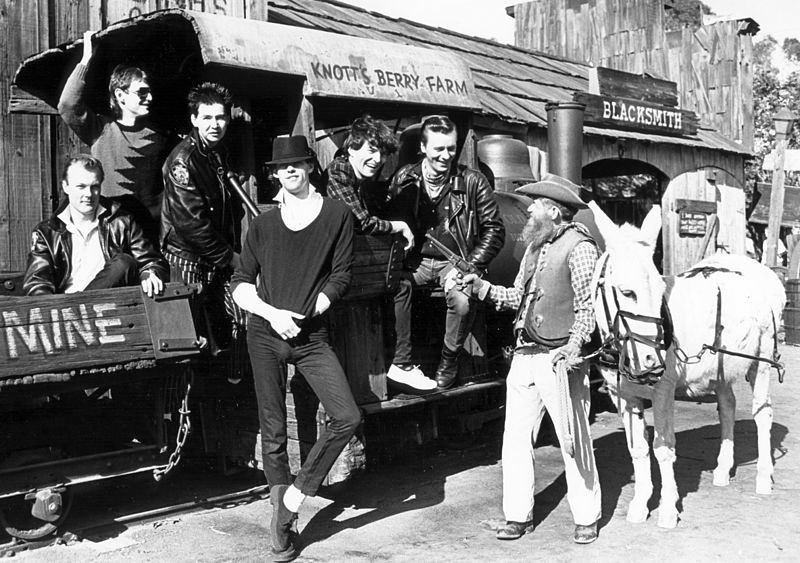
Robert Frederick Zenon Geldof, is an Irish singer-songwriter, actor and political activist. He rose to prominence as the lead singer of the Irish rock band the Boomtown Rats in the late 1970s, who achieved popularity at the time of the punk rock movement. The band had UK number one hits with his compositions “Rat Trap” and “I Don’t Like Mondays”. Geldof starred as “Pink” in Pink Floyd’s 1982 film “Pink Floyd – The Wall”.
As a fundraiser, Geldof organized the charity supergroup Band Aid and the concerts Live Aid and Live 8, and co-wrote “Do They Know It’s Christmas?”, one of the best-selling singles of all time. He is widely recognized for his activism, especially anti-poverty efforts concerning Africa. In 1984, he and Midge Ure founded the charity supergroup Band Aid to raise money for famine relief in Ethiopia. They went on to organize the charity super-concert Live Aid the following year and the Live 8 concerts in 2005. Geldof currently serves as an adviser to the ONE Campaign, co-founded by fellow Irish rock singer and activist Bono, and is a member of the Africa Progress Panel (APP), a group of ten distinguished individuals who advocate at the highest levels for equitable and sustainable development in Africa.
A single father, Geldof has also been outspoken for the movement. Geldof was granted an honorary knighthood (KBE) by Queen Elizabeth II in 1986 for his charity work in Africa; although it is an honorary award as Geldof is an Irish citizen, he is often referred to as “Sir Bob”. He is a recipient of the Man of Peace title which recognizes individuals who have made “an outstanding contribution to international social justice and peace”, among numerous other awards and nominations. In 2005, he received the Brit Award for Outstanding Contribution to Music.
Geldof was born and brought up in Dún Laoghaire, Ireland, a son of Robert and Evelyn Geldof. His paternal grandfather, Zenon Geldof, was a Belgian immigrant and a hotel chef. His paternal grandmother, Amelia Falk, was a British Jew from London. When Geldof was six years of age, his mother Evelyn died at age 41 of a cerebral hemorrhage.
Geldof attended Blackrock College, where he was bullied for being a poor rugby player and for his middle name, Zenon. After work as a slaughterman, a road navvy and pea canner in Wisbech, he was hired as a music journalist in Vancouver, British Columbia, Canada, for The Georgia Straight. He briefly guest hosted the Canadian Broadcasting Corporation children’s program Switchback. Returning to Ireland in 1975, he became lead singer of the Boomtown Rats, a rock group closely linked with the punk movement. In 1978, The Boomtown Rats had their first No. 1 single in the UK with “Rat Trap”, the first new wave chart-topper in Britain. In 1979, they gained international attention with their second UK No. 1, “I Don’t Like Mondays”. This was both successful and controversial. Geldof had written it in the aftermath of Brenda Ann Spencer’s attempted massacre at an elementary school in San Diego, California in 1979.
In 1980, The Boomtown Rats released the album “Mondo Bongo”. Their single “Up All Night” was a huge hit in the US and its video was played frequently on MTV. Geldof became known as a colorful interview subject. The Boomtown Rats’ first appearance on Ireland’s The Late Late Show saw Geldof as deliberately brusque to host Gay Byrne and during his interview he attacked Irish politicians and the Catholic Church, which he blamed for many of the country’s problems. He responded to nuns in the audience who tried to shout him down by saying they had “an easy life with no material worries in return for which they gave themselves body and soul to the church.” He also criticized Blackrock College. The interview caused uproar, making it impossible for The Boomtown Rats to play in Ireland again. In January 2013, Geldof announced The Boomtown Rats would be reforming to play together for the first time since 1986 at that year’s Isle of Wight Festival in June. They subsequently announced further tour dates and released a new CD “Back to Boomtown: Classic Rats Hits”.
Geldof left the Boomtown Rats in 1986 to launch a solo career and publish his autobiography, “Is That It?”, which was a UK best-seller. His first solo records sold reasonably well and spawned the hit singles “This Is The World Calling” (co-written with Dave Stewart of the Eurythmics) and “The Great Song of Indifference”. He also occasionally performed with other artists, such as David Gilmour and Thin Lizzy; a performance of “Comfortably Numb” with Gilmour is documented in the DVD release “David Gilmour in Concert” (2002). In 1992, he performed at the Freddie Mercury Tribute Concert with the surviving members of Queen at the old Wembley Stadium, singing a song he jokingly claimed to have co-written with Mercury, called “Too Late God”. (The song was actually co-written by Karl Hyde.) Geldof has also worked as a DJ for XFM radio. In 1998, he erroneously announced Ian Dury’s death from cancer, possibly due to hoax information from a listener who was disgruntled at the station’s change of ownership. The event caused music paper NME (who had been involved in a running feud with Geldof since his Boomtown Rats days—primarily due to his disparagement of The Clash) to call Geldof “the world’s worst DJ”.
Along with U2’s Bono, he has devoted much time since 2000 to campaigning for debt relief for developing countries. His commitments in this field, including the organization of the Live 8 concerts, kept Geldof from producing any more musical output since 2001’s album “Sex, Age & Death”. In 2002, he was listed as one of the 100 Greatest Britons in a poll conducted among the general public, despite not being British. After Live 8, Geldof returned to his career as a musician by releasing a box set containing all of his solo albums entitled “Great Songs of Indifference – The Anthology 1986–2001” in late 2005. Following that release, Geldof toured, albeit with mixed success. In July 2006, Geldof arrived at Milan’s Arena Civica, a venue capable of holding 12,000 people, to play a scheduled concert to find that the organizers had not put the tickets on general sale and that only 45 people had shown up. Geldof refused to go on stage once he found out how small the attendance was. To offer some compensation for fans, Geldof stopped to sign autographs to those who had shown up. He then played a well-attended free Storytellers concert for MTV Italy in Naples, in October 2006.
Geldof’s first major charity involvement took place in September 1981, when he performed as a solo artist for Amnesty International’s benefit show The Secret Policeman’s Other Ball, at the invitation of Amnesty show producer Martin Lewis; he performed a solo version of “I Don’t Like Mondays”. Other rock artists had “planted a seed” and appeared to have affected Geldof in a similar manner. In 1984, Geldof responded to a BBC news report from Michael Buerk about the famine in Ethiopia by mobilizing the pop world to do something about the images he had seen. With Midge Ure of Ultravox he wrote “Do They Know It’s Christmas?” in order to raise funds. The song was recorded by various artists under the name of Aid. In its first week of release, the single became the UK’s fastest-seller of all time, entering the chart at number one and going on to sell over 3 million copies, making it the biggest-selling single in UK history up to that point, a title it held for almost 13 years. The single was also a major US hit, peaking at number 13 on the Billboard Hot 100. “Do They Know It’s Christmas?” returned to the UK chart a year later, reaching number three, and eventually it raised over £8 million.
Following this massive success, preparations were started for the biggest rock concerts the world had ever seen, the following summer. New versions of “Do They Know It’s Christmas” were recorded in 1989 and 2004. In November 2014, Geldof announced that he would be forming a further incarnation of Band Aid, to be known as Band Aid 30, to record an updated version of the charity single, with the proceeds going to treat victims of the Ebola virus in West Africa. As Geldof began to learn more about the situation, he discovered that one of the main reasons why African nations were in such dire peril was the obligation to make repayments on loans that their countries had taken from Western banks.
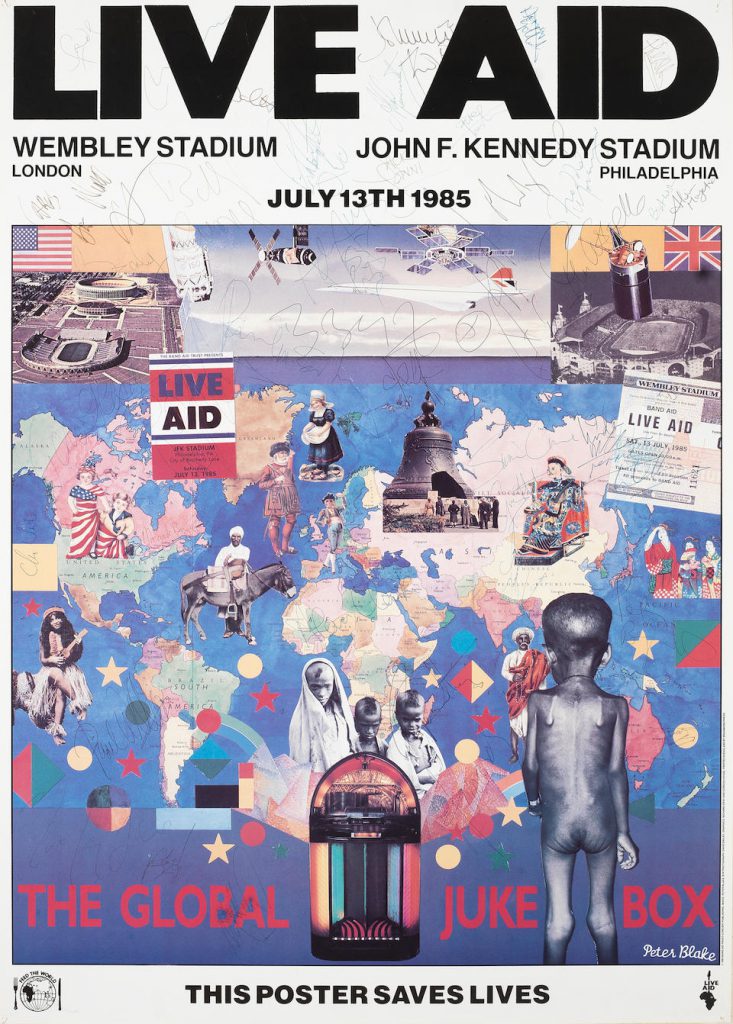
For every pound donated in aid, ten times as much would have to leave the country in loan repayments. It became obvious that one song was not enough. On 13 July 1985, Geldof and Ure organized Live Aid, a huge event staged simultaneously at the Wembley Stadium in London and John F. Kennedy Stadium in Philadelphia. Thanks to an unprecedented decision by the BBC to clear its schedules for 16 hours of rock music, the event was also broadcast live in the UK on television and radio. It was one of the most monumental stage shows in history, with Phil Collins flying on Concorde so that he could play at both Wembley and Philadelphia on the same day.
During the broadcast of Live Aid, Geldof shocked viewers into giving cash by not only twice mouthing profanities but also by slamming his fist on the table and ordering them not to go out to the pub but to stay in and watch the show. Nearly seven hours into the concert in London, Geldof gave an infamous interview in which he used the word “f”. The BBC presenter David Hepworth, conducting the interview, had attempted to provide a list of addresses to which potential donations should be sent; Geldof interrupted him in mid-flow and shouted: “F the address, let’s get the [phone] numbers!” It has passed into folklore that he yelled at the audience, “Give us your f***ing money!” although Geldof has stated that this phrase was never uttered. Due to his Irish accent, the profanity was stated to be misheard as “fock” and “focking” respectively. After the outburst, donations increased to £300 per second.
The harrowing video of dying, skeletal children—introduced by David Bowie following the end of his set—that had been made by CBC photo-journalists setting their films to the tune of “Drive” by The Cars, contributed to the concert’s success. In total, Live Aid raised over £150 million for famine relief. Geldof subsequently received an honorary knighthood, at age 34, for his efforts. His autobiography, written soon after with Paul Vallely, was entitled “Is That It?”. The book achieved further fame for being featured on the General Certificate of Secondary Education examination syllabus in a following year.
Much of the money raised by Live Aid went to NGOs in Ethiopia, some of which were under the influence or control of the Derg military junta. Some journalists have suggested that the Derg was able to use Live Aid and Oxfam money to fund its enforced resettlement and “vilification” program, under which at least 3 million people are said to have been displaced and between 50,000 and 100,000 killed. However, in November 2010 the BBC formally apologized to Geldof for misleading implications in its stories on the subject of Band Aid, saying it had “no evidence” that Band Aid money specifically went to buy weapons.
In January 2004, on a visit to friends in Africa, Geldof came to believe that more people were at risk of starvation there than had died in the famine of 1984/85 which had prompted Live Aid. He telephoned the British Prime Minister Tony Blair from Addis Ababa. According to the Live 8 program notes by Geldof’s biographer and friend, Paul Vallely, the Prime Minister responded: “Calm down Bob. … And come and see me as soon as you get back.” The result was the Commission for Africa. Blair invited Geldof and 16 other Commissioners, the majority from Africa and many of them politicians in power, to undertake a year-long study of Africa’s problems. They came up with two conclusions: that Africa needed to change, to improve its governance and combat corruption, and that the rich world needed to support that change in new ways. That meant doubling aid, delivering debt cancellation, and reforming trade rules. The Commission drew up a detailed plan of how that could be done. It reported in March 2005. To force the issue Geldof decided to create a new international lobby for Africa with eight simultaneous concerts around the world to put pressure on the G8. He called it Live 8. The commission’s recommendations later became the blueprint for the G8 Gleneagles African debt and aid package.
Geldof is a member of the Africa Progress Panel (APP), a group of ten distinguished individuals who advocate at the highest levels for equitable and sustainable development in Africa. Every year, the Panel releases a report, the Africa Progress Report, that outlines an issue of immediate importance to the continent and suggests a set of associated policies. In 2012, the Africa Progress Report highlighted issues of Jobs, Justice and Equity. The 2013 report outlined issues relating to oil, gas and mining in Africa. Bob Geldof worked closely with DATA (Debt, AIDS, Trade, Africa), an organization founded by U2’s Bono in 2002 to promote debt-relief, third world trade and AIDS relief in Africa. It merged with One Campaign in 2008, where Geldof also is very active. In June 2009, on behalf of One Campaign, he co-edited a special edition of the Italian newspaper La Stampa with a view on 35th G8 summit. In March 2005, Geldof and Ure announced the Live 8 project, to raise awareness of issues that burden Africa, including government debt, trade barriers, hunger, and AIDS issues. Geldof organized ten concerts on July 2nd, 2005 in large cities throughout the industrialized world. They featured musicians from different genres and locations around the world. The cities where Live 8 concerts were played were in industrialized countries, and drew huge crowds. The locations were London, Paris, Berlin, Rome, Philadelphia, Barrie, Chiba, Johannesburg, Moscow, Cornwall and Edinburgh. The concerts were free, and were scheduled just days before world leaders gathered in Gleneagles, for the G8 economic summit, on 6 July. Ure organized the “final push” Live 8 concert at Edinburgh. “The boys and girls with guitars will finally get to turn the world on its axis,” Geldof said in a statement.