
Now the news I have for you is that Bruce Springsteen will return to Broadway this summer for a limited run of Springsteen on Broadway performances at Jujamcyn’s St. James Theatre. Shows begin on Saturday June 26, with additional performances taking place through September 4. Tickets for Springsteen on Broadway will go on sale Thursday, June 10 at 12pm ET through the show’s official ticketing provider Seat Geek. See a full list of performances and information on purchasing tickets from Ticketmaster.
“I loved doing Springsteen on Broadway and I’m thrilled to have been asked to reprise the show as part of the reopening of Broadway,” said Bruce. Proceeds from Opening Night of Springsteen on Broadway at the St. James Theatre will be donated to a group of local New York and New Jersey charities including the Boys and Girls Club of Monmouth County, Broadway Cares/Equity Fights Aids, Community FoodBank of New Jersey, Food Bank for New York City, Fulfill (Monmouth & Ocean Counties Foodbank), Long Island Cares, NJ Pandemic Relief Fund and The Actor’s Fund. The creative team for Springsteen on Broadway includes Heather Wolensky (scenic design), Natasha Katz (lighting design) and Brian Ronan (sound design). Based on his worldwide best-selling autobiography “Born to Run”, Springsteen on Broadway is a unique evening with Bruce, his guitar, a piano, and his very personal stories. The show’s original run included 236 sold-out performances at Jujamcyn’s Walter Kerr Theatre, beginning in October 2017 and concluding in December 2018. Springsteen earned a Special Tony Award for the performances, which were later adapted into a film and a soundtrack album. Audience members will be required to provide proof of full COVID-19 vaccination in order to enter the theater. For more information, visit jujamcyn.com/springsteenFAQ.
I will definitely want to go to one of his shows on Broadway before he finishes in September.
Now for a full biography on “The Boss” himself here we go. Bruce Frederick Joseph Springsteen is an American singer, songwriter, and musician. He has released twenty studio albums, many of which feature his backing band, the E Street Band. Originally from the Jersey Shore, he is one of the originators of the heartland rock style of music, combining mainstream rock musical style with narrative songs about working class American life. During a career that has spanned five decades, Springsteen has become known for his poetic, socially conscious lyrics and energetic stage performances, sometimes lasting up to four hours in length. He has been nicknamed “The Boss”.
While he received critical acclaim for first two albums, “Greetings from Asbury Park, N.J.” and “The Wild, the Innocent & the E Street Shuffle” (both 1973), Springsteen failed to find a mainstream audience with his Dylanesque folk rock style. Threatened to be dropped by his label unless sales improved, he changed up his style and reached worldwide popularity with his third album, “Born to Run”, released 1975. Legal battles with his management following the success of “Born To Run” kept Springsteen out of the studio for three years; the 1978 follow up album “Darkness on the Edge of Town” features much darker lyrical themes, and has been assessed as one of the most critically lauded of his albums. The three year gap had given Springsteen enough time to write dozens of new songs, several of which were held over for his 1980 double album “The River”, which would be his first album to reach the top spot on the Billboard 200 album chart.
Changing gears in 1982, he released a solo album of demo recordings, “Nebraska”, without the E Street Band. Recorded over several sessions beginning in 1982 with the E Street Band, “Born in the U.S.A.” (1984) is Springsteen’s most commercially successful album, making him one of the most successful rock figures of the 1980s. It was certified 15 × platinum in the US and has sold 30 million copies worldwide, making it one of the best-selling albums of all time. Seven of its singles reached the top 10 of the Billboard Hot 100 including the title track, which was a bitter commentary on the treatment of Vietnam veterans — some of whom were Springsteen’s friends. Advocating for the rights of the common working-class man, the song made a huge political impact.
Already well known for his live shows, a box set of live recordings, “Live 1975–85”, was released in 1986. By the late 1980s, Springsteen had put the E Street Band on hiatus, and though individual members of the band were brought in to record some parts, he released his next three albums, “Tunnel of Love” (1987), “Human Touch” (1992), and “Lucky Town” (1992) using mostly session musicians. He re-assembled the E Street Band to record four new tracks for his 1995 Greatest Hits compilation, and then released the folk album “The Ghost of Tom Joad”, for which he won a Grammy for Best Contemporary Folk Album.
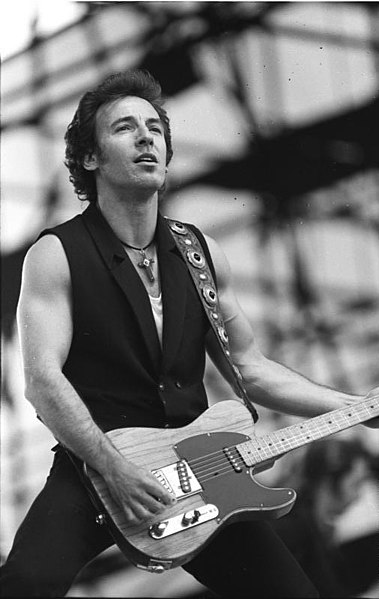 The rest of the 1990s were mostly quiet, as Springsteen only released a five-song EP of new material, “Blood Brothers” (1996), which contained unreleased recordings from the brief 1995 reunion with the E Street Band. An outtakes collection was released as a boxed set in 1998, “Tracks”, and in 1999 in abridged form as the single album “Tracks”. Another reunion with the E Street Band occurred following the September 11 attacks, with the album “The Rising” serving as a tribute to the people who died in the attacks. It would be the first full-length album of new material by the group in 18 years.
Springsteen released two more folk albums, “Devils & Dust” in 2005, and “We Shall Overcome: The Seeger Sessions” in 2006, which won him another Grammy, this one for Best Traditional Folk Album. Two more albums with the full E Street Band followed: “Magic” (2007) and “Working on a Dream” (2009). In 2010 he released “The Promise”, a collection of unused tracks from the “Darkness on the Edge of Town” sessions. His solo album “Wrecking Ball” (2012) would be his biggest album in a decade, reaching the number on spot on the Billboard 200 and the same level of success in numerous countries around the world, Rolling Stone named it their album of the year for 2012, and it produced three Grammy nominations. The follow-up album, “High Hopes” (2014) recorded with the E Street Band and guest musician Tom Morello, also reached number 1 on the album charts.
Delving into country music for the first time, he released the solo album “Western Stars” in 2019, and amid the COVID-19 pandemic released his most recent album in 2020, “Letter to You”, recorded with the E Street Band.
Springsteen has released a number of well-known songs that have been mainstays on mainstream rock and classic rock stations. Among these are “Born to Run” (1975), “Thunder Road” (1975), “Badlands” (1978), “Hungry Heart” (1980), “The River” (1980), “Atlantic City” (1982), “Dancing in the Dark” (1984), “I’m on Fire” (1984), “Glory Days” (1984), “Brilliant Disguise” (1987), “Human Touch” (1992), “Streets of Philadelphia” (1994), “The Rising” (2002), and “We Take Care of Our Own” (2012).
Among the album era’s prominent acts, Springsteen has sold more than 150 million records worldwide and more than 64 million albums in the United States, making him one of the world’s best-selling music artists. He has earned numerous awards for his work, including 20 Grammy Awards, two Golden Globes, an Academy Award, and a Tony Award (for Springsteen on Broadway). Springsteen was inducted into both the Songwriters Hall of Fame and the Rock and Roll Hall of Fame in 1999, received the Kennedy Center Honors in 2009, was named MusiCares person of the year in 2013, and was awarded the Presidential Medal of Freedom by President Barack Obama in 2016. He is ranked 23rd on Rolling Stone’s list of the Greatest Artists of All Time.
Springsteen was born at Monmouth Medical Center, in Long Branch, New Jersey, on September 23, 1949. He is of Dutch, Irish, and Italian descent. He spent his childhood in Freehold, New Jersey, where he lived on South Street. His father, Douglas Frederick ‘Dutch’ Springsteen (1924–1998), worked as a bus driver and held other jobs. Douglas Springsteen suffered from mental health problems throughout his life which worsened in his later years. Springsteen’s mother, Adele Ann (née Zerilli), was originally from the Bay Ridge neighborhood in Brooklyn, worked as a legal secretary, and was the main breadwinner in Springsteen’s family. Springsteen has two younger sisters named Virginia and Pamela. The latter had a brief acting career, but left to pursue photography full time; she later took photos for his albums “Human Touch”, “Lucky Town”, and “The Ghost of Tom Joad”.
Springsteen’s Italian maternal grandfather was born in Vico Equense. He emigrated through Ellis Island, and could not read or write when he arrived. He eventually became a lawyer, and impressed the young Springsteen as being larger than life. The name Springsteen is topographic and of Dutch origin, literally translated as “jumping stone” but more generally a stepping stone used on unpaved streets or between two houses. The Springsteen’s, originally from the province of Groningen, were among the early Dutch families who settled in the colony of New Netherland in the 1600s.
Raised a Catholic, Springsteen attended the St. Rose of Lima Catholic school in Freehold, where he was at odds with the nuns and rebelled against the strictures imposed upon him, even though some of his later music reflects a Catholic ethos and includes a few rock-influenced, traditional Irish-Catholic hymns. In a 2012 interview, he explained that it was his Catholic upbringing rather than political ideology that most influenced his music. He remarked that his faith had given him a “very active spiritual life” but joked that this “made it very difficult sexually.” He added, “Once a Catholic, always a Catholic.”
He grew up hearing fellow New Jersey singer Frank Sinatra on the radio and became interested in being a musician himself when, in 1956 and 1957, at the age of seven, he saw Elvis Presley on “The Ed Sullivan Show”. Soon after, his mother rented him a guitar from Mike Diehl’s Music in Freehold for $6 a week, but it failed to provide him with the instant gratification he desired.
In ninth grade, Springsteen began attending the public Freehold High School, but did not fit in there either. Former teachers have said he was a “loner who wanted nothing more than to play his guitar.” He graduated in 1967, but felt so alienated that he skipped the ceremony. He briefly attended Ocean County College, but dropped out.
Called for the draft when he was 19, Springsteen failed the physical examination and avoided service in the Vietnam War. He had suffered a concussion in a motorcycle accident when he was 17, and this, together with his “crazy” behavior at induction, made him unacceptable for service.
The Springsteen family moved to San Mateo, California, in 1969, but Bruce, 20, and his sister, Virginia, married and pregnant, stayed behind.
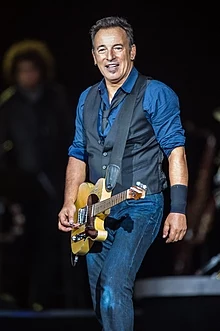 In 1964, Springsteen saw the Beatles’ appearances on The Ed Sullivan Show. Inspired, he bought his first guitar for $18.95 at the Western Auto Appliance Store. Thereafter, he started playing for audiences with a band called the Rogues at local venues such as the Elks Lodge in Freehold. In late 1964, Springsteen’s mother took out a loan to buy him a $60 Kent guitar. Springsteen later memorialized this act in his song “The Wish”.
The following year, he went to the house of Tex and Marion Vinyard, who sponsored young bands in town. They helped him become the lead guitarist and subsequently one of the lead singers of the Castiles. The Castiles recorded two original songs at a public recording studio in Brick Township and played a variety of venues, including Cafe Wha? in Greenwich Village.
Marion Vinyard said that she believed the young Springsteen when he promised he would make it big. Ordinary life in New Jersey beach towns such as Asbury Park is the background to Springsteen’s early lyrics.
In the late 1960s, Springsteen performed briefly in a power trio known as Earth, playing in clubs in New Jersey, with one major show at the Hotel Diplomat in New York City. From 1969 through early 1971, Springsteen performed with Steel Mill (originally called Child), which included Danny Federici, Vini Lopez, Vinnie Roslin, and later Steve Van Zandt and Robbin Thompson. During this time, he performed regularly at venues on the Jersey Shore, in Richmond, Virginia, Nashville, Tennessee, and a set of gigs in California, quickly gathering a cult following.
San Francisco Examiner, reviewing their show at The Matrix, music critic Philip Elwood gave Springsteen credibility in his glowing assessment of Steel Mill: “I have never been so overwhelmed by a totally unknown talent, … the first big thing that’s happened to Asbury Park since the good ship Morro Castle burned to the waterline of that Jersey beach in ’34.”
Elwood went on to praise their “cohesive musicality” and, in particular, singled out Springsteen as “a most impressive composer.” In San Mateo, Steel Mill recorded three original Springsteen songs at Pacific Recording. C
Read part two of the story of “The Boss” in next week’s Irish Examiner USA