
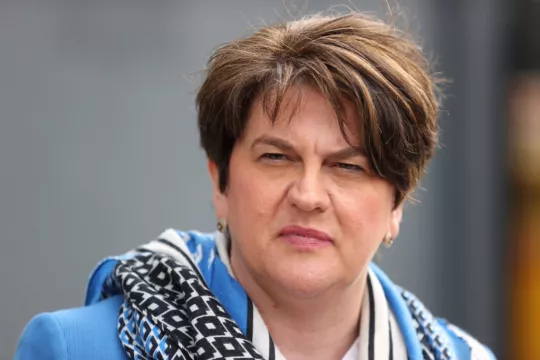
 Arlene Foster will stand down as leader of the Democratic Unionist Party and as Northern Ireland’s First Minister in the face of mounting discontent among her party.
Ms Foster said she will stand down as party leader on May 28th and as First Minister at the end of June.
In a statement, she said: “It is important to give space over the next few weeks for the party officers to make arrangements for the election of a new leader. When elected, I will work with the new leader on transition arrangements.”
Ms Foster said she intended to “depart the political stage”.
“It has been the privilege of my life to serve the people of Northern Ireland as their First Minister and to represent my home constituency of Fermanagh/South Tyrone,” she said.
“I first entered the Assembly in 2003 and undoubtedly the journey of the last eighteen years has been memorable. There are many people who have helped and supported me throughout that period and I will always be grateful for the kindness and support shown to me by them.
“Whilst there have been many difficult and testing times for the executive it remains my firm view that Northern Ireland has been better served having local ministers at this time. It is unthinkable that we could have faced into the coronavirus pandemic without our own devolved ministers in place and no ministerial direction for departments.”
The end of Ms Foster’s five-year tenure at helm of the DUP had been widely anticipated after it emerged that a significant number of her colleagues had signed a letter of no confidence.
She faced the revolt over her handling of Brexit and a recent decision to abstain in a Northern Ireland Assembly vote on gay conversion therapy.
Taoiseach Micheál Martin was among the politicians to send best wishes to Ms Foster following her resignation announcement.
He paid tribute to the DUP leader’s role in “guiding Northern Ireland through this challenging period”.
Mr Martin described the re-establishment of the Northern Ireland Executive in January 2020 as a “key development in supporting peace and stability for all the people of these islands”.
The Fianna Fáil leader also said he had a “positive working relationship” with Ms Foster over the years.
Tánaiste Leo Varadkar said he was “very sorry” to hear of Ms Foster’s resignation and wanted to wish her “the very best in her future life and whatever she decides to do.”
Mr Varadkar added: “Her closing statement today really resonated with me – this understanding we must have that people in Northern Ireland are Irish, British, Northern Irish, or a mixture of all these things, and that we have to be generous to each other and understand each other.”
Minister for Foreign Affairs Simon Coveney also sent his best wishes to Ms Foster and her family following the announcement.
He tweeted: “While we bring different perspectives to some issues, she has worked sincerely, tirelessly & with determination for her party & for NI as First Minister.”
Northern Ireland Secretary Brandon Lewis said Ms Foster was a “truly dedicated public servant”.
“There are many young people, particularly young women, who will be inspired by her example to follow a path into politics,” he said.