
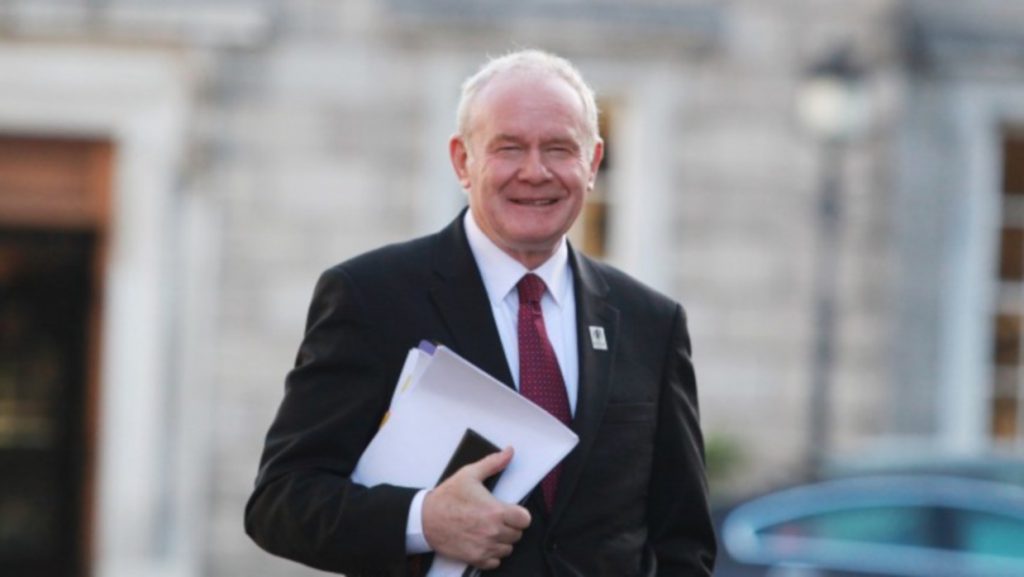
“A true great leader of modern time” were words I used, at the start of an historic Ard Fheis speech, to describe Martin McGuinness in September 2011.
Sinn Fein’s Ard Fheis that particular year turned out to be an Ard Fheis of firsts. For the first time the Republican Party held its annual conference in ‘the north’ and for the first time a Presbyterian Minister was invited to address delegates.
If Sinn Fein delegates, filing the seats inside Belfast’s Waterfront Hall, were pleased with this description of their Vice-President and Northern Leader the same could not be said of many listening to proceedings on the outside. A significant segment of Unionists was convinced David Latimer had been caught by the charm of the former IRA commander and, as a result, been blinded to his violent past. Frequently the assertion was leveled, “Latimer has gone too far!” But who has the right to point a finger and announce that anyone has gone too far? American poet TS Elliott holds the view, “only those who will risk going too far can possibly find out how far one can go.”
When push comes to shove I find myself in complete agreement and my rationale resides in something surprisingly shared during a BBC TV interview in December 2016 shortly after news of Martin’s mystery illness went viral.
In the course of that particular interview the BBC presenter said, “you must feel vindicated?” Unsure of what was being inferred I asked for clarification only to be informed that my description of Martin McGuinness in 2011 as a true, great leader had, in the intervening years, been shown to be accurate!
It was generous of the media to concede I’d got it right six years earlier. Back then I was at ease with my portrayal of Martin insomuch I was prepared to publicly defend the friendship we were together experiencing.
President Jimmy Carter was so right when he said, “go out on a limb; that’s where the fruit is.”
It would have been so easy to have given up, thrown in the towel and quietly walked away but that would have been a cowardly course of action and would, I believe, have prevented many from becoming acquainted with the man I knew whose modus operandi was to govern by treating every single citizen equally.
A handful of years earlier few, if any, could have imagined the former paramilitary activist shaking hands with Queen Elizabeth in 2011 and putting his neck on the line by denouncing anti peace process Republicans in 2017 as “traitors to the island of Ireland.”
Regardless of real personal risk he amazingly dedicated the final decade of his life to resolute and unwavering support for the peace he had helped to forge.
From the terraced streets of the Bogside to the salubrious surroundings of Stormont Martin McGuinness travelled a path once deemed unthinkable. And the transformation did not go unnoticed by First Minister Arlene Foster who, in the aftermath of his untimely death publicly acknowledged, “Northern Ireland may never see a political figure like Martin McGuinness again.”
A close relative of a Protestant murdered by the IRA during The Troubles recently wrote to me in a letter saying, “it has clearly been a difficult journey for you at times but I hope you can look back and see that it was worthwhile. I also hope that throughout you knew that it was what you were being called to do, especially in the hard times. It seems clear that your attitudes and friendship influenced Martin McGuinness for the better and that will have ongoing effects. The ripples of your relationship will surely roll across the pond that is politics and society in Northern Ireland for many years to come.”
It is said our biggest regrets are not for the things we’ve done but for the things we haven’t done. Neither Martin nor I ever harbored any regrets when it came to reaching out and moving closer to one another.
This was what we had been destined to do from the beginning of time and what we did in Derry-Londonderry must be widely replicated if people are to occupy a peaceful and prosperous world.
Now is the time and we are the people, regardless of our age, color, creed or culture, to drill down deeply into ourselves; to appeal to the nature of our better angels, move beyond what comes easily by building bridges of cooperation and friendship that stretch out across frontiers of memory, contemporary grief and more recent loss.