
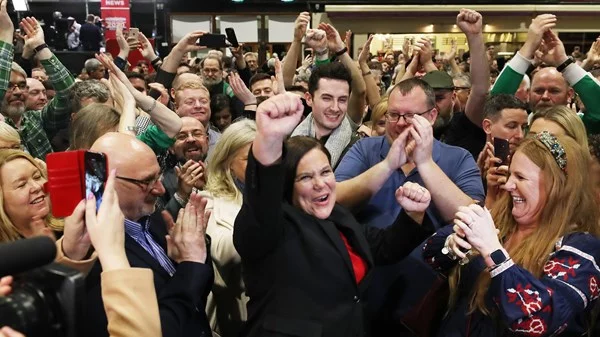
 Sinn Féin will work to form a “people’s government” voters can relate to after making historic gains in the General Election, leader Mary Lou McDonald said.
She pledged to get to grips with crises in housing and health and bring a new lease of life to public administration.
Counting of votes resumes today in 26 constituencies to fill the remaining 82 seats.
Sinn Féin emerged as the most popular party in the country, securing the most first preference votes and topping the polls in the vast majority of constituencies across a state previously dominated by two other large parties.
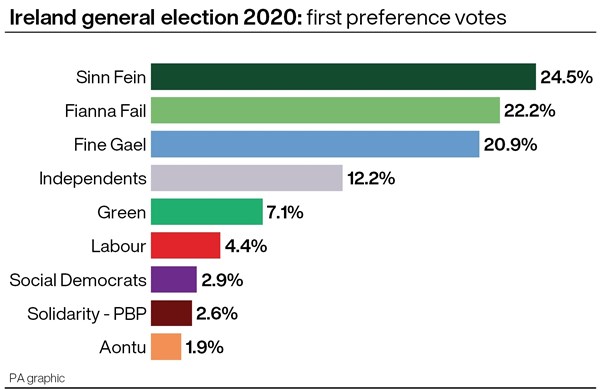
Sinn Féin received 24.5% of the vote share on first preference, Fianna Fáil got 22.2% and Fine Gael 20.9%.
It could be months before a Government is formed, Taoiseach Leo Varadkar said, with talks on forming a coalition set to begin between party leaders.
Mrs McDonald told RTÉ: “We want to talk to anyone who is interested in delivering a program for government. That is about getting to grips with the housing crisis and solving it, getting to grips with the crisis in health and giving families and workers a break and giving a new lease of life to government.
“A government that people relate to, that is in tune with the realities of people’s day-to-day lives, not one that is aloof and adrift from the experiences of citizens.”
 Fianna Fáil remains best placed to secure the most seats, primarily due to Sinn Féin’s failure to field enough candidates to capitalise on its unexpected surge at the polls.
Fine Gael looks like being the big loser and will concede several high profile-seats.
Finance minister Paschal Donohoe said: “It is clear that no political party in our country has a monopoly on representing the people of Ireland.”
None of the parties will come close to securing enough seats to achieve a majority in the Dáil, so thoughts have already turned to the make up of a coalition.
Sinn Féin has been left to rue its decision to run half the number of candidates of its two main rivals.
That will see a significant number of Sinn Féin surplus votes being transferred to other parties in the proportional representation contest.
Smaller groupings such as the Greens, Labour, the Social Democrats and Solidarity/People Before Profit, and a sizable number of independent TDs, may all be courted as the main parties seek junior coalition partners.
Mrs McDonald said: “This campaign has been about change and giving Sinn Féin a chance to demonstrate what it feels like when it is led by or has a party of the people in it, that has been the theme of our discussions and conversations.
“This vote for Sinn Féin is for Sinn Féin to be in government, for Sinn Féin to make a difference, for Sinn Féin to be tested, for Sinn Féin to deliver.”
Yesterday, Fianna Fáil leader Micheál Martin declined to repeat his pre-election pledge never to do business with Sinn Féin.
He later cautioned observers not to “jump the gun” in interpreting his remarks as a signal an alliance with the party was in the offing.
Mr Varadkar said his party’s stance on not dealing with Sinn Féin was unchanged.
There are 160 seats in the Dáil. The Ceann Comhairle is automatically re-elected, leaving 159 seats up for grabs and 80 the magic number for a majority.