
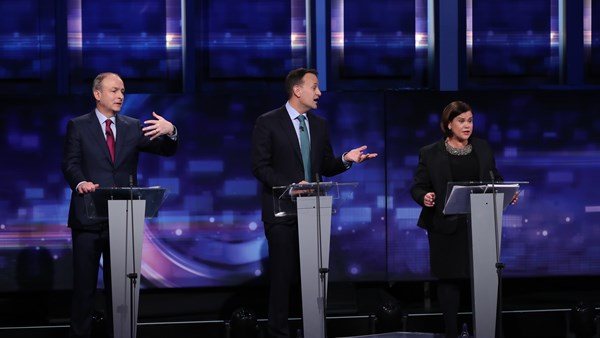
 Sinn Féin is on course to make Ireland a country of three big parties, marking a dramatic change in the state’s political landscape.
Despite an exit poll suggesting almost a quarter of voters backed Sinn Féin in the General Election, both Fianna Fáil and Fine Gael have consistently ruled out going into coalition with their rivals.
As the opinion polls signaled a strong surge in support for Mary Lou McDonald’s party, the dialogue around which parties could lead the next government quickly changed.
Micheál Martin and Leo Varadkar faced down questions about whether they would be open to working with Sinn Féin, with both leaders ruling out doing a deal with Ms McDonald.
Mr Varadkar said his party’s long-held differences with Sinn Féin prevents it from relying on their support in any coalition government.
During the election campaign, Mr Varadkar was challenged on his position on Sinn Féin, as he had long criticized the party for not restoring power-sharing in Stormont sooner, and urged them back into government repeatedly in Northern Ireland.
Mr Varadkar however said that “the north is different”.
“Northern Ireland is a devolved government, it’s not a sovereign state, and in Northern Ireland the Good Friday Agreement provided for what is effectively an all-party coalition,” he said.
“I don’t think people comparing Stormont with a sovereign parliament like the Dáil is an accurate comparison.”
He said the reason Fine Gael have ruled out working with Sinn Féin is a “point of principle”.
He raised concerns about Sinn Féin’s key policy decisions not being made by elected representatives but by their Ard Comhairle.
Mr Varadkar and Mr Martin also say they have a major problem with Sinn Fein’s stance on the Special Criminal Court which Sinn Féin has previously opposed but now say needs to be reformed.
Faced with the Sinn Féin surge, Fine Gael and Fianna Fáil have continued to raise the party’s historic IRA links and, as the campaign entered its latter stages, the past crimes of the provisional movement.
But the Fianna Fail and Fine Gael leaders could face pressure to form a coalition government that involves Sinn Féin given the predicted close election result.
During the last week of the election campaign, a Sinn Féin minister in the Northern Ireland Executive was forced to apologize and withdraw claims he made about an IRA murder victim.
Paul Quinn’s mother Breege called on Ms McDonald to sack Conor Murphy as Stormont Finance Minister after the republican leader admitted Mr Murphy had been wrong to brand Mrs Quinn’s son a smuggler and criminal.
The murder of Mr Quinn 13 years ago, and Sinn Féin’s response to it, became a major issue in the election campaign, with Fine Gael and Fianna Fáil highlighting the party’s IRA links and accusing it of being soft on crime.
Mr Martin said “an omerta” surrounded Mr Quinn’s murder.
He also described Sinn Féin’s policies on tax and housing as “very negative”.
Speaking during the election campaign, Mr Varadkar said: “One thing that won’t happen, you won’t see a coalition involving my party and Sinn Féin. That’s just not going to happen.
“Sinn Féin, in our view, is soft on crime and also high on tax – proposals to tax business, pensions, incomes, wealth, property, you name it, to the tune of four billion euros, and that would be enormously damaging for the Irish economy, for people’s jobs and incomes and livelihoods and businesses.”
Mr Varadkar also posted a video on Twitter saying he asked his Fine Gael team if they would go into government with Ms McDonald’s party.
The 25-second clip shows various ministers ruling out the idea of going into coalition with the party, with each candidate shouting “no”.