
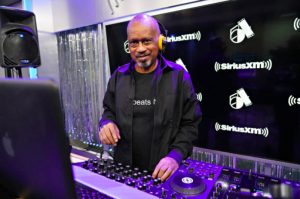
As the club music throbs with electronic beats and the harmonic patterns shift and change according to the desired BPM and the pleasures of the moment, master mixologist Tony Smith has made it his mission and life work — to celebrate the sound and experience.
In fact, the word to sum up Smith’s approach to life would have to be “effervescent.” Whether he is waxing enthusiastic about the vast array of music he has played from his collection or his extensive time working in New York’s club world, the seasoned professional is always bubbling over with excitement. Anchoring his world to the rest of us for the past seven years has been his Sirius X-M Satellite Radio show. It is digitally broadcast weekly, during which he honors much of what defines him through music.
Today, Tony’s one-hour show — “Classic Beats and Rhythms” on Channel 54 — generates an ardent following on Facebook and elsewhere. His fans and followers tune in every Thursday night at 9 pm (Eastern time) to hear, share and re-live some of the music he played with such skill and finesse during Disco’s golden years. [The show repeats each Monday, 2am Eastern.]
His sets can include tracks ranging from the history of R&B, music from New York’s hip hop community, Caribbean ethnic beats, blasts from the best of 1980s New Wave and on through the history of music. Each show represents the latest public culmination of the joie d’vivre that runs through Tony’s entire personal timeline, through all life’s his ups and downs.
Tony Smith has seen it all as far the club scene goes. He’s known around the world for helping Disco music become a global force. He spun records virtually unheard before he played them in such Manhattan hotspots as Xenon and Funhouse, helping them become true hits. Tony even played the opening night of the Palladium with John “Jellybean” Benitez. The late lamented mega-club is now the site of a massive NYU dorm. During the heyday of dance music (Disco was only one subset) and well before the Internet, social media and digital socializing, Tony was on the scene … creating memorable and moving mixes that kept happy dancers out on the floor.
This wouldn’t have been so, however, if Tony hadn’t listened to his heart instead of doing what was “expected” by his parents and his community. Instead of graduating from college and getting a master’s degree like his siblings, he Discovered his passion for music early on in life. By age 15, he had formed his own band. By 19, he was a professional Club DJ. In 1976, Tony was cited by Billboard as one of the Top 10 DJs in the country.
Tony has also been a successful music producer, creating and remixing songs as “Tony’s Soulbeats” with many famous artists from their own musical worlds. He’s also held DJ Guest Spots throughout the globe having played for diverse crowds in London, Paris and across the USA.
During a fine dinner at Ruth’s Chris Steakhouse, Smith smiled and said with a chuckle, “I guess you could say I’ve always been following my own beat….”
Then he added, “I remember from high school, that famous Robert Frost poem, ‘The Road Not Taken.’ I think of it now as I look back on decades of following the road my heart always seems to have desired instead of the path I was expected to take. Just as Frost wrote about two roads diverging in a wood, my taking the one less traveled by – following my own beat along the way – has made all the difference in my life and for my happiness.”
Tony grew up in Manhattan’s Lower East Side, a block away from Chinatown, and was widely “expected” to graduate from college. “My father had left home the year I was born and I was the “baby” in the family of Elaine Smith, a fiercely hard-working single mom, and three much older siblings — two sisters and a brother. Everyone helped to parent me while each of them — Carolyn, James and Antoinette — earned their master’s degrees. It was understood that, of course, so would I.”
But early on, the signs were there that Tony’s life would be different, based around music, notwithstanding a couple of detours. Tony recalls a story his family often told about him. He was just an infant at the time.
“On this particular day everyone was dancing to music while I was lying on my sister’s bed. It must have been clear that their movements were joyful and fun, since I felt compelled to find a way to join.
“Even though I couldn’t yet stand on my own — let alone walk — my family still talks about my unfortunate interaction with a rickety wooden desk next to the bed. I was too young to remember it now, but evidently the desk was low enough that – despite my tiny stature — I could shakily ‘stand’ on the floor by reaching up my arms and hanging on to its top for support.
“I was just a happy kid wanting to dance along with his family. A happy kid of about 10 months old, that is, until the table toppled over. The heavy manual typewriter resting on it clunked me right in the head. My mother fainted and my sister rushed me to the hospital immediately! Fortunately, all ended well — and here I am today.
“That was my first attempt at dancing, and I’ve been dancing ever since. My brother James was the amateur videographer of the family. It seems that whenever he caught me on camera as a boy, there I was – dancing — even sometimes, at embarrassing moments: still dancing!”
“When I was six, I moved along with my brother’s favorites —Olatunji’s ‘Jin-Go-Lo-Ba (Drums of Passion)’. With music always in the air, it now seems inevitable that I began using my allowance to amass a giant collection of 45 RPM records.”
Music perpetually wafted through the air of the household. Tony’s mother listened to gospel, James played congas, Carolyn was a soprano and Antoinette was a tenor. “My sisters formed a group modeled after the Chiffons or The Ronettes, calling themselves ‘The Debonaires’. While Ma was out working at a factory hand-crafting jewelry, she insisted on knowing that her kids were safe at home. So instead of visiting friends, my sisters invited people come over to sing. I was eight when I sang along with my sisters to Frankie Lymon and the Teenagers’ ‘Why Do Fools Fall in Love’.
“By my first year of high school, I’d learned to play guitar. I was 15 when I started my own band with some friends. At first, we were five; then we became ‘The Soul Sound Explosion’. Eventually, we won some talent contests and began accepting paying gigs. We never made much money nor did we become the next Kool and the Gang, but I loved it.”
The experience proved to Tony he could, in fact, both earn money and have fun by making music. That was the defining notion that liberated him from some societal conventions. “Something life-shaping came from that experience. When our band would take breaks — and since I was the guy with all the records — I’d play music to keep the crowd happy. I didn’t fully realize it yet, but I was learning how to DJ.”
By the time he was 16, Tony was playing records for free in the park. “I’d plug into a lamppost to get free electricity and loved watching people dance to my selections. Every day was different, with still more new music coming out. My passion — along with loving movies — had become playing music in the park for people to dance to.”
After graduating high school at age 17 in 1972 – and despite being as addicted to music as Tony had become – his attendance at college was automatically assumed. “I succumbed to my family’s expectations. But although I’d imagined going to Brown in Rhode Island, I chose Fordham in the Bronx for one reason only: so I could remain close to the evolving music scene of New York City. “There I was with lots of music,” Tony enthused as he remembered those early years of Disco. “As deeply drawn as I was to the new music scene, it wasn’t easy to explain it to my mother when I gave her the bad news — that I’d be dropping out of college to become a full-time DJ. Ma was worried about my security and future without a college degree, but I couldn’t care less. I simply had faith: music would take me wherever I needed to be. Music was my rush!”
At about that time, Tony discovered Greenwich Village — filled with dance clubs of multiple persuasions … gay, straight, black, white. As Tony added, “You name it, I was checking them out! I’d listen from the sidewalk without even having to enter — the music inside was that loud!”
As technology evolved, DJs went from simply playing one song after another to mixing the two together into a single, continuous stream — sometimes seamlessly and, at other times, altering course in order to surprise.
Many DJs today just show up for a gig with pre-recorded music on an iPod or thumb drive. They simply push a button and the music unrolls by itself.
“That is definitely not my way,” Tony emphasized. “I like to ‘read’ the crowd – adjusting my choices on the fly as I observe reactions to the different selections I put out there. My goal is to keep people happily dancing and getting thirsty, which bartenders and owners love! When you learn to DJ well, you are truly in charge of the night, directly affecting the mood of the crowd. You can make the entire evening of music feel like your own, single performance.”
Disco was just taking root in the culture. This new musical genre emerged out of jazz, R&B and classical, stealing heat from rock which had enjoyed such an influence during the ‘60s and on. “Disco” — the Americanization of the French word Discothèque, which meant record library — was also the term for the European dance clubs that served as havens for danceable rock.
By 1972, the newest sounds of Disco were not being heard on the radio but in dance clubs, where DJs chose what the crowd would experience. No one could hear the complete version of Eddie Kendricks’ “Girl You Need a Change of Mind” on radio stations. Those DJs were only allowed to broadcast the three-minute “radio version.” But the DJ in a Disco could play the full 7:33-length original and better yet, watch the crowd dancing to it. Discos were becoming launch pads for this new form of music, soon leading people to buy them at record stores. DJs were taste-makers. New York was their hub, but cities like Boston, Miami, Philadelphia, Montreal, San Francisco, Los Angeles and Washington D.C. followed NYC’s lead.
Rolling Stone magazine’s Vince Aletti wrote the first report on Disco in 1973. He also wrote a weekly column about this new form of music for Record World in which he often reported on Tony Smith’s latest playlists. Many of those were later captured in Vince’s book, THE DISCO FILES 1973-78. By 1974, the new form of music had become such a “thing” that WPIX-FM launched the first Disco radio show where, for example, you could hear the full length version of Barry White’s ‘Can’t Get Enough’.
I recently joined Tony and Vince at a theatrical event for Broadway Cares – Equity Fights AIDS, one of the nation’s leading industry-based HIV/AIDS fundraising and grant-making organizations. During the intermission they talked – of course – about music … a core connection among these longtime friends.
Before achieving his status today in music history, however, and acclaim from movers and shakers like Vince, Tony had held boring low-level jobs. He was a clerk typist at a plumbing company and a library page at the Municipal Building library to support what is now vast accumulation of music. “Back then, Warren Brown, my only gay friend at the time, told me about The Village Voice — a weekly newspaper with pages and pages of print ads. There was a want ad for a DJ at Barefoot Boy — a gay club that hadn’t even opened yet. Warren felt I should audition — an idea I thought was ludicrous. I was just a black kid from The Projects. But he pressured and motivated me into giving it a shot. “So I packed up a crate of music — heavy crates of vinyl 33 and 45 rpm records — and jumped into a taxi to 39th St and Second Ave. Along the way I realized that the name I’d been born with — Harvey — simply didn’t seem cool. In 1950, there’d been that Jimmy Stewart movie, ‘Harvey’, with a tall, invisible rabbit. The title character’s name wasn’t exactly sexy in 1975. So during the cab ride to my first audition, I renamed myself, Tony — inspired by my sister’s nickname, ‘Toy’.
“I can still picture the club manager who pointed to the DJ booth and the ladder I needed to climb to get there. Up I went, scared out of my mind — with a new turntable I’d never worked with: no pre-set playing speeds. It was up to me to adjust the speed with each song and vibe I wanted. Even as I studied the mysterious equipment, I was faking a sense of confidence. ‘It’ll take me a few minutes,’ I said. ‘I’m just getting my records ready!’ “I don’t remember what I played. Surely, some Gloria Gaynor. One thing I’d begun to realize was the way that different types of crowds have different musical tastes. Gays, as I already knew, had a weakness for female artists and songs with lots of melody – like ‘Never Can Say Goodbye’. James Brown’s ‘Give It Up, Turn It Loose’ would not have cut it with that crowd.”
Whatever Tony did, it worked. “The manager said, ‘You’ve got the job, – 25 dollars a night, seven nights a week.’ The first thing I thought was, ‘YES! I can buy more records!’” (Disco DJ’s didn’t start getting free music from the Labels until 1975.)
“The club succeeded, to put it mildly. Next thing I knew, DJs who were my idols were coming to hear me – David Mancuso, Nicky Siano, Richie Kaczor and Steve D’Acquisto. Barefoot Boy was packed every night. By 1976, Billboard magazine had named me one of the Top 10 DJ’s in the country.
“I will always consider 1976 one of the best years for music in my lifetime and, certainly, for Disco. By now there were at least 400 Discos in the City! I was being courted by promoters like Ray Caviano Issy Sanchez, Billy Smith and Curtis Urbina. They gave me all the free music I could handle. The gold and silver record awards, hanging now on my walls, hale from that special era. I had become very well-known and was hired for guest spots at other clubs and private parties. Disco was a major force and DJ’s like me were no longer paid cash off the books.”
Studio 54 had opened and a major new and well-funded competitor, Xenon, was looking for a DJ. Barefoot Boy had only 200 people on the dance floor, but Xenon was aiming for 700 or more. There was a lot at stake for its management to make the right choice. “Each of us — there were seven DJ candidates — had one week to show our stuff. As was true for Studio 54, white DJs would get the chance to try out first, something I understood and accepted at the time. But I could tell from my visits that the DJs auditioning before me were playing gay music for a straight crowd. While those colleagues were good at their craft, I saw that they were clearing the dance floor — playing sounds that they personally enjoyed, instead of taking their cues from the crowd. We’re talking about two different musical planets.
“When it was my turn to play, I avoided new songs or personal preferences. I had one goal in mind: keep people on the floor and make the management give me the job. I concentrated on playing popular songs and was hired.”
Xenon and Studio 54 had become the 900-pound “gorillas” of the business — spacious former theaters with lots of room for dancers. Popularity came from word of mouth; there were no big advertising campaigns back then. After one year at Xenon, it seemed that everyone knew: Tony Smith was its resident DJ. “After I got the crowd ‘trained’ — and they knew I was paying attention, keeping their pleasure in mind – I was able to introduce them to new songs that other clubs weren’t playing. I could intersperse my personal ‘finds’ with tried and true hits I knew they would love.
“I’m an extrovert and a natural-born entertainer. My booth was often open and I’d step out onto the floor with the crowd. Famous people stopped by — actors like Richard Dreyfus and Farrah Fawcett; singers like Neil Diamond and Stevie Wonder; athletes like Reggie Jackson and even NYC’s Mayor Koch.
“I got local press coverage as a ‘celebrity DJ.’ The New York Post, for example, did a story about me in 1978 (‘The Men and Their Music’.) It paired me with Bill Lombardo, nephew of Guy Lombardo of New Year’s Eve ‘Auld Lang Syne’ fame. We were paired as two separate musical planets, each with a deep commitment to the music projects we led.”
In 1979, although Disco was still very big, the rock faction of music — bitter that a different style of music had replaced them — started the “Disco Sucks” campaign. It did have some impact, but New York City mostly remained strong.
After Xenon came Magique — an East Side club that mostly appealed to what Manhattanites call the “bridge and tunnel” crowd from other boroughs. This crowd had a narrow taste range wanting to hear the same song, like Laura Brannigan’s “Gloria”, two or three times a night. “Frankly, that got boring and after a long get-away vacation to Mexico, it was clear that Magique wanted more of a ‘formula’ DJ, so we parted ways.”
By 1982, music was moving toward the “new wave” sound of such tunes as “I Ran” by Flock of Seagulls. “Music was evolving. I enjoyed playing songs like The Talking Heads’ ‘Once in a Lifetime’ so I moved to The Palace — a new club with a new wave flavor. Rock was interspersed with Disco for its diverse crowd. I was there for a year, having a ball. I love learning and now I was gaining the experience of playing different sounds for yet another kind of crowd. Every once in a while, I would go to the Fun House where Jellybean Benitez was playing. Sometimes he’d sneak out for his dates with Madonna and I’d play in his stead. Neither management nor the audience knew the difference.
“The crowd was mostly teenaged kids and when Jellybean left to focus on music production, he talked them into hiring me. I continued to observe the differences between one clientele or another including those in a lesbian bar, Network, and another one, Garbo’s. For me, it’s always fun to play for new audiences by studying people’s responses.
“When House music became big, however — check ‘Move Your Body’ by Marshall Jefferson — audiences wanted (just as the lyrics say) ‘house music all night long.’ The same steady beats and not much melody. Sorry: I like variety but ‘house heads’ just wanted house.”
As a result, Tony turned to his other passion, movies. He went to technical school to learn how to repair VCRs, since video cassettes had become huge. “Eventually I became, I was told, the first black owner of a Manhattan video store. Friends in the music business (then and now) – Danny Krivit, Claudia Cuseta, Bobby Shaw – kept me in touch with the latest music.
“The store was successful for a decade (1989-1999) but by the time my lease was up, my beloved mother had suffered a stroke along with other serious health issues. I moved back into her apartment and became a full-time caretaker — the least I could do for the woman who had worked so hard and sacrificed so much. During some of those years, I kept myself in the game by DJ’ing on weekends at the Union Square Lounge in Manhattan.”
Elaine Smith passed away in 2007. Even though Tony had taken a decade-long hiatus in order to care for his mother, his passion for music still gnawed at him even though he had taken this decade-long hiatus. “I’m back to music full-time and loving it.” He proclaimed, “I’ve trademarked my brand — “Tony’s Soulbeats” — producing and remixing songs for artists like Kimberly Davis, Jason Walker and Shara Strand. I’m working with music icons in their fields like dance producer, Tony Moran; choral composer, Jim Papoulis and musician-composer, Paul Guzzone.
“And thanks to my old buddy, Jellybean, I have that Classic Disco show on Sirius XM radio — Channel 54, of course, like the famous Studio. Music remains at the center of my life. I’m still available for guest spots and private parties like those that have taken me to London and Paris, and back to New Jersey, Brooklyn and Manhattan.
“There’s nothing that compares to when I was spinning Disco music during the hot summers of NYC in the 70’s. New Disco music was released literally every day. You never knew what surprises were coming next. “From 1974 to 1980, I was spinning 5-7 days a week so I had plenty of hours to fill with music. I even enjoyed the nights when attendance was light. That gave me the chance to experiment with new music, to see what worked so I’d be ready when the club was packed. There were also certain songs that just sounded ‘summer-y’. I loved to DJ on those summer nights, getting screams from the crowd when I played just the right thing!”
Record label owner/partner Curtis Urbina, who’s known Tony for decades, considers him a rare talent. Urbina describes Tony’s work today on Sirius XM Radio as that of a Master Music Curator since he does so much to help people re-discover Disco hits from the past and bring new value to them. Adds Urbina, “If SONY, RCA or whomever were to hire Tony as a music curator, he could take their catalogue and create new playlists and song compilations that are currently not generating revenue but could. The guy has that much of an uncanny instinct for music.” So Tony Smith is still going strong, whether in person or on the radio. His Facebook fans eagerly await the new show preview he posts every Thursday afternoon.
Tony Smith’s top 10 deejayable tunes of all time, in no particular order:
Girl You Need A Change Of Mind – Eddie Kendricks
Love Is the Message – MFSB
Relight My Fire – Dan Hartman
Love Hangover – Diana Ross
Dreaming A Dream – Crown Heights Affair
Disco Party – The Trammps
Native New Yorker – Odyssey
Love In C Minor – Cerrone
I Feel Love – Donna Summer
Cherchez La Femme – Dr. Buzzard’s Savannah Band
Artists of all time:
Michael Jackson
Prince
Stevie Wonder
Aretha Franklin
Elvis
Madonna
Music Producers of all time:
Quincy Jones – the best
Gamble & Huff – Philly sound
Holland & Dozier – Motown Sound