
Too Fast to Live, Too Young to Die: Punk Graphics, 1976–1986
April 9th – August 18th, 2019
The Museum of Arts and Design
2 Columbus Circle
NY, NY 10019
(212) 299-7777
When he emerged on the scene in 1975 as Johnny Rotten, the lead singer of the Sex Pistols, John Lydon became the face of Punk Rock and a crucial game-changer. Through that band and as the founder/lead singer of post-punk’s Public Image Limited (PiL), he proved that his efforts were not only NOT a fluke but that he has been a serious creator who consciously and intentionally fashioned unique music with a profound and powerfully sense of style. Expressed through his look and attitude, Lydon’s visual finesse spawned oodles of imitative fashion statements and poses that shocked the culture and enshrined him in the rebels’ hall of fame (and the Rock Hall of Fame for that matter).
With the Pistols, he penned singles such as “Anarchy in the U.K.,” “God Save the Queen,” and “Holidays in the Sun” and caused a nationwide uproar; he was viewed as a figurehead for the burgeoning punk movement. Despite, or thanks to, their controversial lyrics and attitude, they defined a generation and are now regarded as one of the most influential acts in popular music history.
After they first disbanded, Lydon’s more experimental Public Image Ltd clearly proved that he was no one’s invention — as Sex Pistols late manager Malcom McLaren once claimed. After eight albums, a string of singles — “Public Image”, “Death Disco” and “Rise” — and personnel changes, the band went on hiatus in 1993, then reformed in 2009. In subsequent years, Lydon has hosted television shows in the UK, US, and Belgium, appeared on “I’m a Celebrity … Get Me Out of Here!” in the UK, promoted a brand of British butter in advertisements on TV, wrote two autobiographies (1993’s “Rotten: No Irish, No Blacks, No Dogs” and “Anger is an Energy” in 2014). He also did a solo album — 1997’s “Psycho’s Path” — and in 2005, released a compilation album, “The Best of British £1 Notes.”
In doing so, his followers and/or imitators created a whole look and feel that spread across England and the world finding its coefficient or competition in the burgeoning genre emerging in the States as well. For lack of 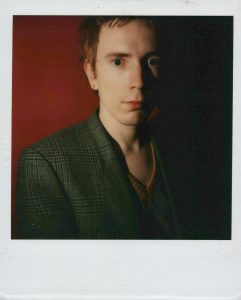 a better word, punk took hold and offer a reaction to all things mainstream, conventional, standard and etc.
Nearly 40 years ago, I found myself in Paris, another refugee from NYC seeking redemption or resurrection in the City of Lights. Under its sway, I joined the punk parade, then making its presence felt on the city’s hallowed streets and luckily attended whatever cool concert I could get into. That also included an appearance of Public Image Ltd in Le Palace, one that later became a live album. There I met Lydon, the band and captured them on SX-70 Polaroid [as you can see here]. Punk’s energy had coalesced into a powerful sub-cultural expression that transcended music affecting other fields, especially fashion, graphic design and photography.
More than 40 years after it exploded onto the New York and London music scenes, it still impacts on the larger culture. Now, at the Museum of Art and Design is a new exhibition, “Too Fast to Live, Too Young to Die: Punk Graphics, 1976-1986” which explores punk’s visual language through hundreds of its most memorable graphics, including shocking remixes of expropriated images and texts, to the DIY zines and flyers that challenged mainstream media’s commercial slickness. Organized by the Cranbrook Art Museum, Bloomfield Hills, Michigan, and curated by its Director, Andrew Blauvelt, the objects in this exhibition are mostly from the collection of Andrew Krivine.
Which leads to this aggressively amiable punk provocateur’s appearance at MAD — and when appropriately abbreviated, it perfectly serves as a place for the now portly punker as well as a place for modern hipsters to celebrate all things punk from band posters to album covers to photograp hs.
hs.
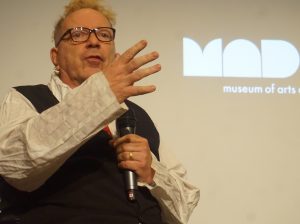
Introduced by MAD Director Chris Scoates, this 63-year old emperor of aggravation and aggression conducted an entertaining Q&A before an small set of journos — yours truly included. Thankfully, most of them were either too timid or terrified to challenge Mr. Lydon with piercing queries, leaving it to me to do the job and get a lot of voice time. What follows is much of that dialogue.
JL: ‘Ello, me name’s John. That’s a good place to begin. I’ve only seen one floor [of the show] because there’s been so many of you to talk to, I’ve almost run out of words. Hard to believe with me. I look at the posters and it’s a thrill to go back to that time. As the Pistols we really really really kept our artwork in house. That was not, not one separate talent outside of the band.
We formed the Pistols and from that day forward we spurred all this. None of this would be a movement if not for the Pistols, and you must never forget that, that’s an absolute fact. You would not be hearing of any other band here were it not for the fact that we spurred them on. Many of them got record deals before us but they watched us first. That’s alright, because like all movements there are going to be those people that want to be the first pop star through the door.
If I’m to accept [the moniker of] King of Punk, which I never would — thank you [English journalist/artist and fellow punker] Caroline Coon — no, that’s not a nice title. I mean, here I am, mocking the royal family, and I’m calling myself a king. There’s a duality in it. The point is I never did this for money and none of us ever did. We never thought it would ever work. Telling the truth was a really novel idea at the time. The closest I could think of [who was] telling the truth at the time was John Lennon, Working Class Hero. Things like that. The Kinks, I love Ray Davies’ writing. For me the written word is an absolute must, it’s the most important. The voice is the first instrument, that’s what hooks you in, that’s the story. We can all have lead guitar solos up the wazoo, but if there isn’t a word in there I don’t want it, and that is the word. So anyone got a question?
Q: What’s the difference in aesthetic between the stuff from the UK and the stuff from New York?
JL: What I’m doing, and always have done, is represent my culture. Where I come from, the society I grew up in, and all the anxieties that entails. It’s a very serious culture, the British one. It’s a class culture, a class divide. If you were born on the poorer side of town you’re trash from here on in, you don’t really stand a chance any way of climbing up the social ladder, no matter how firmly you educate yourself. The Pistols did quite a lot there. Some of them words changed people’s attitudes, opened doors.
You [have to] realize, it was dangerous times to be openly seen as insulting the concept of the monarchy. That was pure treason and I following that with “Anarchy in the UK.” It’s a song that’s done holds a sense of truth, but it’s done with a sense of humor. It’s musical in our way, it’s not openly violent, aggressive, and hateful. That’s never gonna wash because it causes division. You want to unite people and humor is the way to do it. The savagery and the content is there, but you must be able to laugh with it, not against it.
Q: Do you think that shows up more in the British artwork, but not so much the New York stuff?
JL: A lot of content holds relevance to the social situations going on around. You just got over Vietnam, I was expecting more out from the New york scene. What you got really was manufactured bands featuring Beatle wigs and matching leather jackets, just to pick one of the bunch. But which one was that? Sounds like a lot of them. The New York Dolls were great fun, but we had glam rock in England. Look at the musical background I had, my influences. The Kinks, the Stones had three or four good songs, The Who, all of that, and the audacity of those bands too. They challenged the norms. That’s Britain, that’s what we are. We’re a youth culture by nature. We’re always coming from the youth upwards.
Q: How were you involved with the graphics?
JL: Right up until that “Rock ‘n’ Roll Swindle” crap because that’s where I drew the line. It was nonsense and bollocks really going the wrong way. That was small testicles. That was Malcolm fiddling around in there. There was a great deal of jealousy from Malcolm. I don’t want to sound like a knocking shop, I’m not trying to knock him, but he really resented me for being the singer. He thought it was good for a laugh to have someone wearing a “I hate Pink Floyd” t shirt, something vacuous and inoffensive as that, but he couldn’t take it when he [heard] the full content of the songs. So he started taking singing lessons. That wasn’t gonna work.
We fell apart on the American tour as you well imagine; the management was appalling. It was setup in such a way to dissipate our energy and keep up separate. It never should have ended that dismally, but it did. In time I realized that was a really healthy thing because I got to start PiL, which was where I got into a more serious side of my life and analyzed myself and criticized myself rather than just institutions which is just what the Pistols did.
Q: You did some things that were so piss-taking with PiL like that “performance” at the Roxy In New York in 1980 or ’81.
JL: That wasn’t piss taking, that was humor. Music Hall will always be part of our culture, we’re not deadpan intellectuals.
Q: PiL was great because it had that humor.
JL: You’ve got to. Sometimes things go horribly wrong on stage and don’t run ever. Stand up, take it, and make it part of it, because indeed it is. As they say in anything, the journey is part of the adventure, not just getting to where you’re going.
That reminds me of something somebody asked me earlier, because there’s been this nonsense that The Ramones influenced the Pistols. Here’s the difference between The Ramones and the Pistols. What did The Ramones do? They go to Phil Spector and The Wall of Sound, which is muffled, nothing really clear, there’s no real intent in the lyrics. It’s all rather meandering and muffled. Sex Pistols, we go for Roxy Music’s sound, please. Every single note, word, fart, inflection, hiccup, and yawn being picked up completely clear. Clarity, there it is.
Q: But since we’re here to address this show, what were you a part of in terms of the graphics?
JL: Art is one of the things [I was interested in] when I was young. But I [became seriously ill] so that put me in a coma and I had a year in hospital. And the only thing that brought me really around to being a civilized human being was the local library. Not the Catholic school, they were into torture because I was left handed and the Nuns said that’s a sign of the devil. At the library I learned to draw and paint and to re-write and read. That was really important to me and I’ve always said all my life that the best education is completely free, it’s there, it’s called a library. Use it. Just unravel yourself in other people’s thoughts. It’s a wonderful thing to do because you find your vision in that. Well except for half the modern wankers out there that all want to be Hemingway, or a lot of the New York lot that you see cross legged on a Persian carpet with a book of poetry, the thinking lot.
When I first came to New York I couldn’t believe it. I was expecting a vibrant music scene. That’s not what I got. Got to remind you there was no internet then yet, no computers to help you make art work or anything really. It all had to be done by hand. Drawn, stenciled, planned, painted, printed. The same with hearing what New York bands were because there was no way of transferring music across the ocean. So everything was guesswork and second hand gossip. I’ll never listen to gossip ever again.
Q: You have created a bit of the gossip yourself.
JL: I can’t help that, can I? I was born with two left shoes and trouble just seems to attract me. It’s no deliberate intent on my part. I’m glad for it because I think it makes me a better person. It’d just be awkward, it really is fun.
Q: What happened after the disaster of the the Pistols America tour; did you go to New York after?
JL: No, I was stuck in San Francisco for a while and I had no money. Malcolm buggered off after all that and the band, and left me there on me own. It was [NME photographer] Joe Stevens, who was a friend of Malcolm’s, that raised the money to get me to New York and I stayed at his place; that’s how I found out what the New York scene was.
When we first came to tour America we avoided the North completely. We wanted the South, and all its apparent ugliness and [thought] it’d be wonderful. We played the maddest places, like Gilley’s [Club in Texas]. Real rodeo hangouts with tough old cowboys and us sexy young Pistols and the t-shirts we had on. One of the Burning Roads/Malcolm combination of things I thought was hilarious was the two cowboys with their pants down and their willies touching. How’d you think that went down in Texas? That sense of devil-may-care fun, that’s important to do and challenging but at the same time it’s deeply humorous and not meant to hurt.
Q: How did your Irish background — having both parents from — affect your being an outlier?
JL: The Irish are famous for their storytelling but also telling the truth in the most audacious and fun way. I can’t help it, it’s in my blood. The way of communicating, this is before the days of TV — can you imagine that, any of you? This is how far back this stuff goes. You sit around and you start telling stories. Ghost stories, any kind of stories. Then there would come a true story and that would be the one you paid the most attention to because it would tell you something about yourself and the surroundings you’re in, and I’ve never forgotten them. It’s very, very important and I love the Irish for that. It’s [also about] being brought up in England because the Irish weren’t accepted. The Irish won’t accept you ‘cause you’re seen as English and the English won’t accept you ‘cause you’re seen as Irish, so you bugger off and live in California, and I’m not happy about that.
I’m all three things at once. If I had my way I’d live in every country all around the world and keep traveling. The gypsy in me is a vital part of me. I get bored with the overly familiar, and that’s been my approach to music and artwork and film making and anything you involve me with. I don’t like it completely perfectly finished, I like frayed edges.
As the manufacturers of Persian carpets will tell you — the fine fellows they are — they’ll tell you that they use [that] as their guide, but there’s more to it than that. I say there should never be any such thing as a perfect carpet. Always leave one knot undone, because it leaves space for other human beings to improve on. It’s the most generous thing you can do. Sometimes that generosity backfires, [but I have] a sense of humor.
MADactivates: Series Related to this Exhibition
Global Punk
April 25, 2019 to July 11, 2019
In conjunction with the exhibition Too Fast to Live, Too Young to Die: Punk Graphics, 1976–1986, the Museum of Arts and Design showcases films centered on punk’s global influence.
MADactivates: Events Related to this Exhibition
Rock Against Racism at 40
Thursday, May 2, 2019 – 6:30 pm
Marking the 40th anniversary of the concert in Central Park, NYU’s Colloquium for Unpopular Culture and MAD present a multi-media talk about punk activism.
American Punk Graphics: Glenn Cummings, Steven Heller, and Andrew Blauvelt
Thursday, May 9, 2019 – 6:30 pm
Presented with AIGA NY, a discussion of the lasting impact of punk graphic arts on American design.
Punk: Crashing into Being
Saturday, May 11, 2019 – 2:00 pm
Selections from the archive of underground documentarian Beth Lasch, featuring never before seen interviews, images, and performance footage of Iggy Pop, Joe Strummer and more
Person Place Thing featuring Chip Kidd
Thursday, June 20, 2019 – 6:30 pm
Person Place Thing host Randy Cohen interviews the award-winning graphic designer, writer, and punk graphics fan in a live broadcast from MAD.