

“Cold Pursuit”
Director: Hans Petter Moland
Cast: Liam Neeson, Laura Dern, Emmy Rossum, William Forsythe, Tom Bateman, Tom Jackson, Domenick Lombardozzi, Julia Jones, John Doman
Once again Belfast born-and-bred Liam Neeson kicks ass in “Cold Pursuit” — a stylish and spare American revenge fantasy feature directed by Hans Petter Moland from a screenplay by Frank Baldwin. A remake of “In Order of Disappearance,” Moland’s 2014 Norwegian film, it had the earmarks of being a success in Neeson’s string of revenge fantasies. Up to this point, the film had received generally positive reviews from critics, garnering praise for its dark humor as well as the performances, and was thought to be as good as or even better than the original .
Just as Nels Coxman’s (Neeson) quiet snowplow-driver life in a glitzy Rocky Mountains resort — where he was just awarded Citizen of the Year — is disrupted when his beloved son is murdered by local drug dealers who mistakenly think he’s stolen their stash. Coxman’s search for the cause turns into a quest for revenge against Viking, a psychotic drug lord. Using his hunting skills, he transforms into a cold-blooded vigilante from being an upstanding citizen. When Coxman starts dismantling the cartel, he triggers a turf war between Viking and a rival dealer. Though a top-flight cast — Laura Dern, Emmy Rossum, William Forsythe, and Tom Bateman among others — provides some extra twists, it’s really all on Neeson’s shoulders to propel the action as he relentlessly kills the men who’ve done him wrong. As bodies pile up in a sparse, shocking way, so does the director’s mise-on-scene tricks. Worthy as a night’s distraction, this film offers an outlet to vent some anger.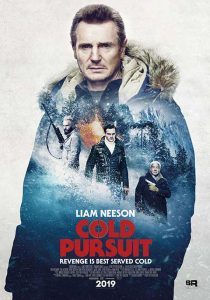
It would have had a simple rollout but, not unlike the storm of snow shooting out of the snowplow, the shit hit the fan when the 66-year old seasoned actor got a little too candid in an interview with The Independent newspaper and revealed a personal story after being asked about how his film character turned to such anger. He recalled that many years ago, when he returned home from a trip, he heard from a friend who had been sexually attacked. Neeson told the paper, as seen in a published excerpt from the audio:. “She handled the situation of the rape in the most extraordinary way. But my immediate reaction was… did she know who it was? No. What color were they? She said it was a black person.”
So, he added, “I went up and down areas with a cosh [crowbar], hoping I’d be approached by somebody. I’m ashamed to say that, and I did it for maybe a week — hoping some [Neeson gestured air quotes with his fingers, according to the Independent] ‘black bastard’ would come out of a pub and have a go at me about something, you know? So that I could kill him.”
Suffice to say, this all went viral and the actor caught hell. On Tuesday he told “GMA’s” Robin Roberts that “It really shocked me, this primal urge I had. It shocked me and it hurt me,” Neeson said. “I did seek help. I went to a priest who heard my confession.The ‘Taken’ star said he power walking two hours a day and talking it out with two friends also helped him.”
Neeson explained to her that he grew up surrounded by violence during The Troubles in Northern Ireland which included terrorist attacks and bombings. But Roberts pushed back, pointing out that Neeson “asked about color. You didn’t ask if the person was tall or short, big or small. You immediately went to race.”
The actor conceded that, but said he did ask those other questions of his friend who has since died. He said he would have had the same reaction had his friend said her rapist was white. “If she had said an Irish, or a Scot, or a Brit or a Lithuanian I know I would have felt the same effect. I was trying to show honor, stand up for my dear friend in this terrible, medieval fashion.”
Roberts pointed out the pain some have felt over Neeson’s remarks and he said he hopes his comments help people to talk more openly about racism and bigotry. “Violence breeds violence,” he said. “Bigotry breeds bigotry.”
The blowback has been huge, maybe even career-crushing. Many used social media to condemn Neeson’s confession as an example of the kind of racism and profiling against black men that has been so rampant and the cause of many lynchings. His admission, troubling so many especially because of Neeson’s generalized profiling and targeting of black men for potential violence which had nothing to do with the alleged crime. Parts of the 66-year-old actor’s confession make wince, but for others — particularly in one insightful CNN editorial — said he display ample courage by speaking out honestly about racial fears and anxieties that plague global society. With brutal candor, this writer noted that Neeson told a story of personal redemption that detailed his personal shame in recalling the story of how — filled with anger, rage and a need for revenge — he went on a futile manhunt “hoping some ‘black bastard'” would randomly try to assault him.
Though he’s blown up as a mega star through the success of the action thriller series “Taken” (2008–2014), Neeson rose to prominence when he starred in Steven Spielberg’s Academy Award-winner “Schindler’s List (1993) — a film in which his character was able to well look beyond his fellow Nazis’ virulent profiling of Jews and saw the humanity in the Jewish people whom he later risked his own life to save. He has since starred in other successful films, including the title role in the 1996 biopic “Michael Collins,” the 1998 adaptation of Victor Hugo’s “Les Misérables,” the epic “Star Wars: Episode I – The Phantom Menace” from 1999, 2004’s biopic “Kinsey,” and the superhero film “Batman Begins.”
It’s painfully sad that an actor with such an extensive resume should have his career defined by this moment of brutal candor. Many who have reacted to his admission haven’t seen the film, but, if they had — given his character’s stark behavior — it might better explained why Neeson used such an extreme example to make clear how he could play someone so driven by such revenge. And given that he grew in a place where people killed in acts of revenge for reasons other than race, the virulent racism that motivated lynchings might not have been as present in Neeson’s mind when he sought to explain his character’s motivation. In honestly expressing his feelings, the kind of stupidity inherent in such racism came to fore; the ideas that Neeson cited deserve condemnation but not the actor himself.