
Preview by Brad Balfour, Arts Editor
Just before the first plane struck the World Trade Center I was sitting in my mom’s kitchen planning a plane trip back to NYC after my dad’s funeral. I was watching TV just before the first plane struck. Obviously I never took a flight that day but watched the tumult from afar. Nonetheless, the attack had the same profound effect one me as it did on the millions of New Yorkers and more.
To recall, at about 8:45 am., the first plane hit the North Tower between floors 93 and 99. Then, while everyone watched live, the second plane hit the South Tower between floors 77 and 75. Both collapsed within an hour and 42 minutes, destroying the remaining five structures in the complex. The air filled with acrid and downtown Manhattan was thrown into chaos.
The attacks killed 2,977 people, injured thousands, and gave rise to long-term health concerns while causing at least $10 billion in infrastructure and property damage. It remains the deadliest terrorist attack in history, as well as the deadliest incident for law enforcement and firefighters in America (including an overwhelming number of its Irish-American members).
One of the first memorials was the “Tribute in Light,” an installation of 88 searchlights at the footprints of the World Trade Center towers. Since more was necessary, the World Trade Center Site Memorial Competition was held in New York City to design an appropriate on-site memorial. The winner, “Reflecting Absence,” was selected in 2006. It consists of two reflecting pools in the footprints of the towers, surrounded by a list of the victims’ names in an underground space. On the 10th anniversary of the attacks in 2011, the memorial was completed and a museum also opened at the site in mid 2014.
Now 25 years later, The 9/11 Memorial and Museum is at the center of the 25th anniversary of the calamitous occurrence. Among the many events connected to this occasion will be the launch of “The Blue Sky Remembrance Wall “— a permanent digital memorial where people from around the world can share memories, reflections, and messages of remembrance.
This milestone prompted the notion that remembrance is not only about looking back — it’s about carrying forward the stories of those who were lost and those who survived. Recalling that day 25 years ago — which coincides with the USA’s 250th anniversary — now include honors for those killed, the first responders who rushed in to save others, and the acts of service and sacrifice which serve as an eternal inspiration.
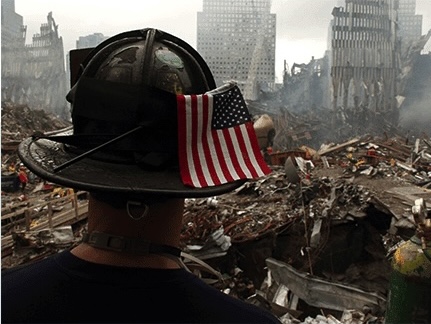
After September 11, 2001, American flags appeared everywhere — on firehouses, front porches, apartment windows, on embassies worldwide and pinned to rescue workers’ chests. In our darkest hour, Americans everywhere reached for the same symbol.
Now, the museum features a new installation, “Our Flag Was Still There,” which tells the stories of some of those flags — including the one raised above the wreckage at Ground Zero and another unfurled at the Pentagon in the aftermath of the attacks.
Additionally, people can sponsor a limited-edition “Never Forget” cobblestone on the 9/11 Memorial plaza for the 25th anniversary. These granite constructions line a sacred space, creating a permanent, personalized dedication on the digital map of the Memorial plaza — a tribute that stands alongside every visitor, community member and student who walks these grounds for generations to come.
As the 25th anniversary of 9/11 approaches, it invites all of us to reflect on the moments that have shaped this nation and the values that guide us all.
In addition, The Paley Museum (25 West 52 Street) will hold “9/11 Through the Media Lens: 25 Years Later” on Thursday, September 10, 2026 at 6:30 pm. In collaboration with the National 9/11 Memorial & Museum, it brings together a distinguished panel of journalists, historians, and photographers who covered the events firsthand, as well as those who later documented, analyzed, and reflected on that tragic day.
The conversation will explore their personal experiences and perspectives, how news was reported across media platforms in 2001, how reporting has evolved in the decades since, and why preserving these firsthand accounts and reflections remains essential to informing future generations. For tickets go to: https://www.paleycenter.org/
For more info, go to: https://www.911memorial.org/