
Review by Brad Balfour, Arts Editor
Film: Dog Stars
Director: Ridley Scott
Writer: Mark L. Smith
Cast: Jacob Elordi, Josh Brolin, Margaret Qualley, Allison Janney, Guy Pearce, Benedict Wong
Master filmmaker Ridley Scott likes big ideas and big characters, especially when they’re dealing with the fantastical and epic. He prefers the dramatic so his films like “Alien,” “Blade Runner,” “Gladiator,” or “The Martian” suit him. He started out as a visual designer before moving on to directing feature films which lends itself to making movies with strong graphic concepts.
Throughout his career, the 88-year-old has taken on huge challenges. When it was announced that his next film after “Gladiator 2” would be “Dog Stars,” the news prompted lots of curiosity. Based on Peter Heller’s soulful 2012 novel and set around Denver, Colorado 10 years in the future, it has contemplative moments and sweeping panoramas sandwiched between a few scenes of furious action. Not quite what’s expected in Scott’s sci-fi wheelhouse.
In this futuristic vision, a deadly virus has seemingly wiped out most of the earth’s population. But since much of the narrative takes place near the Front Mountain Range on the south side of Denver, we don’t know for sure. The deadly flu outbreak has seemingly decimated most of the communities in the cities with almost no contact in between. Many of those who survived are crippled by a debilitating blood disease resulting in an unstable dystopian world. In this brutal, post-apocalyptic landscape, the few who remain are forced to confront the harsh realities of a bleak future. They must struggle to make sense of their new reality, reinvent their lives, and preserve what remains of humanity.
And then there are the crazies. But more on that later.
Young civilian pilot Hig (Jacob Elordi) and military survivalist Bangley (Josh Brolin) have carved out an isolated but efficient homestead on a deserted little airport outside of Erie. While Bangley has no intention of leaving, Hig frequently flies off in a dilapidated Cessna with his beloved dog Jasper on scouting missions into the decimated city, searching for anyone uninfected. Occasionally he delivers supplies to a small isolated Mennonite community. On several occasions, Hig receives a mysterious radio transmission, so he ventures into the unknown in search of untainted humanity.
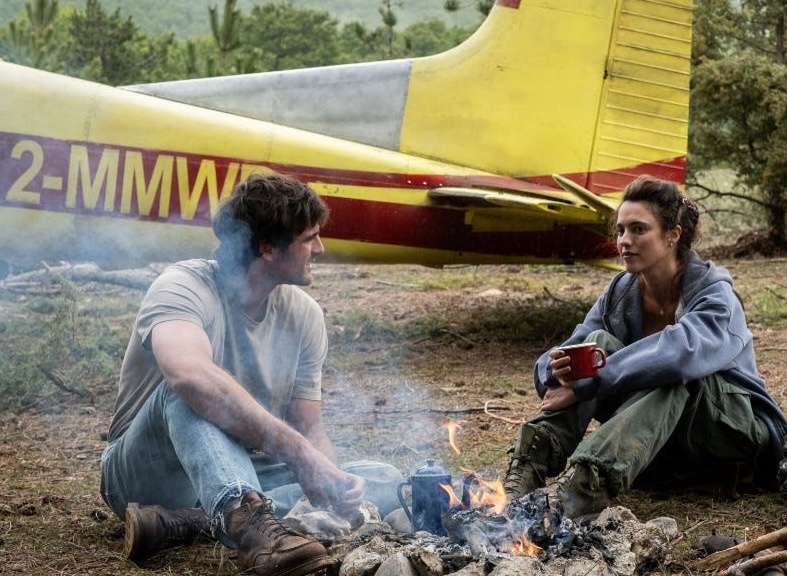
But with plane trouble, he’s unexpectedly forced to land. There he stumbles upon the isolated canyon home of Pops (Guy Pearce) and daughter Cima (Margaret Qualley.) Pops harbors a deep distrust of outsiders and guards his property with military fierceness, embodying a survival instinct stripped to its core. He’s wary, watchful, and unyielding — and regards Hig with suspicion. Cima, on the other hand, retains a sense of the hope that survival is worth it. She carries on without having lost her caring nature — one that had once drawn her to being a hospital intern before the pandemic. Having lost her husband to the outbreak, Cima offers Hig not just kindness, but the first genuine connection neither of them has felt in years.
Together, the duo helps Hig repair his plane. Unfortunately, they’re discovered by berserkers on horseback so they’re forced to flee. That leads to ever greater danger and craziness. Without revealing the details of one shocking set piece, they stop by a rehabilitated airport installation run by Allison Janney who is both the leader and a demented stewardess. In a fury, they escape one more crazed scenario.
What makes the film something more than just another grim post-apocalyptic thriller is its slower-pace and ambling storytelling — not typical of most dystopian ideations. Bolstered by the script’s relatively low word count, moments of reflection appear more in flashbacks rather than in conversation. Though not overtly contemplative, Scott gets his actors to reveal through motion and expression that it’s worth trying to survive if not to thrive. There’s an element of hopefulness imbued in the film’s proceedings. Occasionally, it veers into darker gothic turf. That doesn’t seem to be in the book but it’s there at least for cinematic enhancement if not for anything else.
Not having read the novel, I’m not sure how much of this directly comes from the novel or has been added to the narrative. Would large swathes of humanity form heavily tattooed death cults or become tribalistic killers? Does it make sense, as Bangley believes, that every intruder on his turf is a threat that only needs to be shot down and burned? Of course if they are armed, they need to be stopped. But has humanity become so desolate and desperate that it’s shoot first and ask questions later?
Thankfully, from these grim scenes of death and chaos, a more hopeful note emerges as the film concludes. This isn’t a future to be prettified. Fair enough. But that impulse also falls in line with the film’s rural eat-your-greens demeanor. Can’t something here thrive rather than just survive? There must be other cities not as devastated as the Denver we see. That gives the characters hope for the future and hope for the film as well.