
Review by Brad Balfour, Arts Editor
Film: “The Odyssey”
Director: Christopher Nolan
Cast: Matt Damon, Tom Holland, Anne Hathaway, Robert Pattinson, Lupita Nyong’o, Zendaya, Charlize Theron, Samantha Morton, Jon Bernthal, Bill Irwin, John Leguizamo, Mia Goth, Will Yun Lee, Corey Hawkins, Himesh Patel
At a time when heroics seem in short shrift — especially for certain leaders in power — director Christopher Nolan’s “The Odyssey” returns to theaters to remind us of what a real hero can be. Loaded with all kinds of notable actors, this expansive narrative is based on the famous epic poem by Homer — one of the classic pieces of literature most kids have to read in middle school (if they read at all). Being the classic that it is (something that’s interpreted by its translators anyhow), any cinematic version is subject to the writer/director’s vision. Over the years, as part of the many B-movie sword and toga classics, there is an image of what this film supposedly would look like. But in this case, given the British creator’s predilections, this version is grandiose, expansive and subject to his many narrative whims.
The film is comprised of numerous set pieces as it follows the general plot points of Homer’s epic. But given all the filters that this classic piece of literature flows through (especially when one has a complex knowledge of the world within which it was created), Nolan has ample room for interpretation. That ranges from casting Matt Damon as Odysseus to other idiosyncratic choices, like employing African-born actress Lupita Nyong’o in a dual role as Helen of Troy, Menelaus’s wife and the most beautiful woman in the world. Her abduction triggers the Trojan War. She’s also Clytemnestra, Helen’s sister and Agamemnon’s wife, whose marriage is acrimonious. Jon Bernthal plays Menelaus, the Greek king of Sparta, Helen’s husband, and Agamemnon’s brother.
Capable actor that she is, Nyong’o does the part justice in her limited time on screen. However, many on the conservative side of the political spectrum have accused Nolan of being overly woke in casting Nyong’o, rather than the typically blonde actress usually depicted as Helen. Some have even suggested he was told to be particularly diverse in this film. But given his reputation for doing things his way, that’s ridiculous and a grotesque allegation that can be easily dismissed. Of course, given Nolan’s impressively bullet-proof reputation in generating commercially successful epics, he has the freedom to do what he wants. No amount of pressure makes him do otherwise.
For example, the cast speaks American-inflected English, an unusual move since much of the cast is international with other accents. Two of his big-name actresses — 43-year-old Anne Hathaway as Odysseus’s wife Penelope and 50-year-old Charlize Theron as Calypso, a beautiful nymph who holds Odysseus as her lover under a spell for seven years — show their wrinkles in various close-ups.
Many of those who play his crew are odd choices for their divergent global backgrounds. And John Leguizamo might seem a strange call to be cast in the role of as Eumaeus, Odysseus’s faithful servant and blind swineherd. Unlikely as it might be, his performance has been considered so exemplary that there’s talk of awards for him. Also unpredictable is casting Zendaya as the Goddess Athena, Odysseus’s supposed protector. I could go on but there’s so much more to this film than just its casting. Nolan transforms the epic from being a dynamic between gods and men to more of an action adventure grappling with the consequences of war and its impact on leadership.
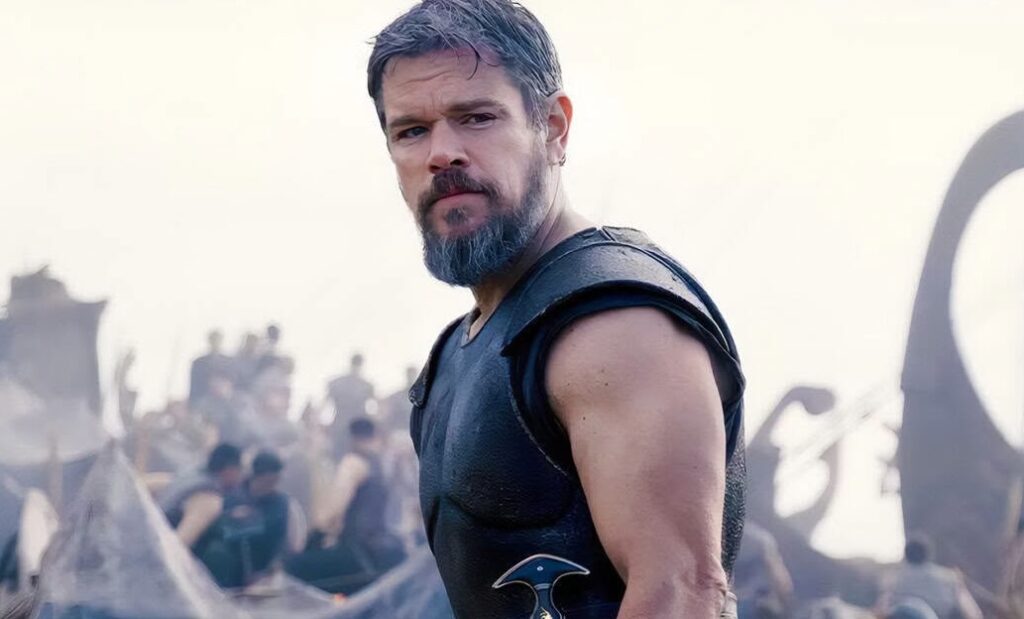
Odysseus leaves his family and kingdom to join the fight against Troy which has sullied itself by allowing Paris to take Helen away from her husband. Once Odysseus devises the Trojan Horse ploy to conquer the well-fortified city state, Troy falls so he can lead himself and his men back to Ithaca. Powering Damon’s performance is the underlying guilt his character feels in unleashing the brutal Greeks who wreak havoc upon the Trojans who are savagely raped and slaughtered. As an actor who can handle being both an action hero and the sensitive everyman (witness his work in the Bourne series), he rewarded Nolan with a fine performance that included archery skills as well.
As Odysseus leads his men through many threats and dangers, he fights for their lives and for his homecoming. They face many celestially spurred dangers whether it be the Cyclops (effectively portrayed by Bill Irwin) or the excellent Circe (Samantha Morton) who transforms men into pigs. Some of these scenes are better executed than others but nonetheless, the IMAX-enhanced filmic episodes has enough to satisfy any audience. Witness the raging battle between Odysseus’s crew and the Titans clad in futuristic armor which powerfully imposes itself on viewers. But since he and his men have offended various gods along the way all but Odysseus are ultimately wiped out. Now more than 20 years away after leaving to fight with Agamemnon against Troy, he makes it home alone.
Once home, the film coheres around the revelation of Odysseus’s reappearance. These scenes involve his proving who he is and defeating all the wretched suitors contending for the hand of his long-suffering wife, Penelope. Long believed to be dead, these nasty guys (including a particularly annoying Robert Pattinson as Antinous, who has been described as sleazy) hope that by marrying her, they can sit atop the throne of Ithaca. Though Penelope’s hope wavers, her son Telemachus (Tom Holland) has always believed he will return.
Return he does and once the ensuing chaos and fight subsides, the family is intact again. But rather than ascend to the throne of Ithaca, the restored king sails off into the west with his queen to create a new life with her leaving his son to take over the reins (or reign).
With “The Odyssey,” Nolan again looks to the past as a way to set the future in motion. Through his mega-hit “Oppenheimer,” Nolan peered into the origins of the atomic bomb through the eyes of his protagonist J. Robert Oppenheimer (Cillian Murphy). As he investigated the scientist’s past, he brought the story forward to his protagonist’s ultimate disenfranchisement and sort of liberation. In a not too dissimilar way, “The Odyssey” explores a man whose role as the creator of the Trojan horse leads him to suffer from the guilt from the consequences of what he has created. So Nolan builds from the past a character who seeks redemption. Once Odysseus gets home, he finds resolution and so does the audience as well.
In both films, Nolan explores a mythic past, but this time one that’s not necessarily based in fact. This gave him the latitude to create a sweeping action epic shot across six countries using brand-new IMAX® film technology. Nolan applies his cinematic powers to bring Homer’s seemingly impossible-to-adapt 2,800-year-old tale to life in a way that somehow feels contemporary and grounded.
The writer-director’s star-stuffed cast and Herculean production make the film feel like a throwback to Hollywood’s mid-century grandeur — with pre-digitally generated effects. Nolan delivers one fantastical set piece after another to test Damon’s Odysseus and us, while keeping audiences equally compelled through the palace intrigue in Ithaca. When the two storylines converge, Nolan throws aside the his usually cerebral machinations and instead satisfies audiences with old-fashioned bloodlust and romance through a gaggle of Grade-A talent. Most filmmakers don’t make them like this anymore. And Nolan’s no avant-gardist; he’s really old Hollywood in contemporary form.