
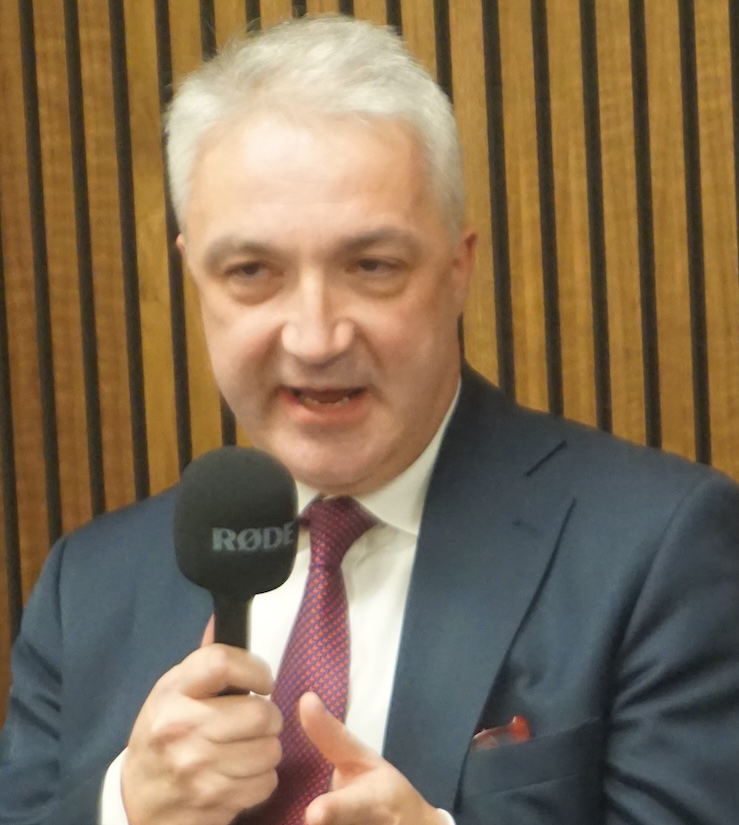
Feature Story by Brad Balfour, Arts Editor
When Gerald Angley attended a monthly Irish Business Organization meeting earlier this year, he outlined his experiences and goals for his tenure as the new Consul General of Ireland in New York. He had recently started his time in the city because Ireland rotates the staff of its diplomatic missions here and elsewhere every few years.
To do so, the Bank of Ireland’s US Country Manager, Tony Dunne, conducted a fireside chat with Angley before an audience that included IBO’s executive board and many others in the packed room at Bank of Ireland offices in Midtown.
According to his official bio, Angley has completed foreign postings in London (2017-2021) as Deputy Ambassador and Political Counsellor), Paris (2006-2011) as Economic, EU and Trade Counsellor and later as Deputy Ambassador in (2013/2014) and Brussels (2000-2004) as the Permanent Representation of Ireland to the European Union.
He also has served in a range of positions in Dublin, including most recently as Counsellor (International Relations) on “secondment” to Ireland’s Ministry of Finance (Treasury) from 2022-2025. Prior to that, he was Chief of Protocol at the Department of Foreign Affairs and Trade. From 2014 to 2017, Angley was Director (British-Irish Relations). And as Director (North America), he worked closely with the Consulate in New York. Earlier assignments included the Protocol, European Union and Consular Divisions of the Department of Foreign Affairs and Trade. In addition to his roles in the Department of Foreign Affairs and Trade, Angley has also served in several ways at the Department of the Taoiseach (Prime Minister’s office), including as Director (Policy Communications) for Ireland’s Presidency of the Council of the European Union in 2013.
After an initial period working in banking and insurance, Angley joined Ireland’s Department of Foreign Affairs in 1999 including with Citibank NA in Dublin.
This was posted on the official Consulate website: “I moved here from Ireland in late August 2025 for my fourth diplomatic posting after previous assignments at the European Union in Brussels, in Paris and most recently as Deputy Ambassador to the United Kingdom. Prior to joining Ireland’s diplomatic service in 1999, I worked in banking and insurance following completion of a business degree at University College Dublin.
“It’s an enormous privilege to represent Ireland in what is easily one of the most Irish corners on this planet –- a home away from home that I plan to get to know very well indeed! I, myself, was born in Dublin to parents both from Munster, with my main roots in Tipperary and Cork. I also spend a lot of time in the West of Ireland.
I look forward to getting out and about and to having the opportunity to meet as many of you as possible during my term.”
What follows is an edited Q&A from that meeting which really introduced Angley to an audience passionate about their engagement in the local Irish community.
Q: To start off, so you’re from Dublin. Are you a true Dub, or where is the family from?
Gerald Angley: I’m a first generation Dubliner. That’s where I was born, and where I went to school. I lived there non-stop until I was 26. So really I am from Dublin, but most people from Dublin aren’t anything really beyond first generation.
My mother is from Cairn. My dad’s origin is a bit more complex, which sometimes happens. His roots are certainly in Firmoy and Cork, with some in Limerick as well. So I have quite a mix of roots. And when you say you’re from Dublin in this town, you generally get a warm welcome at Irish community centers. And a cheer or two.
Q: You did the BCom and UCD. What year did you graduate?
Gerald Angley: Obviously being 30 years of age, I graduated in 1996 [laughs].
Q: You came out of college and then decided you wanted to do something to give back to the world … to do something very noble. You decided to go into banking. What did you do at Citibank? From working in banking, from the B-Com degree, what do you think that it has given to you for your career as it went on?
Gerald Angley: I did this commerce degree. I’ve always been interested in business. I think my dad had business newspapers lying around when I was growing up. He always talked about business leaders and so on. That sort of got into my head. That’s why I chose commerce as a degree to do. In mid-’90s in Ireland, the jobs were beginning to come at that point. Those was the years of emigration. Some people in this room were part of the immigrant group that left in the ‘80s. By the mid-’90s, the FDI jobs started to arrive.
I started for a few months at Irish Life Assurance, a just-after-college job. Then [I went to] Citibank, which now has 3,000 or 4,000 people in Ireland –– recruited for their first international roles, the first 11 or 20 of them. I was just out of college, competed for a role and got it. I had two and a half good years there. I discovered that it wasn’t for me, to be honest. I had an interest in public service, history, politics and things like that. Eventually, that led me to what I do now.
Q: So you joined the Department of Foreign Affairs in 1999, correct? You’ve had an amazing career. You’ve served outside of Ireland. You’ve been in Brussels, Paris, London, and New York. We always hear about these hardship posts that people have to go on. You seem to avoid those. [Laughter]
Gerald Angley: Yes. Just don’t tell the management back home. They make sure people don’t look back enough in the files. I’ve gotten away with it so far. {Yes,] it’s something I haven’t done yet. It’s totally different work. The one thing about London or New York is it’s incredibly intensive. You get to live in a lovely city, but the jobs are more intensive than in other locations.
Q: Following on about London, because the London [post] is very interesting… and maybe it explains why you’re the right man for the job today over here. You got to London in 2017. It was just after Brexit. So relations between Ireland and the U.K. wouldn’t have been great. Or you wouldn’t have been concerned about the relations, what would happen to Ireland, what would happen to the Good Friday Agreement, et cetera. Talk about your time then and how you dealt with it.
Gerald Angley: It was a fascinating period. I sort of looked at it as a seven-year period because, in Dublin, I drove the Director of British-Irish Relations. The first week I was in it, the Scottish independence referendum took place. Scotland almost voted to leave the U.K., which would have been a significant event for them, but for us, too.
Then, at that point, David Cameron, as Prime Minister, had announced his plans to have a referendum to say, “We’ve got a better deal with the E.U. if you want to stay or if you want to leave.” That instantly caused nervousness in the Irish system, because we knew that referendums on European matters would go against the government’s wishes. And they didn’t have experience of that in the U.K.
There was a three-year period in Dublin where the referendum happened, but there was a build-up to it. All the contingency planning for it took place … really detailed contingency planning if the U.K. left the E.U. They didn’t do any themselves, but we did this in Ireland. And then, as a glutton for punishment in 2017, I actually thought to stay with that area of work. [With an] an assignment as the Deputy Ambassador in London, I came up with specific responsibility for engagement with politicians in Westminster.
I had four years, up to 2021, right in the heart of the storm there. It was a very fascinating period. But do you know what? Ireland learned then that if you [have a] contingency plan for something and then you go on a diplomatic offensive to win your side of the argument, we probably have applied that to other challenges like tariffs and like other things that are going on in the world today. Aalthough today’s challenges are rather more different and not much about Ireland.
Q: When you were in London, as you said, it was intense, a huge learning curve because you hadn’t been through something like this. What were the things you were learning about contingency plan and all the rest, even in dealing with U.K. contacts at the time?Talk about this and the relationships you had at the time.
Gerald Angley: Dan Mulhall, which some of you will remember well as a great ambassador to the U.S., was ambassador in London up to after the referendum. He was involved in the contingency planning and management of the referendum itself and did a great job. But Adrian O’Neill was the next ambassador that I worked with for the four years there. It was very good. We had to have difficult conversations with people that didn’t agree with us. You have the Brexiteer sort of members largely of the Conservative Party.
You had a Labour Party that’s now in government, that was very nervous about going back there or being too pro-EU. They were just afraid they’d lose their voters. One of the people that two or three of us had focused on with this work in London and got to know extremely well on a personal level was Keir Starmer, now the prime minister.
He was the shadow Brexit secretary for the Labour Party, and was a very thoughtful, considerate guy, but took a lot of convincing. So, not one conversation was easy. No one totally agreed with us or wanted to give us what we wanted, which was no hard border on the island of Ireland, as an open trading relationship between Britain and the EU was in Ireland’s economic interests. That was a hard sell, actually, whether it was with media or with politicians or stakeholders. So a lot of tricky conversations,
Q: You arrived at New York in August, 2025. So they say, if you haven’t been through a St. Patrick’s cycle, you’re still a newbie here. That’s coming at you. But you’ve hit the ground running. You’ve had a very busy few months. Maybe you want to talk through what you’ve been at.
Gerald Angley: I’m joined here by Roisin Mennard, as deputy consul general. And then Katie Dorman. And we have a new vice consul starting in a couple of weeks. We will be a completely new diplomatic team during St. Patrick’s Day. If we look lost on 5th Avenue, just grab us and direct us the right way. Collective appeal for help. We haven’t done this posting before. We’ve been through what we call, collectively, the office of the madness.
But [we’re] really looking forward to it. What an amazing thing for a small country to have this. In terms of the early months, I think this forms a list of those six states. I actually ran some numbers on what we’re dealing with in terms of those six states. Each of them are significant places. But added together, the six states we cover are, in their own right, the third largest economy in the world — those six states alone by GDP. About $2.2 trillion, I think. It’s the same size as the U.K. And then the last bit of it is the figure of 59 million. Seven million claim Irish heritage in the U.S. Census. That’s a lot of people to try and connect with. We just won’t be able to achieve all of that. But it is great to get out to the other states. There’s lots of great things going. Some of you live in them, and some of you have come from them. It’s been a fantastic experience so far. Trying to get everywhere. I haven’t reached everyone yet. Haven’t met everybody yet. But we’ll do our best in the time ahead.
Q: There have been some formidable past Consul Generals. You’ve [got] big shoes to fill and all the rest. How do you put your stamp on the roll? How do you put your mark on it over the next couple of years?
Gerald Angley: Actually, my big boss back home, the Secretary General Joe Hackett said, “Do you know what you should do? Go and talk to as many previous council generals as possible, including the retired ones.” One of the ones I couldn’t get to, I didn’t get to yet, but almost every other one. I got great advice from each of them. All said, be yourself. Just do it your way. Don’t be too worried about someone telling you how great one of your predecessors was. And that’s sort of reassuring, but it doesn’t quite carry it.
I suppose what I would say is that I have that little bias towards the business world coming from a commerce background, starting in the private sector. My job in Paris was all about the economic and business relationship. That was through the global financial crisis. As the Irish economy collapsed, [its] economic reputation with it. We sort of fought back on that and won back reputation in relation to people like that. We’re not in that position now, but I liked that work.
Helping Irish businesses and helping people connect is something I really like. There’s been really good work done here, but now in this time of uncertainty, people need to connect more, and we want to play a bigger role in that. Roisin’s key to this. Her role has been to free up focus in this area. So you’ll see more of us in the business space, but not in a way that neglects the many other fantastic areas from community to culture and so on.
Q: To go back 20 or 30 years ago, if somebody was arriving into New York, there was a time when the consulate was nearly one of your first points to go to GAA, whatever. But now with social media, there’s other ways that people connect and meet up. There’s a lot of Irish people who are here that aren’t involved in the Irish community, aren’t involved in the consulate, and all the rest. Have you thought about how you keep the importance of the consulate, how you bring [in] these people, and make sure that the Irish American community sticks together?
Gerald Angley: All about it, yes, I don’t come to any conclusions. It’s something actually all of us, the entire diplomatic team in the U.S. are thinking about a lot. Of course, we talk with the entourage in Ireland, the IPA, the state agencies as well. And even those in the room working in the organizations sporting Ireland, whether they’re charitable or otherwise, I know the challenge — it’s actually finding that next generation of champions for Ireland. There’s a certain group in a higher age category that have done wonderful things, but they’re kind of appealing to us, “Please move on and find the next people.”
That is definitely a challenge, and I can see high potential in this room already, in that space. But I think people still don’t come to the consulate first, in a way. In fact, you no longer have to come to the consulate to get your passport and things like that.
So there isn’t the sort of traffic just walking in off the street at all. In fact, we closed our public offices in that way. But we’re a sort of convening entity. We have a good space, obviously, there in the Consulate, Two in the park –– much bigger than we had before. We tend to use this more in partnership with others. We know people in this room. We let the space be used and things like that. So we think there’s a lot to do there. Technology is going to be our friend, I think, in this way.
I think other networks like the IBO, no doubt, as well, can actually target people now using things like LinkedIn and stuff like that. We’re going to look deeper into that. We’re a bit behind the curve in that space, but we want to get into the technology piece as well.
Q: There is an opportunity for us all there, and it makes sense to us all, the more we can connect each other and work together.
Gerald Angley: But each of these, what’s great about each of these organizations …. The Women with Ambition is a fantastic one. The IBO, we’ve been speaking to ourselves in conference here. We think Digital Irish, who have been in this room as well, I know. And I think so many others each offer something different. Now, what we’re thinking of doing, and we possibly will do is … almost just for our own purposes in a way, but with a product at the end of it: to do a big stock take of how many organizations are out there, who’s leading them, what’s their offer, what would they like to offer?
We’re considering doing an old-fashioned thing, a directory. And that’s a go-to place. We won’t exclude anyone from it, but they would have their short space in which to kind of say, “This is who we are, what we do, this is who we contact, this is our website, whatever it will be.”
So we have that in mind for this year, so that people have a kind of a one-stop document to go to, and they’ll find what works for them. But with space for every organization, I think, where we want to connect with them deeper, and understand them better. We’re a brand-new team here, so we have to understand more about what IBO does and what the organization does.
Q: It’s a very interesting time to be a diplomat. [Laughter] What do you see as the diplomatic mission for the Irish in America over the next year or two years, given what’s going on?
Gerald Angley: We obviously have to engage. At the top of the job in our network of U.S. diplomatic missions is that of the embassy in Washington. They’re with the federal government. They’re there, but they know an ambassador of our nation, who many of you heard speaking. It’s very clear, you know, that the Trump administration is the elected administration, so we’re engaging with them. The Taoiseach will go do the White House visit. There will be ongoing contacts with Republican senators and members of Congress. We’re engaging as ever.
A big part of it — and this is relevant to a business audience — a big part of our message, which we started last year, is to tell the story of Irish investment in the U.S. like it’s never been told before. I think we were shy about telling it for many years because there was a view back home that any job created by an Irish company outside of Ireland should have been created in Ireland. But that’s not how business works now in many ways. There are actually amazing business stories here. Some of them are very small, but some of them are very big. We know the names of the sort of big sort of big brands and fuel agents and so on. Some of them from our currency, of course, but they’re creating thousands of jobs in certain areas.
So the level of U.S. investment in Ireland, which the administration has focused on a little bit, is quite easily matched by the level of Irish investment in the U.S. The more we tell that story, it actually goes down very well with the audience, and it balances the view of Ireland as an equal partner.
Q: And for Irish companies, there’s a lot of negativity at the moment, et cetera. But what would be the case you’d make to Irish companies as to why they should be here in the U.S., and why they need to be here in the U.S.?
Gerald Angley: Based on just my few months here, you’re better able to answer to that question, I imagine. I’m not yet really seeing it. I did this kind of role in France when I was there. The pitch was: you must go to the Eurozone. You’re using the same legal environment and you’re using the same currency, crucially. Invest time into France. When you win business, there’ll be loyalty and you’ll keep it. However, that was always a harder sell in the U.S. and the U.K. The U.K. has been challenging because, obviously, they’ve had the EU. But the U.S. is actually still the place where you can really scale your business and surge it.
I know we’ve talked about this, and with your help here and the companies in it, people have to be very careful about diving in and trying to take on the U.S. and multiply their size by 10 in a year. But here’s where the scaling opportunity is. So based on what I’ve seen through the different business networks working with Edinburgh, Ireland –– even more beyond the food side –– is that the level of interest, including young, small companies, about getting into this market is growing. And putting people on the ground is as big as ever and possibly growing. In certain sectors, you can’t not come to the U.S.
Q: You touched on it a bit, but if there was a company you were talking to and they were coming over, what advice would you give them? They’re like, “We’re thinking about entering the U.S. “market, and we’re looking at it.” For the few months you’ve been here, what advice would you give them?
Gerald Angley: I’m sort of learning, too, from the people with experience here: try to do it. Don’t be afraid by the environment. Business finds a way faster than politics of dealing with the trading environment. The tariffs piece is largely about goods. If you’re in the service area, you’re more unaffected. There are things to research, research, research the market and what’s possible for it.
The one I haven’t settled on in this conflicting environment is do you put people on the ground? Do you hire somebody here who’s an American citizen with no immigration issues and so on? And start with them? Or do you put someone else on the ground? There seem to be mixed views on that, and I haven’t quite settled on that one, but I suppose it differs on a case-by-case basis. It makes total sense in some cases and no sense in other cases, but research would probably say: don’t just dive in.
Q: Going the opposite way, you’ve been in many meetings with the IDA where you’ve heard the pitches as to why companies should move to Ireland or why it’s been such a success. What would be your high-level view of why U.S. companies should still go to Ireland?
Gerald Angley: This is where the IDA will hand me a hymn sheet. I love this work. They’re brilliant at what they do. In many ways, it’s still about the sort of package that’s the best base to go into the European and broader market with. Ireland os the English-speaking, highly educated, common law, European Union member. It’s at the core of the European Union: a pro-business, pro-trade country in which to do business, and where you can find the talent.
There were numbers we saw about the level of AI training in Ireland, that it’s already the highest. So already, in terms of in the AI space alone, we’re beginning to win the battle on talent, whatever about the wider battles in that space. The old IDA thing was talent, track record, and tax. The tax offering is clear, and it’s actually been sort of changed by the OECD tax deal. But it’s a definite tax offer. So really it’s the talent, the track record and the access to the EU. Fantastic.
Q: Ireland is a small country, but huge, as you said. We punch above our weight here in the United States. How do you see us continuing to do that as we go forward? Especially when, if you want to say like, it’s American first kind of policies and stuff like that, how do you see Ireland positioning itself so we can continue to excel and punch above our weight?
Gerald Angley: Well, that’s certainly the plan, and actually the government is investing more and more in our kind of official and diplomatic and state agency footprint here. There was an announcement of extra staff across the U.S. for diplomatic missions. The Office of New York has one extra person, which is actually a very significant boost for us, which means we’ll be more outreached to yourselves. So there’s a doubling down. And there’s a new Ireland House here. There’s a new embassy in Washington at 1700 Pennsylvania Avenue. There’s a new residence for the ambassador, which can convene more people.
There’s [also] a new consulate in Chicago, a new Ireland House. Everywhere we are growing up, our kind of piece here. So that’s part one of it. But one of the things we have to look at, part two of it then, is telling that story of Irish investment here and being proud of it and shouting it out rather than being slightly quiet about it. And, if Irish companies or Irish people are creating jobs, that’s a great story to tell.
The third part involves critically examining the community aspect. I was in Trenton, New Jersey, yesterday, and the [number] increased from 1 million to 9.5 million. Across the U.S., it’s 31 million claiming Irish heritage. That’s becoming more complex because I think we’ll miss one or two generations regarding immigration patterns, including those around now.
So that old pure Irish person who’s only one or two generations through and has an Irish name is sort of John Kavanagh or something like that. Now it’s just more complex. So there could be an Irish-Italian-American. There could be an Irish-African-American. So if we begin to sort of drill into that broader community, we can prove our reach more so. But we all know them, and some of them are doubtless in this room. There are people who are three or four European or other origins that are proud of what piece of it is Irish.
Q: You’re only a few months into this world, and you’ve jumped in with both feet. Being a diplomat is not for everybody. It’s not a nine-to-five role. You have very little private life. Even your residence isn’t your private residence. Do you ever go, “I’ll skip that one. I’d just like to chill tonight.” Where does the motivation come to keep going? We’ve seen it from the teams all through the years. It’s amazing the work you do, and you’re always out and doing this nonetheless.
Gerald Angley: Good question, I suppose. It is sort of a challenging job on a personal level. You sort of move countries every couple of years, and you set it back in at home. Then suddenly you’re gone again. Anyone who’s ever moved a house once always says, never again.
I’ve done it about 11 or 12 times by now. what I like about the job program, to stay with it, is I like a job where every day is different. It’s a real privilege to have one of those jobs. the mad thing about it, I’ve always had the same employer, the Irish government, with a very stable layer of salaries and pensions and things like that. That’s great, but always the same employer. But you know the way, if you hate your job, you think, “How do I get out of this?” We know that in three years’ time or whatever, it’ll be over. Now, if you love your job, sadly, it’ll come to an end.
But then you really throw yourself at them. Some people actually do step out. A few colleagues based in New York who have been in US offices have decided to step away after meeting someone or finding a good role there. But they’ve provided some service to the state during their tenure with us.
Q: This is a hard question to ask, but maybe talk about one or two highlights of your time here so far. Obviously, tonight with the IBO, but one or two other highlights.
Gerald Angley: One thing I absolutely love, and I think the whole team does — [is] the work done by the New York Irish Centre, the Ashton Centre, the Emerald Isle and other community centers is extraordinary. It’s at the unglamorous end of our work, far from the heart of Manhattan or a metropolitan suburb. But one of the highlights, where we occasionally go, is to the senior lunches, and to walk around those tables and hear the stories of some people who moved here in the ‘50s, who had no choice of their own, they got on a boat and came here, and have never been back. They’re amazingly polite and, my God, are they in touch with what’s going on at home! They can tell you what’s in the news better than I can. They’re wonderful to meet and [are] inspiring, and the state fails them back then. That’s a highlight. I suppose the more kind of humorous one — there’s one thing… Jon Bon Jovi is the man [laughs].
Q: As part of that, he’s going down to Bardstown to give a song for the kids.
Gerald Angley: Yeah, he’s a really nice guy. Beyond cool celebs, that happens as well. A strange, yet fun, highlight was the many fantastic Irish community events around the place, which feature ceremonies upon entering a room. So, a local parish priest, a few other people, and I entered rooms to the tune of “Eye of the Tiger.” And that’s a stand-out memory for all of us.