
Review by Brad Balfour, Arts Editor
Film: “The Bride!”
Director: Maggie Gyllenhaal
Cast: Jessie Buckley, Christian Bale, Peter Sarsgaard, Penélope Cruz, Annette Bening, Jake Gyllenhaal
In Maggie Gyllenhaal’s “The Bride!” “Frankenstein” author Mary Shelley speaks from the afterlife, saying she has a story she wants to tell after her famous tale, but could not due to her death. So she possesses Ida, a woman living in 1936 Chicago. Consummate actor Jessie Buckley is tasked with switching back and forth from each character who, in her trance, discusses the criminal activities of crime boss Lupino. Lupino’s henchmen Clyde and James discreetly kill Ida afterward.
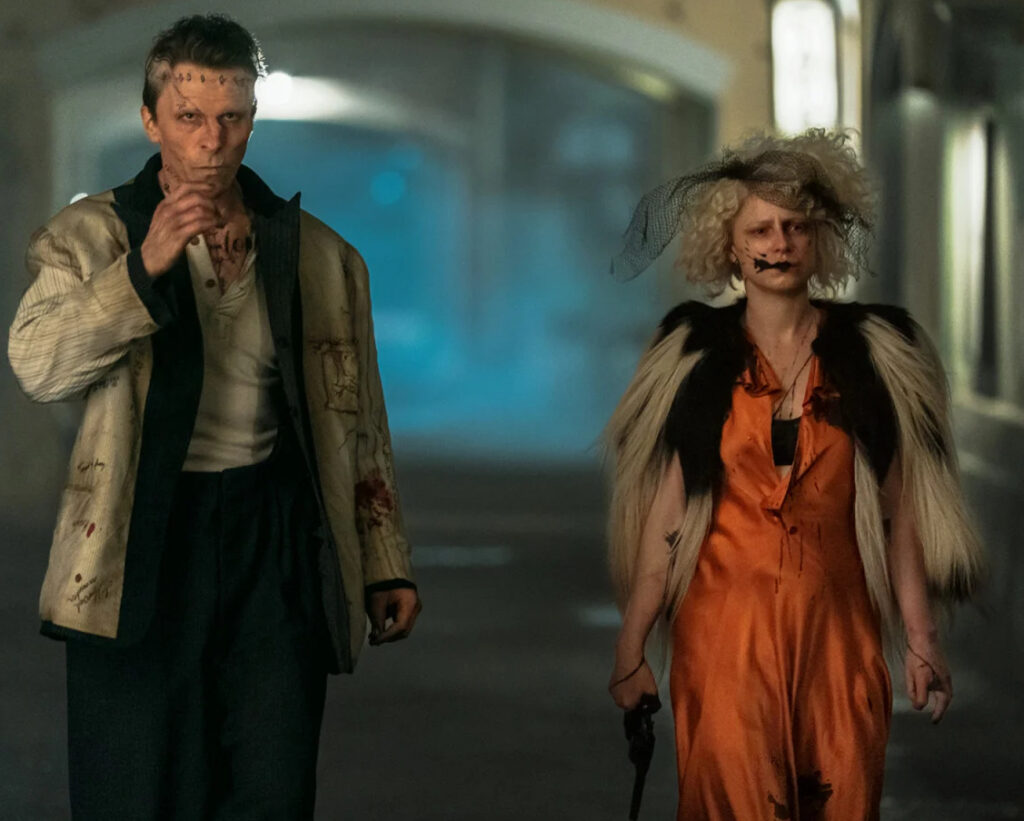
Then there’s “The Bride” — the wife that Frankenstein’s monster, who calls himself “Frank,” wants to have animated from a dead body, in this case Ida’s. He arrives at the Chicago-based house of scientist Dr. Cornelia Euphronius (Annette Bening). Frank has read Euphronius’ work on reanimation, so he enlists her to create a companion after a century of loneliness. Euphronius and Frank get Ida’s corpse and successfully revive her, but she lost her memory in the process. Frank takes advantage of this and states that she is his Bride and lost her memory in an accident, which she accepts.
These three separate and competing personalities — gangster moll Ida, the ghost of Mary Wollstonecraft Shelley, and the eponymous Bride — all lurk in one body. They emerge at various times throughout the film, confusing both the audience and the other characters within the story’s framework.
If this sounds bizarre, it is. The film is a very surreal rethinking of the original story and makes these two characters into personalities that are unlikely and unexpected in the extreme. While Buckley doesn’t really look like she’s been reconstructed, she has odd facial blemishes and other strange markings that suggest she is some kind of creation. Bale’s Frank does have the stitches and staples the original monster had, but they don’t seem to make him appear monstrous on the face of it (so to speak).
The monstrous side of him appears when he’s agitated. And he gets agitated as authorities and the public misunderstand who they are. So they resort to guns and killing to force their way through human society. Along the way they also sing and dance to favorite tunes of the time. Yes, sing and dance. Kind of like “Young Frankenstein” but not comically.
Buckley — the likely future Oscar-winner — plays every tic and gesture with aplomb. If nothing else, it shows her range in light of the character she plays in “Hamnet.” The film’s tonal extremes and expansive leaps in logic are not always bridged effectively, but it remains strangely compelling to watch. Buckley throws herself skillfully into the performance, and Bale plays a more tragic, lonely monster than usual. The result is a film that feels like a Frankenstein creature itself: stitched together from a dozen influences and never quite coherent, but it sure does leave a spectacular looking trail of nonsense in its wake.
The film reimagines the Frankenstein myth not as a tale of scientific arrogance, but as a psychotic, twisted and deeply tragic love story about what happens when a woman refuses to exist for someone else’s need. Bale’s Frankenstein is very different. The actor portrays him as a man deeply hurt by loneliness. You can clearly feel loneliness in his gaze toward others and in his quiet, careful movements. Frankenstein believes that creating a companion will solve his emptiness, but he underestimates the complexity of what he is asking for. And the results are sort of tragic.
The movie is absurd on almost every level, but is interesting with so many ideas and images, that it can’t be categorized as a failure. Are horror tropes sacrosanct? Well. if you watch Maggie G’s version of “The Bride,” it may step into the world of monster horror and sci-fi, but it defies expectations as well.
Nothing is sacred here — certainly nothing within the realm of our expectations of the Frankenstein novel and the mythic character that Mary Shelley created. While Guillermo del Toro’s version treats the “Frankenstein” story with a certain delicacy, Maggie’s version stomps all over the manuscript. A singing and dancing Bride and Frank — why not? This may not be great cinema, but it certainly stretches the boundary of what cinematic storytelling is about.