
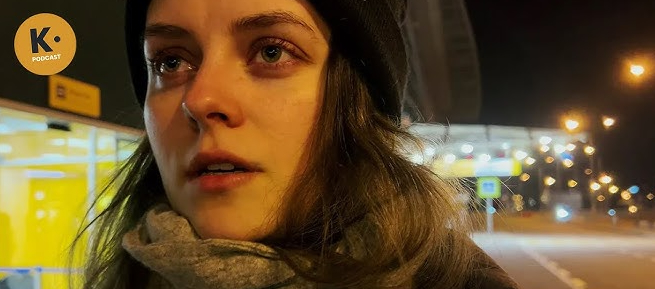
Exclusive Q&A by Brad Balfour, Arts Editor
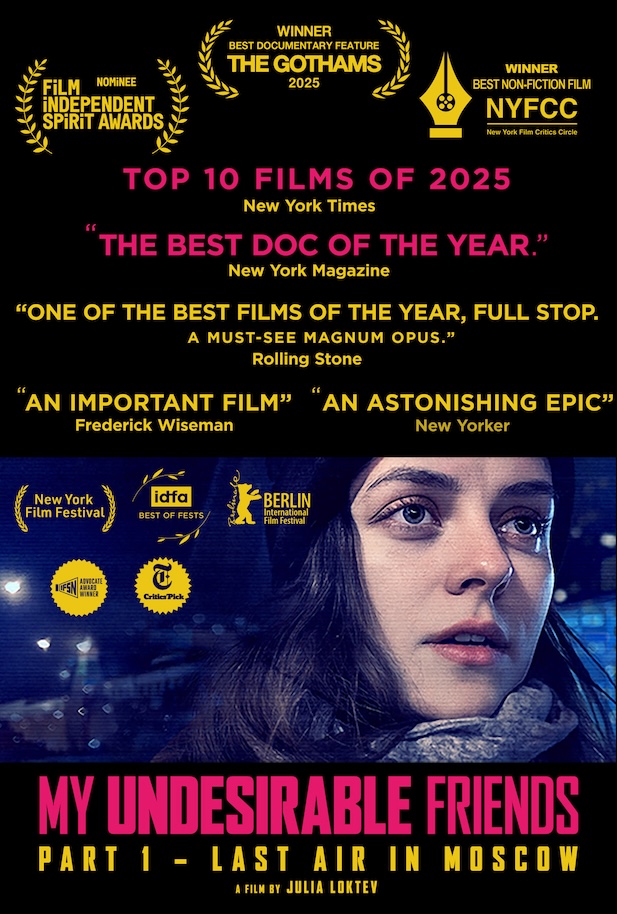
Though viewing the five and half-hour documentary, “My Undesirable Friends: Part I — Last Air in Moscow,” might seem daunting, it hasn’t been for audiences or those giving awards. From its global debut at the New York Film Festival to its US theatrical premiere last summer at Film Forum, this remarkable documentary has been gathering great reviews and accolades along the way.
This lengthy film documents the chilling effect Putin’s Russia has had on Russian journalists trying to report on the news freely. Thanks to director Julia Loktev’s uncanny footage — and the deft editing done by her and Michael Taylor —the feature has enters the Oscar shortlist with huge momentum.
Recently, the film was named Best Documentary/Nonfiction film by the Los Angeles Film Critics Association, not long after it won Best Documentary Film at the Gotham Awards and Best Non-Fiction Film at the New York Film Critics Circle Awards. It’s also earned a nomination for the Film Independent Spirit Awards and is on the Oscar shortlist for Documentary Feature.
Born in then-Soviet Union Leningard [St. Petersburg now] in 1969, Loktev immigrated to the U.S. at age nine. She returned to Moscow in 2021 to make her film. Told in chapters, she embarked on this doc to tell the tale of journalists dedicated to independent reporting in Putin’s Russia. Within weeks of Loktev’s arrival, Putin launched his assault on Ukraine and anyone who who didn’t toe the Kremlin line.
Taylor came on-board once she had came back to the States to get the film underway. Though this production is quite a challenge, over Taylor has grappled with lots of others over his 60 film-long career. As an editor of many, many independent films, he’s been able to address them and garner various awards and nominations over the many productions he has been able to finish. Now he and all those involved with “My Undesirable Friends” — are hoping the reach the cinematic summit of being in the Oscar race next year.
In order to help the momentum I decided to conduct this interview with Taylor just as many other noms and awards are being decided this season.
Q: When doing an edit do you see it as a process of subtraction or more a matter of re arrangement?
Michael Taylor: On both narrative films and documentaries it’s a matter of addition at first – an editor starts with an empty timeline much as a writer starts with a blank computer screen or empty page in a typewriter.
The difference is the director has already gone out and shot most if not all of what you will need to construct a scene. A documentary editor typically drops a whole lot of material which is thematically related into a timeline and that’s where the subtractive process starts. You begin by culling whatever feels truly unusable and then with each successive pass the timeline grows shorter until you bare outlines of a scene starts to emerge. Because “My Undesirable Friends” is nearly entirely in Russian, it was necessary for Julia Loktev, who was born in the Soviet Union but emigrated to the U.S. as a child, to do the initial culling.
Julia directed and produced the film as a one person crew in Moscow, filming with an iPhone, recording sound using zoom and lavs. Our heroic assistant editor Eric Jacobs synced it all up. Julia was the initial editor of all the material. We only collaborated once she had made selects. We started by screening together all the material that ultimately became chapters 1-3 over a 5 day period in March 2023. In our recent theatrical screenings we often show chapters 1-3 as a 3 hour, 20 minute program called “Crackdown.”
I was spending most of that spring in Budapest, where my production designer wife Judy Becker was working with Brady Corbet on “The Brutalist,” but I returned to Brooklyn, where Julia lives and works, for another marathon five-day screening in April 2023. That footage ultimately became chapters 4 and 5 — what we call in the theaters “First Week of War.” Julia filmed in Moscow for the last time in March 2022, or just about a year earlier.
After Putin launched the full scale invasion of Ukraine, the journalists Julia had been following fled in exile lest they be jailed for their anti-war reporting. Julia stayed behind a few days to upload her footage to the cloud, and then rejoined her characters in Istanbul. That footage opens “Part II – Exile,” which will be coming out in 2026. Starting in May 2023 Julia started sending me long assemblies, asking me to cut them down, after which we would study them and start re-ordering and further reduction until we had a scene.
We had simple rules for what made a scene — time and space. A change in time period would warrant a new scene, just as a change of location [would cause the same]. Some scenes would focus on a single character, perhaps initially giving a tour of their workspace, others would be community gatherings in living rooms and kitchens as journalists and members of civil society would gather to strategize how to keep fighting. So the short answer is – add material, subtract material, organize material. That’s true on a scene by scene basis.
We would then arrange the scenes in chronological order to create a chapter covering a longer time period — such as late October 2021 (Chapter 1), early December 2021 (Chapter 2), last days of the year (Chapter 3), and so on. At that point, we did sometimes break pure chronology, but never more than by a few days. For instance, we re-ordered some of the events in chapter 1 so that we could lead with what felt the strongest, most visceral material. None of this changed the essential facts.
Q: You’ve done lots of docs and narrative features. Talk about the difference in the process of editing with each.
Michael Taylor: It’s true, I’ve done a lot of documentaries and narratives, and they are all the same in some regards, different in others. Both begin by adding footage to the timeline. Obviously with a narrative film I (usually) am guided by a script and the actors’ performances, who are (usually) following the script. Though that is not always the case.
The first two Rick Alverson films I cut (working with Rick, much as I do with Julia), “The Comedy” and “Entertainment,” were completely improvised. The scripts read more like treatments – there was no scripted dialog. Rick only uses one camera, so in cutting back and forth conversations between folks like Tim Heidecker and Gregg Turkington in “The Comedy” I had to get creative since I did not always have responses ready to match the other side. It’s a spectrum though.
Some narratives are shot strictly according to the script (I would say that’s true of Lulu Wang’s “The Farewell” and Ira Sachs’ “Love is Strange”), others, such as Elizabeth Wood’s “White Girl” and more recently Noah Pritzker’s “Ex-Husbands,” contained a bit more improvisation — or to put it another way, actors taking some liberties with the lines. That can work out very well if you remain engaged and observant throughout the edit. And it goes beyond spoken language of course — every gesture an actor makes in a film can add or subtract for your overall experience watching it.
Julia has often said that we approached “My Undesirable Friends” as a narrative project, and that’s true. We treated the footage as scenes, and cut them much as we did “Day Night Day Night” back in 2005, the first time I worked with Julia. We both are also huge fans of cinema in general, whether films made by American auteurs or the great films coming out of Europe and Asia.
We’ve noticed that many documentaries have a similar format — sit down interviews, musical cues, graphics, voice-over narration. Except for a brief spoken moment from Julia at the beginning of Part I, we don’t use any of those techniques.
That’s not to say I have cut more conventional documentaries myself, but even in films that do employ interviews, such as the two I cut with Margaret Brown, “Be Here to Love Me: A Film About Townes Van Zandt” and “The Order of Myths,” and Holly Morris’s “Exposure,” I’m always looking to bring as much character and as much flow to the final edit. For me, films with outstanding characters, which flow fairly effortlessly from one scene to the other, gradually building to a powerful ending.
Q: How is it to create/work on a film that needs more cutting down? Does that require intense interplay with the director? Do you get to be a sort of director?
Michael Taylor: I never think of myself as a director, or even writer on a documentary, as the directing has already been done by the time I come on, and editing to me implies enough of a creative role that I don’t feel the need to take on another one. That said, in many instances I have been editing a documentary while it was still in production, just as I am usually assembling scenes on a narrative film when it is being shot.
All of “Part I” had been shot when I came on, and the first year of material for Part II had already been shot as well. I haven’t really needed to suggest to Julia what she might shoot over the past couple of years, but on some films I have had to be more proactive during the edit. Ethan Silverman hired me to cut his documentary “Angelheaded Hipsters: The Songs Of Marc Bolan and T. Rex” the summer of 2020, right in the middle of the first year of the pandemic. I spent several months pulling subclips, little nuggets which I thought I might use in the first assembly (in this sense my approach was not additive, but selective).
The additive approach works with a verite film, which I realize now many of the documentaires I’ve worked on were [like that] including “The Order of Myths” and “My Undesirable Friends.” But films more of an essay nature, made up of archival interviews and performances, recent interviews, recent performance footage, required a different approach. I needed to create scenes out of disparate thematic elements, and the only way to do that was to create bins and bins and bins of material which might be useful, and then in a few intense days trying stringing the best things together, almost in a stream of consciousness.
While I was working on Ethan’s film I realized though something was missing — the presence of Gloria Jones, Marc Bolan’s most important musical collaborator in the last part of his life. I asked Ethan why we had no interviews with Gloria and he told me that she had been too hard to track down and was in fact living in West Africa, where she had founded the Marc Bolan School of Music and Film Production. I suggested a few zoom interviews, and not only did those help to structure the film, but they led to a terrific idea from Ethan for the ending of the film, something far better than I could have ever imagined.
Q: What were the unique parameters to editing “My Undesirable Friends: Part I — Last Air in Moscow?”
Michael Taylor: I think I have already pretty much answered this one — we followed chronology fairly strictly, and did not try to combine single locations into one scene. We also did not intercut between characters and locations. We would linger a while, then move on.
Q: What’s planned for “Part II?”
Michael Taylor: This probably was the biggest surprise for us. As I mentioned Julia had already been filming from March 2022 through to the spring of 2023 when I started working with her, but we gave very little thought to the footage while we were cutting Part 1. We finished Part I for the most part by spring 2024– so that five-hour, 24-minute film took essentially a year.
The next few months leading up to our world premiere at the 2024 New York Film Festival were spent color correcting, doing the mix, finessing subtitles, and doing some security edits (some relatives of our main characters were still in Russia and we could not reveal their identities). We started on “Part II” late in the year, and now, a year later, and nearly done with it.
We hope to finish by late winter, early spring, and plan to submit to festivals as soon as it is ready. Like Part I it is in 5 chapters, and like “Part I” it will be about five hours long. What surprised us is how much character comes to the foreground in “Part II.” The characters are more like astronauts drifting through space. (They are quite literally drifting from country to country — at this moment some are in Europe and a couple are here in New York.) Some of the background characters from “Part I” come to the foreground of Part II. It feels very different, even though the filming and editing style remains the same. We actually find it even more moving than Part I, which is a hard thing to say. We hope others agree when it comes out.
Q: What have been your toughest challenges especially with this film?
Michael Taylor: Trying to determine which conversations and visual moments mattered the most Although it’s a five-hour, 24-minute movie, we still wanted to only include what felt what developed character and story, what felt most special.
Our characters are quite talkative, which presented a challenge with subtitles. We found we needed to use two lines in many cases and full sentences rather than fragments.
We also had to edit around characters who either did not want to appear in the film when Julia was first filming them (various partners) or who had to be cut out later for security concerns once Putin invaded Ukraine. Our main characters all left Russia, but some family members who were not journalists remained.
We blurred some workers in the background if they decided to remain in Russia and could not be identified for safety reasons.
We had one character who only appears during the last half hour of the film, and shared scenes with some of our main characters. She had some emotional moments which we wanted to preserve so blurring or cutting her out was not an option. We used AI to replace her face and it worked very well – allowing us to keep her in scenes without revealing her identity.
Q: In “My Undesirable Friends” how was it decided what to cut — characters, situations, background while still maintaining its continuity?
Michael Taylor: That was never really an issue – most scenes take place in an apartment or workspace and we stay there until it’s time to move on. Sometimes we combine footage from several days before in one location and outfits change slightly. No one seems to notice.
Q: How did you and Julia decide on its focus and what was the best way to establish that?
Michael Taylor: Julia went to Moscow initially in October 2021 to show the lives of newly designated “foreign agents,” a form of state oppression of freedom of the press. As she spent more time with the journalists and members of civil society she was portraying she wanted to document their continuing struggle.
That night might have been the film but then Putin launched the full scale invasion of Ukraine, a lawless act of aggression which sadly continues today almost 4 years later.
At that point Julia found herself an eyewitness to history and she filmed her characters as they realized they needed to flee into exile, as their continued anti war reporting would land them in prison.
Julia realized then, and I helped her to develop this in the editing, that the film showed how a noose can gradually tighten and strangle in an increasingly authoritarian society.