
Review by Brad Balfour
Play: “The United States vs. Ulysses”
Playwright: Colin Murphy
Director: Conall Morrison
Cast: Clare Barrett, Ross Gaynor, Morgan C. Jones, Mark Lambert, Ali White, Jonathan White
Dates: April 30 – June 1
Where: Irish Arts Center
726 11th Avenue
In light of the banned book movement raging throughout various right-of-center MAGA dominated states, where sexually provocative writing is being forced out of libraries and schools, this story about James Joyce’s “Ulysses” — a nearly banned book — is nothing new.
In Nazi Germany, there were mass bonfires of books. In 1953, American writer Ray Bradbury created “Fahrenheit 451,” a dystopian novel which presented a future American society where books have been outlawed and “firemen” burn any that are found. The novel follows Guy Montag, a fireman who does the burning. He becomes disillusioned with his role in censoring and destroying literature.
In 1922, notorious Irish author James Joyce published “Ulysses,” his most famous work which is a major contribution to the modernist avant-garde movement. Joyce is regarded as one of the most influential and important writers of the 20th century.
Prior to its hardcover publication, the book was serialized in “The Little Review,” a literary magazine. This periodical was published in 1920 with the “Nausicäa episode,” which contained a masturbation scene. Copies were mailed to potential subscribers. A girl of unknown age read it and was shocked, and then a complaint was made to the Manhattan District Attorney.
Since the magazine could be purchased in a New York bookshop and the publishers of “The Little Review” were based in NYC, the local district attorney brought a case against the sellers. “Little Review” publishers, Margaret Caroline Anderson and Jane Heap, couldn’t argue that the chapter should be considered in light of the work as a whole, since only the offending chapter was published. The court convicted and fined the duo after a trial in which one of the judges stated that the novel seemed “like the work of a disordered mind”. That stopped publication of “Ulysses” in the United States for over a decade.
Then in 1932, Random House –– a relatively new publisher which had the rights to publish the entire book in the United States –- decided to bring a test case to challenge the de facto ban in order to publish “Ulysses” without fear of prosecution. It made an arrangement to import the edition published in France and have a copy seized by the U.S. Customs Service when the ship with the work arrived. Although Customs had been told in advance of the anticipated arrival of the book, it was not confiscated. When the ship docked, it instead was forwarded to Random House in NYC.
Since seizure by Customs was essential to the plan for a test case, Morris Ernst –– the attorney for Random House –– took the unopened package to Customs, demanded that it be seized. And it was. The US Attorney then took seven months before deciding whether to proceed. While the Assistant U.S. Attorney assigned to assess the work’s obscenity felt that it was a “literary masterpiece,” he also believed it to be obscene within the meaning of the law. The office decided to take action against the work under the provisions of the Tariff Act of 1930. That act allowed a district attorney to bring an action for forfeiture and destruction of imported works which were obscene. It set up the test case.
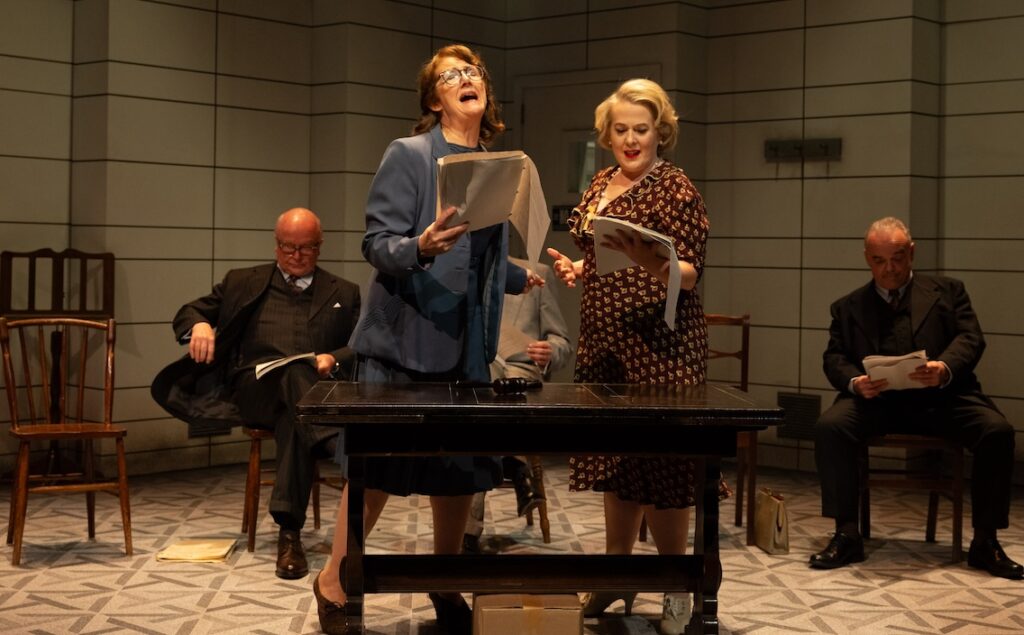
It’s this test case which is the focus of Murphy’s play, conceived originally for radio and adapted for a full stage production. The date is December 8, 1933, and it’s set in CBS Radio’s New York studio, preparing to go live on air with an episode of the dramatized newsreel, “March of Time.” This time it’s about the court case, “The United States versus One Book Called Ulysses.” Inside this basis of a radio broadcast, Murphy and director Conall Morrison insert two other levels of narrative, each depicted with a slightly skewed visual and dramatic style.
In the broadcast room, as they read their script about the trial, five actors are being directed with passion. The trial has ended just a few days earlier — as has Prohibition — and the risqué bits of “Ulysses” provide some saucy material. A hanging microphone, around which the actors gather, offers a focus as they make sound effects and dramatize scenes. The actors who are not speaking sit in chairs upstage, reading their scripts.
Interwoven with the radio reenactment is a more straightforward dramatization of the events being depicted (as outlined above). Furniture shifts to the center of the stage which creates various rooms for various events to transpire. In James Joyce’s Paris dining room, young publisher Bennett Cerf is there to make a publication deal. In lawyer Morris Ernst’s office, he and Cerf strategize how to make sure they get their day in court and win. Then there’s the customs office, where a courier fails to get caught smuggling in the contraband book.
And of course, there’s the courtroom where the lawsuit plays out. With Ernst facing Sam Coleman in front of Judge John Munro Woolsey in Customs court, the actors make fine sparring partners. But the whole trial is pointed toward one question — will the purportedly obscene material get read in court or be dramatized onstage.
Finally, at the moment when the radio broadcast takes its intermission, one of the actors opens up “Ulysses” itself, and that world opens up. Hitherto unseen portals appear in the set, as they slip into the world of Joyce’s Nighttown — and its all these things, scatological, outrageous, and abject all at once.
We see Leopold and Molly Bloom themselves, as well as an array of other characters that Bloom encounters, sketched in Joyce’s archly convoluted prose. It’s in these sections that the play comes to life, when the actors let loose. The dialogue throughout the rest of the piece is scattershot, excerpted from different passages and moments.
This is less an issue in the courtroom scenes with some of it partially verbatim from the actual trial transcript –– Murphy cites it as a primary source –– than in the radio play sections. Nonetheless, as the various actors shift roles and characters, they try to give life to all that’s happening.
There’s a play (scenes from “Ulysses”) within a play (the court trial) within the play –– that is, the radio broadcast of “The March of Time.” It’s a challenge to teach a modern audience what “March of Time” was in the first place, show how it works, and present the entire episode. The information requirements sometimes stack the dialogue to be a little stiff, even a bit fakey. It can get confusing and the switching around can cause one to lose track as to what’s what.
Ultimately, though, the message is clear. Yes, there can be an impulse to “protect” the people’s prim and proper sensibilities. But in recalling this case for free speech, it is plainly apparent how important it is that artistic freedom be protected. That is more necessary than ever.
In the dramatized sections of “Ulysses,” Joyce’s poetry transcends any possible scatalogical offenses, both verbal and visual. Though Cerf didn’t set out to be a crusader for the First Amendment, he achieved that nonetheless. The role he played in this suit meant that the company he founded –– even these many years later –– champions not just the commercial but the innovative. Technically, conceptually and socially: the right to freedom of speech prevailed.
The people — not the government — won back then, but so do we now. This play should be staged all throughout the United States — given that not only “Ulysses,” but hundreds of books have been banned by Florida and Iowa along with particular towns. “The United States vs Ulysses” may have been the cause back then but even today, the battle for freedom of expression goes on.