
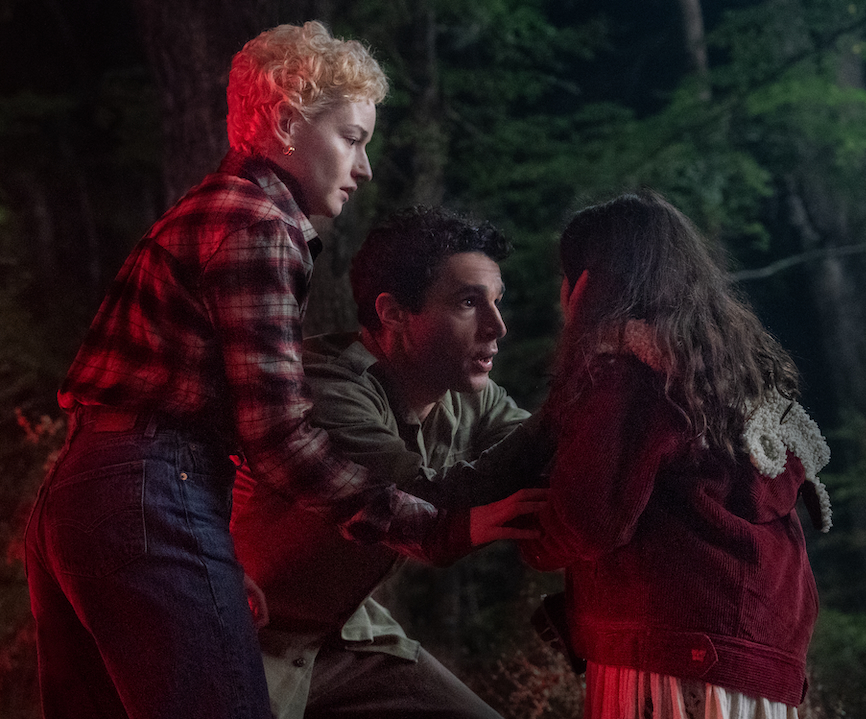
From left: Charlotte (Julia Garner), Blake (Christopher Abbott) and Ginger (Matilda Firth)
Feature by Brad Balfour
Film: “Wolf Man”
Director/writer: Leigh Whannell
Cast: Christopher Abbott, Julia Garner, Matilda Firth, Sam Jaeger, Benedict Hardie, Ben Prendergast, Zac Chandler, Beatriz Romilly, Milo Cawthorne
Many years ago, starting in the 1930s, Universal Pictures launched a bunch of classic horror films which established a series of characters who have become legendary pop culture figures such as Dracula. Over the years, the company has produced sequels, parodies and re-boots, some successful, others, a disaster. More recently, Universal tried it re-imagine “The Invisible Man” and “The Wolf Man.”
Along the way, they established many new horror franchises through Blumhouse, an amazing production house that has had an on-going deal in play with the studio. So, through Blumhouse — Jason’s incredible production factory — and visionary writer-director Leigh Whannell, they re-imagined the chilling modern monster tale, “The Invisible Man,” to much success. Now, they’re trying again by re-conceiving the terrifying lupine nightmare of “Wolf Man.”
Set in the States rather than Europe — as it was in the 1940s version titled “The Wolf Man” — husband and father Blake [Christopher Abbott] inherits his remote childhood home in rural Oregon after his own father vanishes years ago and is finally declared dead. With his marriage to high-powered wife Charlotte [Julia Garner] fraying, this San Franciscan persuades her to take a break from the city and visit the property with their young daughter, Ginger [Matilda Firth].
But as the family approaches the farmhouse in the dead of night, they’re attacked by some unseen animal and, in a desperation, barricade themselves inside the home as the creature prowls outside. As the night stretches on, however, Blake begins to behave strangely, transforming into something unrecognizable. Charlotte is forced to decide whether the terror within is more lethal than the danger without.
As directed and written by Whannell (with Corbett Tuck as co-writer), this Wolf Man is grounded in science rather than the supernatural. Whannell’s previous films with Blumhouse including “The Invisible Man,” “Upgrade” and “Insidious: Chapter 3” were all very successful.
The film is produced by Blumhouse founder and CEO Jason Blum p.g.a., and Ryan Gosling (The Fall Guy, Lost River) who was originally going to be in “Wolf Man.” Since it’s executive produced by Whannell, Beatriz Sequeira, Mel Turner and Ken Kao, Universal Pictures and Blumhouse presented this as a Gosling/Waypoint Entertainment production [ in association with Cloak & Co: Wolf Man] in the hopes of making another box office hit.
Now being released in theaters this month, Universal had held a Blumhouse preview session at New York Comic Con with Whannell’s “Wolf Man” one of the films being spotlighted. The following Q&A is excerpted from this session.
Q: What do you think was the original appeal of the classic Wolf Man legend, and what interested you most in dissecting and rethinking him?
Leigh Whannell: These classic monsters are so durable you can make them contemporary. I felt that what I tried to do with “The Invisible Man” was to take this classic monster that’s been around for a hundred years or more, and really put it in the modern world. The idea of doing that with Wolf Man was really attractive because it’s such a known monster, and it’s an image of something that’s embedded in people’s minds.
I felt like, with “Invisible Man,” there’s nothing to see, literally, like, there’s no there there. But with “Wolf Man,” people have an image, so I really wanted to drag that into contemporary times.
Q: “Wolf Man” also explores the terror of a loved one becoming a threat. How did you approach that concept to make it both scary and meaningful?
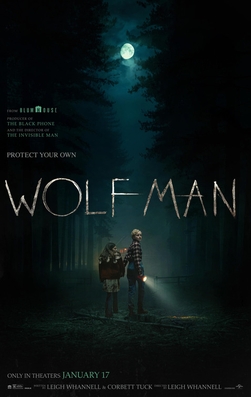
Leigh Whannell: I usually let the film tell me what it wants to be. At the risk of sounding pretentious, I don’t try to force things on a movie, like this is where I’m going to do my Civil War epic, or something. I felt like with “Wolf Man,” ‘the thing that presented itself the easiest, or that seemed to be staring me in the face, was infection, terminal illness, degenerative diseases, and I felt that with “Wolf Man” is really good, it dovetailed nicely together.
Leigh Whannell: Horror in general? It’s very technically difficult. As horror fans know, it’s really hard to get it right. I think some people think it’s easy, but the technicality and the precision, the choreography of making something scary, I think is the hardest thing.
Q: Did Christopher Abbott stay in character the whole time? Was he method?
Leigh Whannell: He is definitely not method. I’ve got many videos of him dancing to New Order and doing impressions. He has this weird ability to… You call “Action,” he goes there, and then you call “Cut,” and he’s just joking around, making fart jokes, and you’re like, “Where’s the guy that was just here?” It’s a switch that he just turns on and off.
Q: Were the vibes on set in between takes rather fun and jovial?
Leigh Whannell: Chris was always joking around. I was trying to get him to take it more seriously, but then when I would call action, he was great.
Q: Casting was incredible on this. How critical was that?
Leigh Whannell: It’s huge for any horror movie. As Jason knows, a lot of these movies are dealing with these outlandish situations or heightened situations. You can only sell that to an audience through these proxy characters that make it believable. If you think about a film like “The Exorcist,” you believe everything in “The Exorcist” because of Ellen Burstyn’s performance… because of everybody’s performance.
I think one of the most, if not the most, important things in a horror film is getting the actors right. I was really happy to have this cast because Julia Garner and Chris Abbott and Matilda Firth, the young girl, they just have this ability to… They’re allergic to any inauthenticity. You just believe what’s happening to them.
Q: When you do the scars, the blood and stuff that’s all practical [come in?] How difficult was that?
Leigh Whannell: It’s not difficult for me, it’s difficult for the actors who sit in a chair for six hours. The make-up artist we have on this film is this guy, Arjen Tuiten. He basically trained under the Dick Smith, Rick Baker, Stan Winston, all legends [of the make-up arts]. And, yep, he respects these guys. He’s so good and is such an artist. To him, it’s not fun, it hurts his soul. As such an artist, he’s always been a fan of the Wolf Man, so this was a dream for him. I just thought he was the right guy for the job, and he went above and beyond.
Q: Were there any funny stories about what happened on set? Did anything exciting happen that you’re like, oh, this is so fun, I want to share it?
Leigh Whannell: I’m always trying to make it fun on set. I’ll do it in pre-production, I tried to get the cast and crew to bond, doing escape rooms [and more]. So we did this escape room in New Zealand that was werewolf themed. I love seeing people’s true personalities. Nothing will bring out someone’s true personality like an escape room. Have you ever seen this happen before, where somebody who was just fine and nice before, but there’s 10 seconds left on the clock, and they’re like, “Don’t fuck us up!” It’s like, “I’m trying to find the key,” and they’re like, “Well, hurry!” I love seeing that come out. That was definitely a memorable day, and the fact that it was werewolf themed was great.
Q: You found a werewolf-themed escape room?
Leigh Whannell: It was purely an accident. I had no idea, it was like that one. We turn up, and they’re like, welcome to Curse of the Werewolf. I’m like…[laughs] Let’s do this.
Q: Here’s the thing… It’s so funny that it’s a husband turning into a wolf. If your partner turned into a werewolf, would you leave them?
Leigh Whannell: It depends on which wolf? Like, is it Teen Wolf? He was pretty sexy. I’m not leaving Teen Wolf. But in this movie, you’re going to run out of [of the room]. It’s not going to be a fun time.
Q: What was your favorite thing about pre-production? Like, location scouting, or was it coming up with what the scenic designs look like?
Leigh Whannell: That was all great, coming up with the designs, but I had a film festival during production, the Full Moon Film Club, where every Wednesday, I would force the crew to come and watch this movie. The studio where we were shooting had a movie theater, and that was my favorite part, was trying to get people to be excited about movies.
I would always give these speeches, trying to be a good coach, and be like, remember, we’re making a movie, and it’s a theatrical release movie. It’s not a TV show or whatever. Not that I have anything against TV shows, but I wanted people to get excited about movies.
We were watching “The Fly,” “The Thing,” “Under the Skin” and “American Werewolf in London.” Every now and again, I would torture them by making them watch “The Moor,” or something like that. They would all come up to me afterwards and be like, “Thanks for ruining my Wednesday night [chuckles].” But then I would give them a little gift and they’d be like, “Okay, fine, now we’re going to watch “The Thing.” I think that was my favorite part, just the bonding with people and getting people excited about movies, theatrical movies.
[As I produce stories on the entertainment world, I want to use this closing aside to mourn what’s happening with the Los Angeles fires. I hope people will reach out to the Red Cross and other organizations to offer one form of support to all those whoa are suffering — Brad Balfour]