
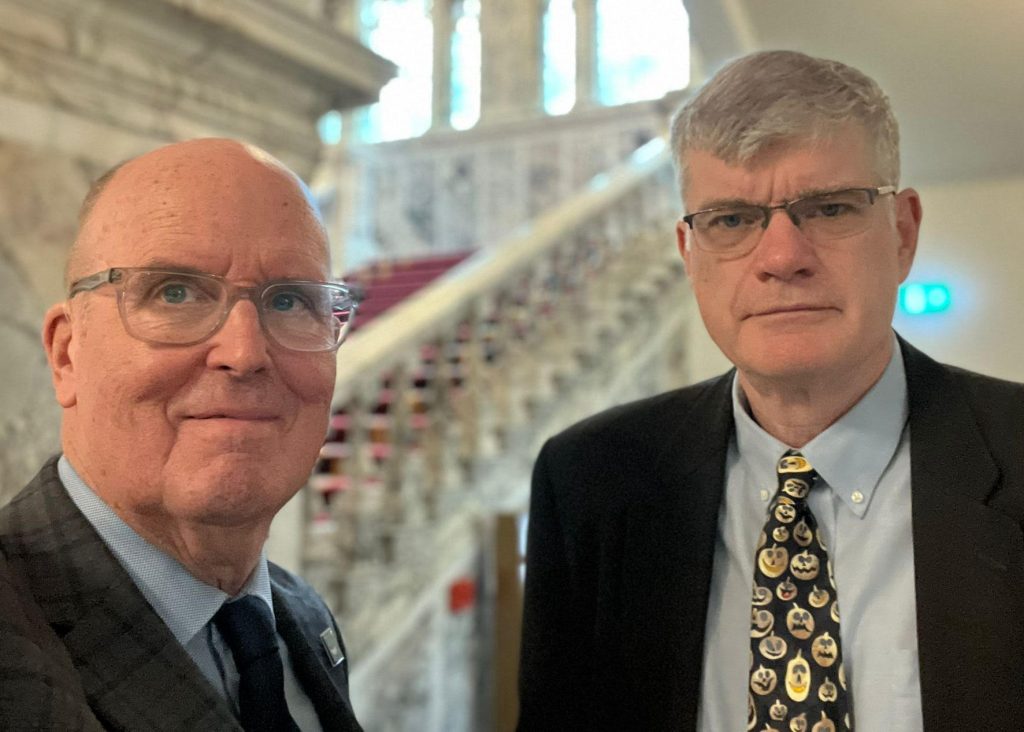
John D Lee and Martin Nutty
Exclusive Q&A by Brad Balfour
When John D Lee and Martin Nutty dropped episode 100 of the Irish Stew Podcast they turned the tables on the concept. Subject Shelley Ann Quilty-Lake became the interviewer and Nutty and Less were the interviewees. That’s the kind of gamesmanship the two podcasters share in making their ongoing series.
According to Lee, “Only 11% of podcasts make it to episode 50 and only 6.4% get to 100. So, excuse us, The Stew if we’re feeling a wee bit chuffed to drop episode 100 now.”
For this milestone show, co-hosts Lee and Nutty are on the receiving end of questions from Wexford’s own attorney Quilty-Lake, who grills the pair on their four-year journey, their podcast concept, the show’s evolution, their changing interview approach, and how they collaborate.
They reflect on the podcast’s dynamic guest lineup from astronauts to archaeologists. Both commented on standout moments in the first 99 episodes, what they see as their role in the Irish diaspora, and shared the buzz from their recent “Irish Stew Gets Lost in Belfast Road Trip 2024.” These episodes are dropping mid-January which will be the first of many road trips across the Global Irish Nation.
And thanks to all their efforts, they’ve managed to humbly brag about being on the short-list for three 2024 Irish Pod Awards — Best Society and Culture Podcast, Best Hosting Duo/Trio, and Best Editor (thanks to the Stew’s secret weapon, audio guru and inaugural guest Bill Schultz).
Added Lee, “We both offer thanks to Shelley Ann for her deft interrogation. We also shared their deep appreciation for our intriguing guests and loyal listeners. And we look forward to dishing out many more servings of ‘Irish Stew.’”
So, with all this info in hand, the two were quizzed by email as to how they got this far.
Q: What prompted you to start a podcast in the first place?
John Lee: A starting point for me was writing a Huffington Post column called “Irish Media Nation” but when I produced the “All Business with Jeffrey Hayzlett” podcast, I began to see the potential in that medium for exploring a more global view of Irish identity.
I created a presentation deck and the rudiments of a business plan for a podcast I had titled “Irelandia” but I just wasn’t getting it off the ground. Something else was always taking priority and I stumbled over the tech aspects of launching a podcast–although the barrier to entry is not that high.
I met Martin through the Irish Business Organization of New York. He already had a podcast called “The Nutty Chronicles” and wanted to develop a new one that was remarkably close to what I envisioned, so we decided to collaborate. After considerable advance work, we launched “Irish Stew” four years and a hundred episodes ago.
Q: How has it evolved over time?
Martin Nutty: As originally conceived, we wanted to make the show about 35-minutes long. I’d read that shows longer than the average commute were less than ideal.
When we started recording, we found our conversations ran longer than the target duration. I knew that was a possibility and expected editing out parts of the conversation was easy enough, but we found that you can’t cut an earlier piece because it is referenced later in the recording. So, attempting to cut out parts of the conversation can really extend the editing process.
What we’re doing in our episodes is attempting to capture a profile of our guest–where they came from, the arc of their career, and why they do what they do. You can’t do that and maintain a relaxed conversational vibe in 30 minutes. We find some of our best stuff comes 45 or 50 minutes into the recording when our guest has relaxed.
So now we keep a close eye on the clock and when we get to the 45-minute mark we’re looking to wrap things up in a natural way to keep the episode under an hour. We feel more than 60 minutes can be off-putting but I guess Joe Rogan might tell you otherwise. We minimize the editing needed and get a more organic sound. We think that works. Our listeners seem to agree.
Q: When you developed the podcast, were there certain guests in mind that you got and others that you still wanted to have?
John Lee: I would say the guest list exceeded expectations. We are finding that accomplished people, from academics to astronauts, from actors to ambassadors, are willing to generously offer an hour of their time for our Global Irish Nation Conversation.
We’d love to have the likes of a Cillian Murphy or a Liam Neeson on the podcast, but that level of fame has never been our target. Instead, we’ve featured a roster of leaders in their fields— Pulitzer Prize-winning journalists, award-winning playwrights, best-selling authors, top diplomats, game-changing entrepreneurs as well as some lesser-known people doing amazing things that we love to highlight.
We try to keep a lively mix of locations, occupations, ages, and genders. We’ve gone as far afield as New Zealand and Tasmania for guests and we’ll soon expand our Northern Ireland focus with a dozen episodes we’ll be dropping in the new year from our recent “Irish Stew Gets Lost in Belfast Road Trip.”
But Cillian and Liam — you’d be very welcome to join us on Irish Stew!
Q: Do you feel there is a greater intimacy doing a podcast rather than text articles
John Lee: There’s a different level of intimacy when you speak to someone on a podcast rather than that person reading what you wrote in an article. Many people listen to Irish Stew on headphones, so you get into their heads in a deeply intimate way.
The listeners are, in a sense, eavesdropping but we want them to feel included in the conversation in a way. We’ll stop a guest to ask them to explain a technical term or local slang respecting our global listeners and helping to keep them in the conversation.
With writing you can edit, rephrase, and polish the prose. We do minimal audio editing–cutting out the occasional gaffe, deleting some of the “ums” and “ahs”—so the podcast conversation is more real, raw, exposed, and yes, intimate. It’s hard to capture the unguarded moments in text, but they are the moments that resonate on our podcast. I had one myself in our recent episode with Dee Ahearn, CEO of the wonderful Irish charity Barretstown, where I let myself talk about something I rarely even let myself think about. That’s the kind of intimacy a podcast can create.
Q: What effect do you hope the podcast will have?
Martin Nutty: When conceiving the podcast, we felt there was an opportunity to create content that focused on what we call the Global Irish Nation. Meaning we understand collective Irishness as being composed of five major groupings:
The Irish of Ireland – those who live in Ireland.
The Expat Irish – those born in Ireland but have left temporarily or permanently.
The Diasporic Irish – those that have an ancestral connection to Ireland.
The Residential Irish – those who have chosen to live in Ireland that don’t have ancestry there.
The Affinity Irish – those who love Ireland but don’t have an ancestral anchor there.
We wanted to create a podcast that spoke to all those groupings. While we recognize that some might take umbrage at our view, we encourage our listeners to think inclusively about Irishness, believing the Global Irish Nation is better served when we pull together rather than act alone. One hundred episodes later, we continue to refine our thinking about how best to make this work. Keep listening as we encourage our guests to reflect more deeply on how Ireland and Irishness have influenced the work they do.
Q: Have you been surprised by the reaction to it?
Martin Nutty: I continue to be surprised by our footprint as a small independent podcast. After four years, when we reach out to guests, I’m surprised by the numbers that have heard about us.
Periodically, we’re approached at gatherings where somebody will say they recognize our voices, which is both amusing and surprising!
Finally, we receive compliments that recognize our professionalism, which is funny as neither of us has a deep background in media. We just wanted to create episodes where guests were asked interesting questions. That happens when you do the kind of prep necessary.
For example, if we have an author on the podcast, we read the book cover to cover so we can ask the questions we hope other readers would ask. We like to think that kind of effort is value-added. We’re mindful that there are many podcasts in the wild and we need to differentiate. We hope our research efforts give us an edge.