
By Michelle O’Mahony, OM History Consultant, author of Famine In Cork City (2023), contributor to the Atlas of the Great Irish Famine (2012)
On an “Out&About Meeting” with Paddy McCarthy in his native Cork City last February, while sipping tea (mostly likely Barrys) in Paddy’s favorite establishment – The Metropole Hotel, I promised to write him an historical story about a great contributor to the world of American Art and American Black History. Given that October is Black History Month, perhaps it is fitting to put pen to paper now.
The setting for this story is Dunmanway, West Cork – the hometown of Sam Maguire: – recruiter of Michael Collins to the IRB, freedom fighter and GAA enthusiast. Not only was Sam born in Dunmanway but also many other notable characters in Irish and international history.
The venue was the old bridewell or gaol house. The cataclysmic event that shaped the artist’s life was the Great Irish Famine. The artist was Thomas Hovenden (1840-1895), and he is often referred to an artist of both hearth and homeland.
Revered as an artist for his depiction of real-life events, of American families of all heritage and colors. His portrayal of the struggles encountered by the African American community and the slaves, together with his compassion for children and the underdog ensured that he be remembered as a “hero artist”.
An obituary in the Cleveland Plain Dealer Newspaper remembered him as the “hero artist” with the following opening lines which probably are the best introduction I can write for Thomas: “To the thousands who stood before Hovenden’s canvas of ‘Breaking Home Ties’, in the American section of the World Fair Art Palace, it is not a surprise that the painter who could lay such a wealth of purest love and tenderest sentiment into that picture should prove a hero for human love’s sake and perish in saving the life of a child. Tom Hovenden has always been one of the obscure heroes on the battlefield of life from the days he left his Irish home in Dunmanway. to a new country which he gave the best of his art.”
As a history consultant, a famine historian and author, Thomas Hovenden has always been on my historical radar. He was just a few years older than Sam Maguire. Thomas was deeply affected by the Great Irish Famine and no telling of the Famine History of Dunmanway would be complete without referring to Thomas and his contribution to American society, culture and the world of art. Yet, I sometimes reflect on whether this giant of a man in artistic circles somehow landed on a cloud with a silver-lining.
“What-ifs” are fascinating. If the Famine had not occurred would his life’s contribution and artistic legacy have been as great, if he had not been part of the Irish diaspora and emigrant story? Perhaps, out of his famine experience came a sense of compassion and humanity together with an artistic gift.
He has been acclaimed both in books and museums ever since. And yet, little stands testament to him in his own hometown or in Ireland which is why I strive when giving historical talks on the Irish Famine to include him in my narrative and to document Thomas’s famine orphan experience.
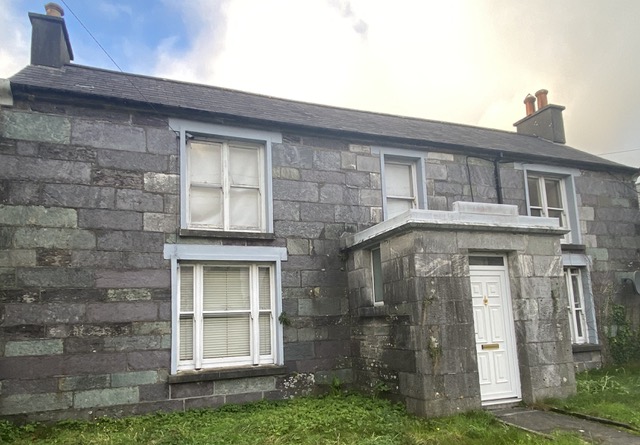
Thomas was born on 28th December 1840, the son of the local gaol keeper, Robert and the daughter, Ellen Bryan of the local methodist minister. The Hovendens’ resided at the Bridewell – the prison, Main Street, Dunmanway. Thomas was the second son; his elder brother was John and his sister was Elizabeth.
The old bridewell, now a dwellinghouse though still manages to look the same as when Hovenden was a child, with carved stone making for a historic façade although the porch and front door extension it is thought is possibly a later addition to the property. It still reflects the austere look of a Victorian bridewell.
In a curious irony it looks across the street to the St. Mary’s Church where a sign directs the visitor to the grave of Sam Maguire. Each renowned in their own right.
If the walls surrounding the Hovenden’s family home could talk they would tell of a story of a family, struck down around 1847 with the dreaded illnesses that accompanied the Irish Famine – such as typhoid, cholera and other illnesses. 1847 was known as Black ’47 because this was the worst of the famine years.
Between 1846-’47 the Hovenden children lost both of their parents. Even though Thomas’s grandparents are supposed to have lived locally, (this needs further research) the children were placed in an orphanage in Cork City.
The mortality rate of 1847 was so high that orphans were commonplace in the city at this time. Orphans were either placed in orphanages or in the Poor Law Union Workhouse during the famine years.
After a few years in the orphanage, Thomas’s talent for art came to the fore he was apprenticed to a carver and a gilder called Tolerton in the city, 1855-63.
In 1858 Tolerton recognizing Thomas’s ability decided to try to enrol Thomas at the Cork School of Design. Here, some of Thomas’s watercolors were painted together with (according to sources, in Thomas Hovenden, American Painter of Hearth & Homeland, Woodmere Art Museum) his large pencil drawing of a cast of Venus de Milo.
This fact has me intrigued in that very few have picked up on the fact that the cast of the Venus de Milo has for numerous years resided at the Crawford Art Gallery in Cork City. This is probably the same Venus that Hovenden sketched as his muse.
Around 1849 the Royal Cork Institution acquired the cast. From 1803 to 1885 the Royal Cork Institution comprised a reading room for manuscripts, ogham stones and museum artefacts and other artwork and it took possession of Brucciani’s cast bust of Venus de Milo.
Made by Domenico Brucciani who was the leading plaster cast maker in London who specialised in high-quality casts that were later purchased by likes of The British Museum and Victoria and Albert Museum (V&A). (According to the website of Cork’s Crawford Art Gallery).
Displayed in recent years in the Sculpture Galleries, the Bust of Venus de Milo was one of several casts transferred from the Royal Cork Institution.
Having viewed the Venus de Milo cast in Cork on a few occasions it is only recently I realized that Thomas had sketched it. It is believed that this sketch may have been the reason he was accepted into Cork School of Art around 1860.
Years later various exhibition catalogues including one at the Smithsonian mention Hovenden’s Venus de Milo on exhibition 1876 and his address was given as 724 Broadway, NY.
Hovenden was famous not only for his realistic depictions of homelife and society but also for his use of shading in his sketches and paintings. Looking at any of Hovenden’s paintings, it is the detail that is the main intrigue, the more you look, the more you see. Figures and objects tend to lurk in the shadows, details emerge that tell the bigger picture.
For Thomas, the bigger picture in his life was emigration to America from Queenstown, otherwise known as Cobh, more famously known as the last port of call for the Titanic. A copy of his passport application which I have seen, documents his voyage to American on board the City of Baltimore Ship, on 12th August 1863. He resided “uninterruptedly”
for eleven years in the United States from 1863 to 1871 and then from 1888 to 1891, in Philadelphia, Baltimore and New York. His brief absences were accounted for in Paris.
During the mid-1870s he was allowed work and study in the atelier of Alexandre Cabanel in the Ecole des Beaux-Arts, funded by a patron. Cabanel was one of three master painters at the Ecole. At this time Thomas lived and painted within walking distance of The Louvre Museum.
In 1875, Thomas met his wife, Helen Corson for the first time while attending a type of artists retreat at Pont Aven in Brittany. Helen, also an artist from the Plymouth Meeting, Pennsylvania was also traveling around France.
From 1876 through to 1879 Thomas exhibited some of his work in New York’s National Academy of Design.
In 1881, Helen and Thomas married and together they welcomed a son Thomas junior in 1882 and a daughter, Martha in 1884.
He became a naturalized citizen in 1887, one year after he became Professor of Painting and Art at the Pennsylvania Academy of Fine Arts in 1886.
Thomas’s catalogue of his own works must have totaled over one hundred. His work at the time was exhibited and deemed especially significant, especially his paintings of African-American people, many who had achieved their freedom. This was a genre where he was especially famous and gifted. It also hinted at his compassion for people.
He and his wife, Helen I believe often provided a safe house and a “half-way” for anyone needing assistance.
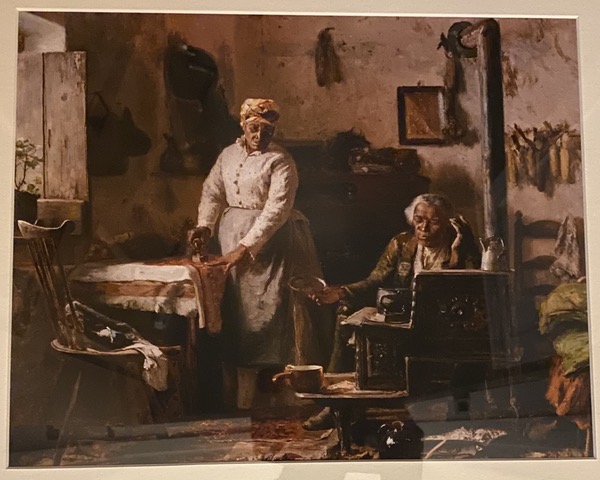
One of my favorite paintings is that of Chloe and Sam painted in 1882 and which is a scene of domesticity. In the absence of any photographic evidence with the camera having been only recently invented, Chloe and Sam is a snapshot into the lives of these two people, their kitchen, their chairs, seats, flowers and living arrangements. The more you study Hovenden’s art the more one sees. Each time I look at Chloe and Sam I see something else; he manages to draw the viewer inwards into the scene. Again, this is largely due to his clever techniques of shading.
As a historian, a famine author and native of Dunmanway, I have three of Hovenden’s prints on my office wall, constantly reminding me of the Irish Famine and the Irish Diaspora and how good often comes from the saddest of situations.
The original Chloe and Sam is under the curation of the Amon Carter Museum at Fort Worth Texas.
Chloe and Sam is just one of many paintings where Thomas is seen to “capture the essence of African-American domestic life” and he compassionately and sensitively brings to the fore the African-American in art in a manner unseen before.
His sensitivity towards this community must surely come from his own Irish Famine background. Perhaps many of his artistic themes of domestic bliss, children and the family unit have their origins in Dunmanway, and how his family unit was torn apart by the ravages of the Irish Famine.
Hovenden gave artistic interpretation to the many themes encountered by the African Americans in his work.
The raid on Harpers Ferry, involving the abolitionist John Brown and his execution in 1859 “electrified” the nation. Years later, being an abolitionist himself and having read the accounts of the trial Thomas painted his interpretation of The Last Moments of John Brown in 1884 for a patron. Today this is under the curation of The Met in New York City. According to their online resource: “A sensational newspaper account reported how he paused on his way to the scaffold to kiss a baby. At the request of a patron two decades later, Hovenden, also an abolitionist, made it the subject of this sympathetic work”.
Thomas Hovenden’s interpretation of the last moments of John Brown is again a snapshot in time, his interpretation of the final moments, meticulously uses shadows and shading to hide the various other elements from being immediately recognizable, the more you look, the more you see, the little children peering out from behind the legs of the adult onlookers.
While I look at my print of the Last Moments of John Brown, I wonder what were Thomas Hovenden’s last moments as he left Ireland’s shores and County Cork? I wonder, did he realize the contribution he would make to art, to the abolition movement and to history? Did he intentionally remember his early years in Dunmanway, West Cork and incorporate them into his work via the titles he gave his individual works?
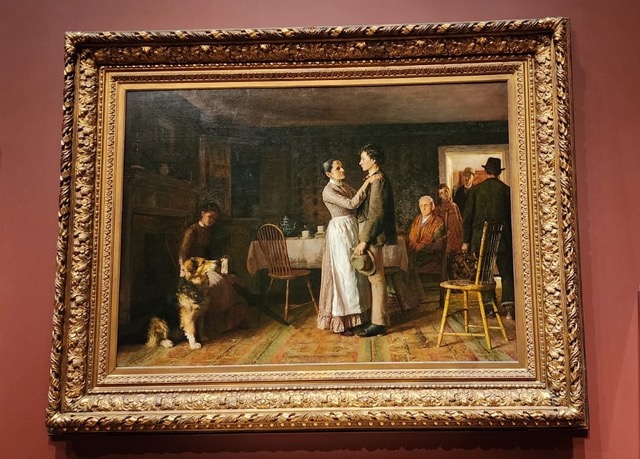
One in particular, Breaking Home Ties is another family scene where a son is leaving home and this print was donated to Dunmanway Historical Association some years ago by a visiting donor.
The donor felt this work was a suitable title to be hung back in his hometown as the Great Irish Famine had broken Hovenden’s family ties.
This work of art was voted the most popular painting in the Chicago World’s Columbian Exposition in 1893. Its audience readily identified with the son saying goodbye to his parents and family as he left the small family farm to seek his fortune and livelihood in the bigger towns and cities, a scene that was replicated all over the United States at the time as the 1890s witnessed a decline in small farms. Again, there is detail everywhere in this picture and family ties are evident, even the family dog makes an appearance.
This work of art also has been a link between myself and some of my American friends who have traced their ancestors to Dunmanway and who, when visiting Philadelphia, visited the Museum of Art there to specifically view Breaking Home Ties. For them it encapsulated in art, the Irish Diaspora and a similar experience of how their ancestors broke with home ties to emigrate and settle in Oregon.
Hovenden’s art lay largely unexplored for the first part of the twentieth century, despite his fame in the nineteenth century. Since the early 1960s and possibly in conjunction with the Civil Rights Movement, his work became the subject of many academic and artistic papers.
Hovenden however came to a tragic end. A railway track near his property saw him and a local ten-year-old girl fatally hit by a locomotive in August 1895.
Speculation and various reports mention stories of Hovenden attempting to save this little girl, however a coroner’s report detailed it a tragic accident. In any event, whether he was attempting to save this little girl or not, the compassion he showed in his life and his art is something no coroner could adjudicate on.
For now, it’s wonderful to see his work is still attracting attention and appreciation in various galleries across America. If I had to use two words to describe the theme behind his work and what it means to me and many of those who I know have appreciated his work in the galleries in America, it would be home ties. Home ties as a phrase that evokes something for us all and in particular those who formed part of the Irish Diaspora.