
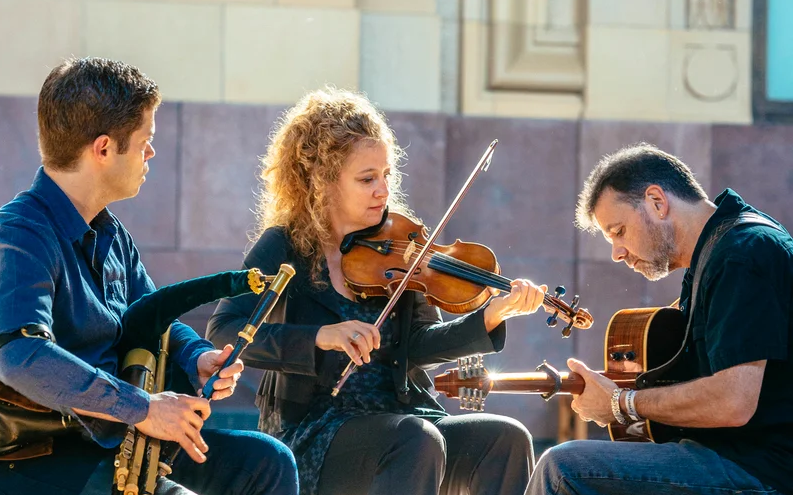
Exclusive Q&A by Brad Balfour
A road-tested, audience-approved trio of Irish musicians, Open The Door For Three released “A Prosperous Gale,” their fourth full-length album this September. It will be available on all digital platforms and CD, and is available for pre-order on Bandcamp. This team of veteran Irish traditionalists includes fiddle player Liz Knowles, uilleann piper Kieran O’Hare and Dublin-born singer and bouzouki player Pat Broaders. Their music combines tunes unearthed from centuries-old collections with newly composed melodies and fresh arrangements of songs old and new. Together, they possess the unmatched energy of a trio of good friends playing great Irish music together. Throughout there are homages to the musicians and bands they grew up listening to.
Knowles –– born and raised in Lexington, Kentucky –– started playing the violin when she was a kid. She went to SUNY Stony Brook to study classical violin, and then branched out into contemporary classical, baroque, and eventually Irish music. While in NY, Knowles became the fiddle player for Riverdance in the late ‘90s.
USA-born O’Hare had family from Clare and Cork. So at 19, he moved to Ireland and lived there for several years, graduating from Trinity College, Dublin. He started playing tin whistle, flute, and uilleann pipes at home in his early teens, learning from many different teachers and mentors on both sides of the Atlantic.
Broaders was born in Dublin to parents from County Wexford. He started playing and singing at home, where his father Dominic played the tin whistle and sang. He was playing in several different bands around Dublin before emigrating to the US in 1990, He now lives in Chicago.
On “A Prosperous Gale,” they explore a fresh set of traditional tunes and new arrangements, delving deep into the heritage they reflect. The album takes its title from a line in one of the songs, ‘William Glen’, in which an ocean voyage begins with “a fine and a prosperous gale.” As O’Hare explained, “We thought it was a really rich and vivid lyric, but it’s also a great way of describing how this music works for us, and how this whole project came together. Of course, we couldn’t resist the low-key pun — while the wind is blowing we’d all be thrilled to become ‘prosperous Gaels’ at some point!O’Hare continued, “We exist within the Irish tradition of music-making, which means that we carry hundreds and even thousands of songs and melodies around in our heads, so we have that deep well to draw from. But Open the Door for Three has always been about digging new wells, too. We actively go out and source material from old albums, old archives, manuscripts, family members, friends, musical mentors. We even learned one tune on this album from an Instragam clip!
The following interview was conducted through email in order to lend support to the latest release.
Q: When did each of you first discover music?
Kieran O’Hare: Pat’s first musical memories would have been hearing Irish songs being sung at home in Dublin by his father, Dominic Broaders. Liz discovered music at home in Lexington, Kentucky, where she was raised by her grandmother. She started banging on a piano as a toddler, but took up the violin at age seven, under the Suzuki method. I started playing my father’s harmonica as a toddler, and grew up with 24/7 music in the house from his father’s record collection; most memorably, albums by The Chieftains.
Q: What were the first instruments you learned to play?
For Pat, it was the tin whistle, then the uilleann pipes. Liz started with the violin. For me, it was the harmonica, then the tin whistle, then the Irish flute, then the uilleann pipes at around 14.
Q: Talk about discovering Irish music.
Kieran O’Hare: One of the things that makes the trio such an interesting musical combination is that the three of us came to Irish traditional music in such distinct ways — Pat and I were born into Irish musical environments, and Liz discovered it later in life.
Pat Broaders was born in Dublin to parents from County Wexford. He grew up surrounded by music –– most immediately the singing and tin whistle playing of his father, Dominic Broaders. He initially took up the uilleann pipes, at least partly on the inspiration provided by family friend, the legendary piper, Tommy Reck. Over time, Pat’s singing came to be influenced by various figures in the Irish and English folk revival: musicians like Christy Moore and Andy Irvine of Planxty, Liam Weldon, and Nic Jones and Ewan MacColl, among many others. Pat emigrated to Chicago in 1990. He’s been a mainstay of the Irish musical scene in that city and across the US.
For me, born in the Midwest into a musical Irish-American family, my first taste of Irish music would probably have been through my father’s Chieftains albums. Then there was the playing of family friend, Frank Martin, who started me out on tin whistle and flute. I traveled to Ireland as a teenager and dove headfirst into the music scene. I later attended university at Trinity College in Dublin, where I became an active member of the Dublin music scene.
Liz attended SUNY Stony Brook as a violin student, firmly on a path of classical music. A chance visit to an Irish festival at the time exposed her to Irish fiddlig. That exposure changed the course of her life. She immediately fell in love with the sound of the violin in its context as a fiddle. She worked Irish traditional music into her trajectory almost immediately.
Q: How did the group form?
Liz and I lived in Chicago from 1999-2010, where we met Pat. We started working together as far back as 2003, beginning with an artistic residency at the University of Florida. Later, Liz and I took on the role of music directors for a couple of large-scale touring productions based in France. They integrated Irish traditional music and dance in a theatrical setting. Pat was a natural fit to bring along on those projects, which lasted until 2012. Open the Door for Three was born out of those years. The three of us began by adapting many of the arrangements they’d made for the large stage, with several musicians, into a trio context. This trio made its first album in 2012.
Q: Talk about the difference between live performance and recording?
Kieran O’Hare: We’ve just spent the last few months working in the studio, putting together “A Prosperous Gale.” In the course of our four albums, we feel that we’ve really refined our work process to prepare for recording. The three of us bring songs and tunes to the trio that we’ve sourced from various places — friends, family, musical mentors, old recordings, manuscripts, archives. We’ll individually sit with that material for weeks or months, generating ideas and possibilities. When we get together, we start to assemble our arrangements. We refine them through the process of rehearsal.
What we record becomes the backbone for the repertoire for our live shows. I suppose we have a reputation for being a very “tight” trio — we often receive the compliment that we sound like more than three musicians — and for our intricate, harmonically complex arrangements. Though these are refined and put down on recordings in the studio, when we play live, we can really focus and relax and put all our energies into the performance. The work of arranging and perfecting has already been done. We can just really dig in and have fun with the music!
Q: Outline the creation of this record both on the production side and writing side ….
Kieran O’Hare: In the past, we had released an album every two years, but the pandemic threw that schedule into disarray. We needed to take some time to reevaluate where we were going. But those long hours in lockdown gave us all a chance to think a lot about where we were coming from, too. The way we develop an album project is different from a band that might get together and crank out all new songs for their new album. As bearers of the Irish tradition of making music, we carry hundreds and hundreds of songs and tunes around in our heads. It’s like a reservoir of music from our oral tradition.
Having said that, we have our own ways as a trio of refilling that reservoir. We are passionate about looking for new material from unexpected places, like archival recordings, manuscript music collections, musical friends and mentors, even the Internet. For “A Prosperous Gale,” we took all of the music we three had gathered in these ways, brought it to the kitchen table, and the three of us played through it. We singled out the songs and tunes that we loved — the ones that provided a certain sound or texture or musical opportunity that we wanted to explore.
On the production side, four minutes from Liz’s and my house in Maine is the fabulous Acadia Recording Company. We’ve built a wonderful working relationship with sound engineer, Jason Phelps and mastering engineer, Pat Keane. They’ve really allowed us to capture the sound of ourselves the way we imagine it, the way we want it. Both of those guys have ears that are really attuned to the nuances and requirements of decidedly acoustic instruments like ours, and that’s a rare commodity these days. We went into the studio with lots of ideas, but having those guys behind the mixing desk really gave us the freedom to play around and develop those ideas for “A Prosperous Gale.”
Q: How different or alike is this release to your other work?
Kieran O’Hare: One of the new departures for us on this album is the inclusion of a couple of different ‘suites’ of music. We started thinking in terms of suites for our live shows. For us this means that we started putting together groupings of seemingly unrelated tunes and songs, which we arrange so that they flow into each other in a seamless way. That gives us a broader canvas of textures and tempos to mess around with and contrast. And also a way to explore more fully the pieces of repertoire that we fall in love with enough to commit to playing over and over!
The track “Farewell, Lovely Mary/The Lizzes” is one such suite. Pat got the song from an old archival recording of Nora Cleary from County Clare back in the ‘70s. It’s an amazing performance: she’s singing solo and unaccompanied, and she is a master at putting across a story through the verses of a song. When Pat got messing around with the song, he added bouzouki to it. And he sort of invented a way of getting a thumpy, almost clawhammer banjo sound out of the hugely resonant instrument he plays. Liz came up with some melody and harmony parts for a very aggressive duet of fiddle and uilleann pipes, and then integrated a stirring reel that our dear friend Liz Carroll wrote. It weaves in and out of the song. Liz plays the stuffing out of it to close out the suite. The whole track churns with different influences, ingredients, and musical connections.
Q: How do you three work together?
After 20 years, we’ve got a set of pretty well-worn wheel tracks in our musical pathway. We know each other pretty well! And we’re thrilled that we’re one of the lucky bands that hasn’t had to resort to group therapy to stay together! We all bring different interests, skills, and experience to the table. It’s the amalgam of the three of us that makes us unique in terms of our sound, but also our human experience of life as music-makers. We really enjoy each other’s company. We’re best friends in life as in the music. I think we’re all really grateful for each other, and for each day we get to make music together.
For more info go to: www.openthedoorforthree.com