
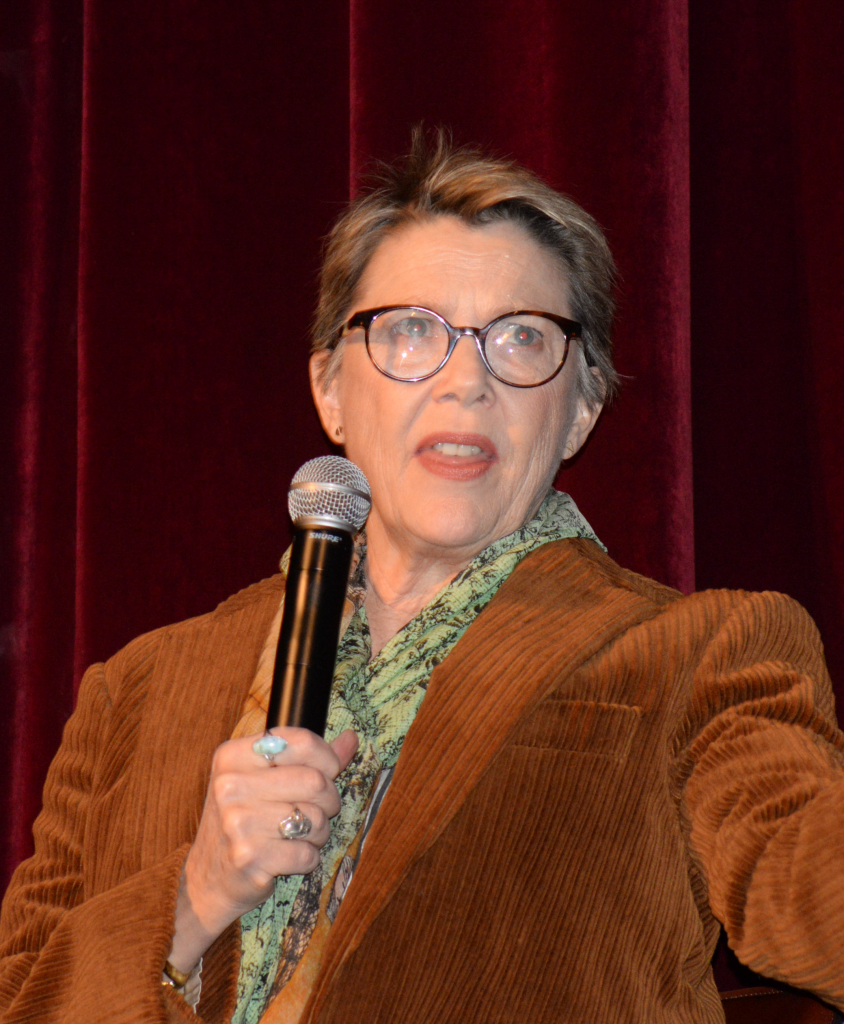
Report by Brad Balfour
Film: “Nyad”
Directors: Elizabeth Chai Vasarhelyi and Jimmy Chin
Cast: Annette Bening, Jodie Foster, Rhys Ifans
Having joined the much vaunted Oscar nominee list again — this time for “Nyad” — actor Annette Bening returns to the spotlight. After years as an A-list star, Bening, who had taken a pause, decided to play Diana Nyad, the world championship swimmer who came out of retirement at 60 in order to traverse the Straits of Florida. She made multiple attempts in the early 2010s to accomplish the 110-mile swim from Cuba to Key West. That’s a near impossible feat for any swimmer, even one at a 30-something physical peak. Finally, at 64, Nyad succeeded on her fifth attempt. She beat sharks, jellyfish, age and the ocean itself.
The film, which co-stars Jodie Foster as her longtime friend and coach Bonnie Stoll, is directed by Elizabeth Chai Vasarhelyi and Jimmy Chin. It’s their feature narrative film directorial debut (after having won a Best Feature Documentary Oscar in 2019 for “Free Solo”). Written by Julia Cox, it’s based on Nyad’s 2015 memoir “Find a Way.”
In a career spanning more than four decades, Annette Carol Bening has received many accolades, including a BAFTA Award and two Golden Globes. Also nominations for a Primetime Emmy Award, two Tony Awards, and five Academy Awards.
Born on May 29, 1958, Bening first hit the stage with the Colorado Shakespeare Festival company in 1980, and then played Lady Macbeth in 1984 at the American Conservatory Theater. She debuted on Broadway in “Coastal Disturbances” (Tina Howe’s 1987 play), garnering a Tony Award nom for Best Featured Actress in a Play. She returned to Broadway in the revival of Arthur Miller’s “All My Sons” (2019) earning another Tony nomination for Best Actress in a Play.
Bening won the BAFTA Award for Best Actress in a Leading Role for playing a materialistic wife in “American Beauty” (1999). She received nominations for five Academy Awards for her roles in “The Grifters” (1990), “American Beauty,” “Being Julia” (2004), “The Kids Are All Right” (2010), and, of course, “Nyad” — which is now streaming on Netflix. She was nominated for a Primetime Emmy Award for playing the title role in the television film, “Mrs. Harris” (2005).
The following dialogue was conducted recently between Vasarhelyi and Bening in New York City. It has been edited and annotated for this publication.
Elizabeth Chai Vasarhelyi: How can an actor such as yourself, come to inhabit so many different lives and roles? Starting with “Nyad”, what did you learn from the roles you’ve played? Does it leave you changed in some way? What is that experience or evolution like?
Annette Bening: As you enter a project — or any creative endeavor — you bring yourself to it in the moment that you’re in, whatever you’ve got going on in your personal life. But with each one, there’s a different group of people, a different creative dynamic going on among the family that’s gotten together to make the project. As you learn later on what you’ve got, sometimes it takes a while to really feel and understand it. Because I started on the stage and hadn’t really seen myself, I hadn’t learned that the inner work is very similar, but doing movies [is a different experience]. It took me a while to really feel comfortable in front of a camera and on a set, working with microphones, machines and all of that. I had been used to rehearsing in a room, then everybody else goes away, and you’re just on the stage. So it’s just a different thing. But it’s great. Every time you do it you learn and grow. Sometimes the size of the challenge is the size of the growth.
Elizabeth Chai Vasarhelyi: In that case, would you say that this is one of the more challenging roles you’ve ever played? Would Diana be up there?
Annette Bening: Yes, in the most delicious way. Don’t we all want a challenge? I think so. In life, I think that when we risk, that’s when we’re free. When we can throw ourselves deeply into whatever it is, whether it’s a relationship or work, whatever the endeavor is, we’re only really free when we can absolutely risk everything. I think that’s why Diana had to do what she did. She needed to risk everything and to never give up in order to feel her inner freedom. There’s something to that, that I find really interesting.
Elizabeth Chai Vasarhelyi: Since we’ve just seen this movie, I was wondering if you could talk a little bit about the swim training you did to prepare for the role. Did you learn anything interesting about yourself through all that swimming? Did it turn you into a swimmer off screen; are you still swimming?
Annette Bening: I am still swimming. What happened was, I read the script and was so touched by it, that I thought she was like no one I had ever read about. As a woman, I’ve never read about this character before let alone the athleticism of it. I didn’t really think about that. I thought about her inner journey and was just touched by the story. That was what made me leap in. I knew you and Jimmy were directing it. I knew that and had the script. I was entranced by it and just thought, “I’ve got to do this. I just have to do this.” It wasn’t until I got into it that I really thought, “Wait, it’s like swimming. Okay, so how’s that going to work exactly?” Now in retrospect, I see it differently, but at the time what I was seeing was, maybe it would be just me or maybe there’d be people helping me.
Can I do that? I was 62 at the time. What am I thinking? I’m a pretty athletic person and was in the water a lot as a kid, but I wasn’t a swimmer. I had an Olympic coach – a swimmer named Rita Owen – who came to my house and I trained with her. She got in the water with me, and we started working. At the beginning, I was quite nervous about whether it was all going to work out. I didn’t quite know what to expect. That uncertainty is important for me to remember. There was a lot of fear, quite frankly, and I didn’t quite know where we would end up. Well, maybe we can fake it and there’ll be other people, and, I don’t know, maybe it will just be me or partly me. I don’t know what I was thinking. It didn’t really make sense.
I just plunged in, kept trying and kept at it. I felt like I was getting a little bit better and better. Then she would shoot videos of me swimming. I think she would send them back to you guys [which showed my progress]. Diana came to my house to see me swim. I was scared. She’s a very nice woman. We had gotten close. She’s an incredibly interesting person to be around. I really fell in love with her and she trusted me. A lot, of course, of what I was doing was thinking, not about the swimming, but about this human being and what’s behind her eyes. The soft parts of her, the complexity of her, because she’s charismatic and really bright, but she’s also impossible. Anyway, [Diana] was dying to come over and see me swim. I made sure that my swim coach was there that day. I don’t know why, but she was going to help me or guard me or something.
Then I came out in the swimsuit — it was like one that she had worn — and she’s like, “Oh, that’s my swimsuit.” She loved that. Then she was like, “Oh yeah, it’s all good.” [After that] we swam together in my pool and she gave me a few pointers. I mean, she had a beautiful stroke and I knew that I just had to have a plausible stroke. It didn’t have to match hers, but I did have to learn how to do it and that’s great, to learn a new skill. It’s wonderful for the brain, the heart and the spirit. And, to be humble, that’s not such a bad thing. I was like, “Oh God, [I don’t know about this]” and then I got kind of like, “No, I have to do this. No one else is going to be swimming for me because that’s going to look fake.” I just ended up feeling like I needed to do it all. I liked being in the water by the way. I was in the water a lot and I enjoyed it.
Elizabeth Chai Vasarhelyi: I’m so happy to hear that now. No, you never complained.
Annette Bening: No, no, no. I loved being in the water.
Elizabeth Chai Vasarhelyi: No, she never complained. She’s so gracious and generous and such a professional that it would be hour-six and Jodie would be like, “Is she still in the water?” She’d take breaks and stuff, so come on!
Annette Bening: It takes a while to reposition the boat. [I kept at it.] And it’s not like I’m swimming for six hours straight.
Elizabeth Chai Vasarhelyi: Let’s just put it this way, when we hadn’t started shooting yet, it was our first day on set. And Annette came from her safety trial – her safety briefing – and all the professional swim safety people were standing around. Everyone’s staring, looking at her, being like, “Oh, here we go.” She got in the water, and it was a moment of wonder. It wasn’t relief, it was absolute wonder because of how natural it was. It was effortless. As you said, it wasn’t about matching Diana. It was finding your own Diana. [That’s something that we’d always remember]. Jimmy and I were so impressed. Of course, you wanted it; you were going to create your own stroke and make it yours in every way. I think that’s very true of the performance as well. How do you see playing a role like Diana Nyad as fitting in with your very wide and varied career and the different characters you play?
Annette Bening: I don’t think of it that way at all. You just take the task at hand, and you take the job at hand, and it becomes very personal. Any good creative work is very, very personal. If you’re lucky enough to get a great role, then you take it very personally.
As you know, I got to meet Diana, spend time with her, really talk to her in depth and I think she began to really trust me. She could see that I wanted to protect her. I’m her advocate. I have her back, and we began to talk very deeply about her life. That was a great experience — to have that kind of intimacy with someone is a beautiful thing. We created a bond between us.
Jodie Foster was also meeting with Bonnie. Then the four of us got together, hung out and talked. It was a really wonderful experience for all of us. Hopefully going towards making a story that maybe other people could enjoy. That’s really the goal of it, on a personal level, not even connected to the film. It’s a wonderful thing to be immersed in someone else’s reality and to really deeply, deeply empathize. It was great.
Elizabeth Chai Vasarhelyi: One other first. When Jimmy and I first sat down with both you and Jodie together, I think it was the first time you guys looked at the script together and began reading. The spiciness of the connection, the real-time work that was happening in the moment — the energy was something incredible for us. I’m just curious, what is that like as an actor when the relationship between you and Jodie on the screen as Bonnie and Diane is palpable. It’s the beating heart of this film. What is it like to cultivate that with another actor?
Annette Bening: It’s the very center of the job and you are only as good as your partner is. When you have someone very open, intelligent and committed like Jodie is, then a lot of it is that my work is done because Jodie’s there and I can watch her and listen to her. Most of acting is listening and if you think about the great moments on film, you think about certain actors. I know I do. I love going to the movies. I love watching them. I’m a huge fan. Often an actor might just be listening, responding. It also might be a story point that’s happening in a film.
You know, I asked her the other day, “How long have you been in the business?” She’s 61. She said, “57 years.” She’s been acting since she was a little girl. And she’s done it all. She’s a director, writer and producer. So all of that matters. We talked about how shooting a film on the water is. Everything takes three times as long, and it’s just a very, very challenging environment in which to shoot. You have to be organized.
And yet, a maximum creative situation has some chaos that you need. You need a certain amount of surprise in order for there to be something magical on screen. With a film like this, it’s tricky to find that because there’s a massive amount of logistics involved. We were shooting in a tank and you can imagine the logistics of that. We needed to find that maximum creative energy among everyone to have the ability to disagree in a creative way without it being taken personally.
It’s a good thing when someone says, “Well, maybe you should come in from that direction.” And somebody else is like, “I think she should come in from that direction.” In films, that can have a huge impact. Then you need to be able to have those moments where everybody can sit down together and the best idea hopefully comes out of everyone being able to voice their ideas. Everyone is heard and then, maybe at the end, the best choice becomes obvious.
Elizabeth Chai Vasarhelyi: Because we’re in New York, I want to talk about theater. You’ve been in two Broadway plays, shows in New York. You were nominated for a Tony both times — for Tina Howe’s “Coastal Disturbances” in 1987, as well as the revival of “All My Sons” by Arthur Miller, opposite Tracy Letts, which was amazing. I saw it in 2019. Why is it important for you to keep on playing on the stage and revisiting these stories? You’ve played Heather Gabler. Theater has played a very important role in your life.
Annette Bening: Well, my husband is rooted in LA. I have four children. They’re now grown. But back in the day, the only way for me to do a play was to do it in LA. I just couldn’t be gone that long. I didn’t choose to be gone that long, let me put it that way. So, I figured I could do some plays in Los Angeles, which was good. I was glad that I did that. I don’t know if it’s interesting to hear about that, but that’s how I started. I just went to the theater and fell in love with watching it as a kid. I was taken by my teacher to the local nonprofit theater in San Diego called the Old Globe Theater. Then I started doing plays in high school. It’s not an unusual story. Then I went to Community College, which was a dollar a unit. They had a theater program which happened to be really great. They were doing plays. I had no idea what Bertolt Brecht was talking about, but we were doing plays by him.
I later learned that it’s just the intellectual rigor of the theater and that always interested me, the dramatic literature. I was in many, many bad plays. My parents went to see all of them because they’re nice people. But if you get it right, there’s this incredible marriage of emotion and intellect in the theater. It’s all about language. I loved hearing the voices of actors. That was one thing I loved about the theater. It’s such a different thing than the visual medium that we’re talking about. That’s how I started. I really didn’t do movies until I was almost 30. It was something that just came very naturally to me. I got interested in it, and then just kept doing it. But I love the theater and still do.
Elizabeth Chai Vasarhelyi: For my own personal edification, is there anything that you were interested in tackling next in the theater in either New York or LA?
Annette Bening: I used to feel there were many things that I did want to do. I don’t know for certain that there still is. It depends on the day, if I read something. There’s a few classics that I could read and think I need to do. Then on another day, I would think, maybe not. There’s a part of me, I like taking time off. I like being away from work. I have always done that because I had kids. It was a great opportunity to stop and walk away from this and walk away from that and walk away from the theater and just be. I find that very interesting now too.
Elizabeth Chai Vasarhelyi: You were nominated for an Oscar and, as I heard, on Netflix, there was a bomb of a million viewers in something like 24 hours of the film [going live]. That’s a lot of people, probably a lot more than are seeing movies in the theaters. In view of the trajectory of when the film was released, I’m curious if you’ve experienced the reception of audiences differently. I know it’s different because the strike was on, but I’m curious, as an actor, do you get a sense that more people have seen your work in this particular [circumstance]?
Annette Bening: Because it’s on Netflix, there’s, I think, 300 million international subscribers. I definitely have heard from people that I haven’t heard from in a long time. Colleagues of mine or people I went to acting school with or just different people from my life even my doctor. They play lots of movies and you can tell when someone likes a movie. And you can tell when someone’s just being polite. You can tell when someone has reached out because they’ve been touched by it.
We did a screening last week and a little girl was in the audience, probably about 10, and she came up to me afterwards and handed me the most beautiful note. She just said, “I think you worked really hard.” It was so sweet. What I want when I see something, is to be touched. Yes, I want to learn but the bottom line is I want to be moved. If that can happen for people, then it feels like it’s all worth it.
Elizabeth Chai Vasarhelyi: I had a lot of feedback that “Nyad” makes someone want to move, to exercise more. A guy the other day said, “My wife made me watch it. I was really inspired and now I’m back on my exer-cycle.” I got a lot of emails like that.