By Geraldine Comiskey, all photos by Alf Harvey
Irish farmers have a saying: “Where there’s muck, there’s luck”.
Last week the luck of the Irish was in abundance at the 92nd annual National Ploughing Championships, which was the muckiest on record according to Ladbroke’s bookies.
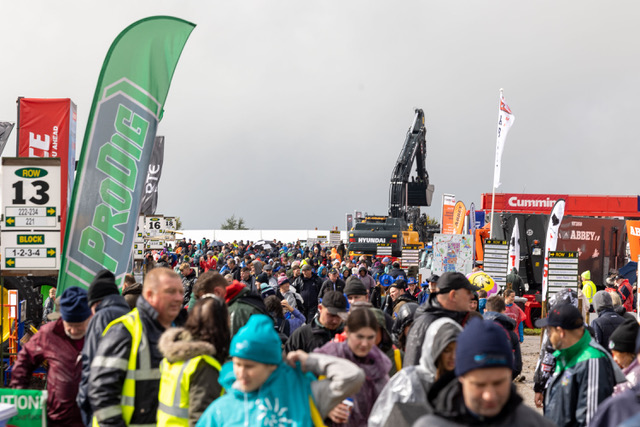
That did not stop more than 200,000 [200,550] visitors headed to a muddy patch in the midlands last week for the three-day pow-wow in the countryside.
While this was 76,450 fewer than last year, “The Ploughing” as it’s known, was still Europe’s biggest outdoor event – and arguably its best value, whether you were there to do business, go shopping, talk politics or just enjoy the free food, entertainment and a chance to meet friends from every corner of the country.
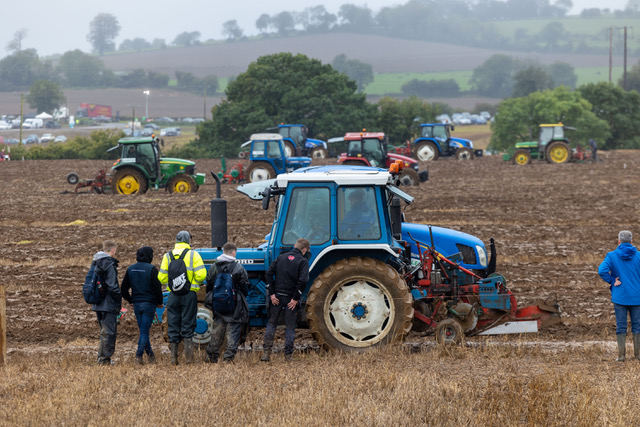
Hardcore ploughing enthusiasts headed to the far-flung fields to see more than 320 tractor drivers compete for 19 titles.
But most people didn’t go near a tractor. Indeed, the Ploughing attracts as many city dwellers every year, lured by the assurance that it’s “like a city built in the middle of the countryside!”
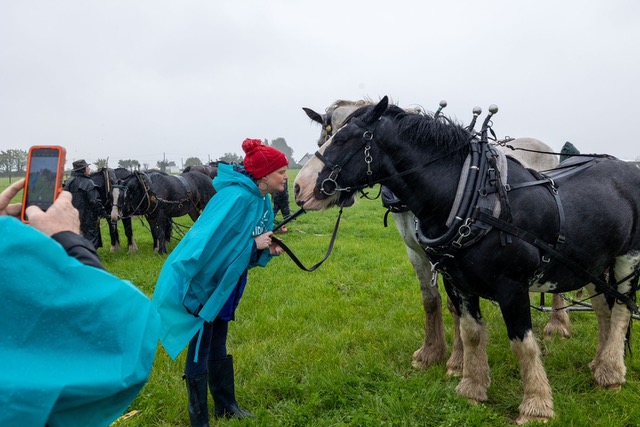
Just down the road from the recent Electric Picnic, the iconic event (known simply as “the Ploughing”) has the atmosphere of a festival, only with a wider demographic, talk shows instead of music (all the national broadcasters decamp to the Ploughing for the three days) and 1,700 trade stalls selling everything from combine harvesters to designer clothes, avail of services ranging from a quick health check-up to having your fortune told, join the Army or find a new religion.
Popular features this year were the fashion show, sheep shearing and welly throwing contests, a funfair, a brown bread baking competition, the tents where chefs demonstrated their skills (and handed out goodies!) and live radio shows (RTE, Midlands 103 and KCLR were on-site for the three days).
Wacky events included an attempt to set the World Record for the most wellies thrown (the Guinness Book of Records is expected to confirm this in the coming months), a horse-shoe throwing contest and the Holographic Experience, in which punters got to make 3D holograms (“volograms” of themselves courtesy of Screen Ireland, the National Talent Academies and a company called Volograms. Screen Ireland also had a networking hub for wannabe film industry professionals.
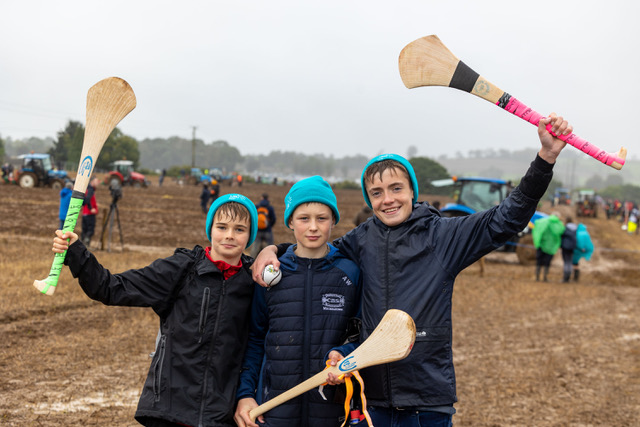
Tourists in particular were targeted by commercial companies and State bodies promoting hotels, arts and outdoor activities.
Sport Ireland launched new trails open to hikers and previewed their Get Ireland Active initiative. There were also opportunities to try out kayaking (using VR technology – though there was no shortage of muddy pools!) and play Ireland’s finest golf courses using VR technology.
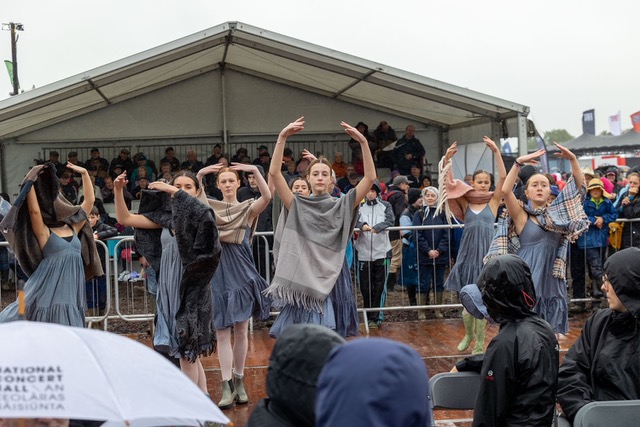
Music buffs could choose between taking part in a drumming workshop run by the National Concert Hall’s percussionists, listening to live bands (including the local Laois Trad Orchestra and Trad Group, the Bass Brothers Country Band which consists of Irish Travelers, Music Gen Rock Band and the Malva Ukrainian Choir) – or waltzing in your wellies to Irish country star Mike Denver.
Traditional crafts were on display too, whether you wanted to buy an Aran geansai or actually get out those knitting needles and add a patch to the “Wall of Wool” (an initiative devised by Creative Ireland). There was also a workshop in how to make a Harvest Knot out of straw, with instructors from the Department of Education and National Museum of Ireland and hay freshly reaped from the local fields. In keeping with the spirit of the festival, this workshop ended with a Harvest Dance, with participants wearing hay knots in their hair and clothes.
Of great interest to people looking up their roots was the National Archives exhibition of photos dating from 1923-46 at a marquee hosted by the Department of Arts, Culture, Sport and Tourism marquee.
Despite its size and the density of the crowd the Plouging is also probably Ireland’s safest event, with local volunteers acting as stewards and organizations such as the Red Cross and Civil Defense holding on-the-spot First Aid clinics.
Costing more than €6 million to run and involving a massive roads-policing plan, the event, which started in 1931, was only cancelled once: in 2020, during the Pandemic “Lockdown”.
This year it returned to Ratheniska, Co Laois, a midlands townland with one school, one church, a community hall, a GAA club and less than 100 postal addresses.
While Laois’s fertile fields were clearly a major factor in deciding to hold the event here for the sixth time (and the third year in the row), the location was also chosen for its accessibility: just off the main Cork-Dublin-Limerick motorway junction, and easily to reach from any part of the county by car, train or bus (there are shuttle buses running from Portlaoise town).
And it is business above all that drives the Ploughing. With exhibitors coming from all over Europe and as far afield as New Zealand, the Ploughing has something in common with that other Irish icon, the Late Late Show, in that there really is ‘something for everyone in the audience’.
The Plough’s star is Anna May McHugh, who has been MD since 1973. Despite facing her 88th birthday at the end of this month [on September 30], the Laois farmer is showing no appetite for “retiring”.
Having initially joined the National Ploughing in 1955, the former Queen of the Plough is credited with turning the Ploughing into an event that is no longer “just for farmers”. The fashion show was one of her many game-changing ideas and the show has her dynamic personality stamped all over it.
Controversies
Of course, it wouldn’t be an Irish gathering without a big row and this year, as usual, the air was buzzing with controversy as it attracted farmers, politicians, businesspeople, and just about anyone with an agenda to promote.
The first big barney had broken out before the gates even opened. Anxious to avoid having to turn people away at the gate like last year, the organizers tried to encourage visitors to book in advance by charging an extra fiver for those who showed up at the gate. But the dual-pricing strategy sparked outrage with regulars including Jackie Flannery of the Irish Rural Association who said elderly people in particular were “very upset” to hear that “the Ploughing has gone cashless!”
Defending the decision, the event’s Assistant MD, Anna Marie McHugh, said they had to curb numbers on health and safety grounds, having taken advice from the emergency services.
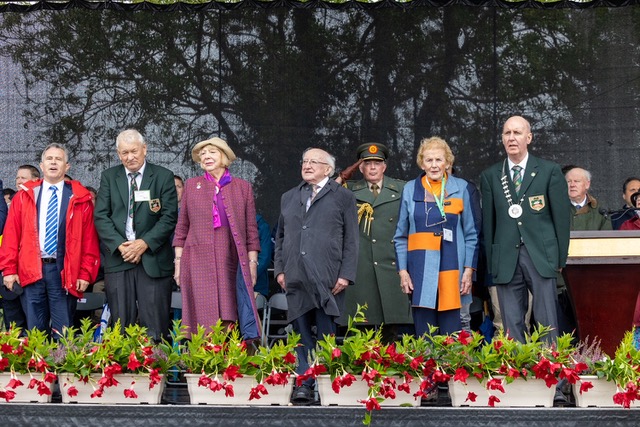
President Michael D Higgins ploughed into controversy as he opened the event, angering beef farmers by urging the Irish to change their diet to save the planet. While he did not directly condemn meat, he said: “You’re going to see big changes in diets. Change is not easy, but it is unavoidable for survival.”
His comments outraged Irish Farmers’ Association boss Tim Cullinane, who said: “I don’t think we need anybody, whether it’s President Higgins or whoever, advocating to people the type of diet to consume.”
However, President Higgins slightly mollified farmers when he added that consumers should be willing to pay more for sustainable Irish farm produce.
Another big controversy was the absence of Taoiseach Leo Varadkar, Tanaiste Micheál Martin and their coalition partner, Green Party leader Eamon Ryan, who were in New York for the whole week, to attend the UN General Assembly, with Mr Varadkar co-hosting the Sustainable Development Summit.
While Agriculture Minister Charlie McConalogue, Justice Minister Helen McEntee and Housing Minister Darragh O’Brien made brief appearances, Mr Varadkar and Mr Martin missed the chance to go head-to-head with irate farmers wishing to air their grievances in person.
They also missed a riot outside Government Buildings as “far right” activists sought to disrupt the first day of the new Dáil term, protesting on a range of issues (an open-borders policy on immigration, homelessness and healthcare, cost of living, “Green” taxes, aspects of the new sex education curriculum in primary schools, the content of children’s books in public libraries, availability of puberty blockers and proposed “hate speech” legislation).
In contrast to the gardai who were arresting eleven noose-wielding demonstrators outside Leinster House, their colleagues at the Ploughing had a more peaceful week as they managed Ireland’s biggest traffic policing plan.
Ironically, one of the main topics of conversation at the Ploughing was rampant rural crime due to a shortage of gardai (which the Association of Garda Sergeants and Inspectors blamed on new rosters – and voted “no confidence” in Commissioner Drew Harris).
Other hot topics included a reduction in Ireland’s nitrates derogation (a mechanism to allow a country to apply the EU penalties for excessive nitrates production less stringently), curbs on diary and beef production to meet “Net Zero” targets, the “mica” concrete scandal (which has affected homes built in rural Ireland since the 1990s), proposed new motoring speed limits, crowded hospitals, planning laws restricting farmers from building homes for their children on their land, a lack of accommodation for rural youths attending university in our cities – and the lack of legal standing in Ireland for “prenuptial” agreements (40 per cent of farmers who took part in a survey said they worried about the family farm passing into a stranger’s hands following a divorce).
All the main political parties – Fine Gael, Fianna Fáil, Sinn Féin, the Green Party and Labour – had a presence at the event, along with a few niche parties including Aontu (a center-right breakaway from Sinn Féin) and the “far right” National Party, which had election-style posters along the roads into the event featuring new “leader” James Reynolds. Reynolds, a former Irish Farmers’ Association President, recently seized control of the party from Justin Barrett.
Independent MEP Luke ‘Ming’ Flanagan was encouraging farmers to grow cannabis – to feed to their cows! “It has a higher protein content than soya”, he told the Irish Examiner USA, adding that he regularly vapes cannabis.