
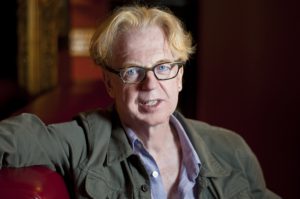
Q&A by Brad Balfour
Rockaway Blue
Larry Kirwan
Three Hills/Cornell University Press
To most who know him, Larry Kirwan has been thought of as the leader of Black 47, a New York-based Irish rock band with clearly left-of-center political leanings. Founded with Chris Byrne in late 1989 after a jam in Manhattan’s Paddy Reilly’s Pub, the band has released a library of 17 CDs such as 1993’s Fire of Freedom (which included the hit “Funky Ceili”), 2008’s Iraq and 2010’s Bankers and Gangsters. The now-disbanded group performed over 2000 shows in its career. But Kirwan is still performing and plans on hitting the road later this year.
Though he’s done that for the past 25 years, this elder statesman is also the author of six books, including Rockaway Blue — his most recent. Besides the others — among them, Liverpool Fantasy, Rockin’ The Bronx, and Green Suede Shoes — he’s created 16 plays and musicals, including Hard Times and Rebel in the Soul — and hosts Celtic Crush, a popular radio show on Sirius/XM.
As scribed by Kirwan, Rockaway Blue tells a poignant tale of a family struggling to recover after an unthinkable trauma. It starts with the World Trade Center terrorist attack on September 11, 2001. After Lieutenant Brian Murphy rescued seven people, he rushed back up the stairs of the North Tower in search of others in need. He died a hero, one of more than four hundred police officers, firefighters, and other first responders who perished that day.
Three years later, his Vietnam veteran father, Jimmy Murphy, a retired NYPD detective-sergeant, takes on the mission to find the truth behind his son’s death. Why was Brian in the tower that morning? Had he anticipated the attack? Suspecting a cover-up, Jimmy must confront his family, friends, and old colleagues in the police department to discover what happened to Brian and who, exactly, was his eldest son.
Murphy journeys from his home turf in the Irish American enclave of Rockaway Beach to Muslim Atlantic Avenue and beyond in the course of his investigation to find his own truth about 9/11. With a sure hand and clear-eyed cultural insights, this former Wexfordian authors his own unique take on many contemporary topics and concerns under the guise of an intriguing detective story.
Prior to Black 47, Kirwan and fellow Wexfordian Pierce Turner were the house band in Malachy McCourt’s Bells of Hell in Greenwich Village. A fusion of Celtic folk, trad, prog-rock, and punk, their ensemble was one of the few groups banned from CBGB’s. In the words of Hilly Kristal they were “too demonic”. Their new wave band Major Thinkers got signed to Epic-Portrait and they recorded one album, Terrible Beauty, which was never released — but prior to those sessions, they garnered a national radio and dance hit, “Avenue B is the Place to Be.” After a performance in Irving Plaza on St. Patrick’s Day 1985, they disbanded.
Born in the early ’50s, Kirwan’s celebration of many things Irish also includes having done a weekly column for the Irish Echo and a various artists compilation for Valley Entertainment titled Larry Kirwan’s Celtic Invasion which he co-produced In 2013.
But now his primary concern is getting the word out about his latest novel which tackles many issues on the mind of Kirwan and many of the rest of us.
Q: What’s the difference for you in making music versus writing — especially in doing a novel?
LK: At this point, I’ve integrated the three (music writing, playwriting, and novel writing) into how to tell a story. The difference is more in the process. With Black 47 it was making sure the structure of the song would enable the great instrumentalists in the band to interpret and expand it musically. So the lyrics had to be 95% polished as none of us would listen to them until we first performed the song in front of an audience. It was all about the music.
With playwriting, it’s all about hearing the words in your own head but making sure that both the statement and the sound of the words fits the character. And if it’s a musical, then both the music and lyrics must also drive the story.
With novel writing, it’s just you, the story and the characters you’ve created. As the story progresses the task is to link the different characters, while at the same time allowing them to breathe.
With all three, I try to employ the Eugene O’Neill concept — “a touch of the poet.” You don’t want your work to be overtly “poetic,” but you do want some “poetry” in there, because that’s what ultimately touches the listener, watcher, or reader. Without that you might as well go down to Wall Street and make some money. It’s a lot easier.
Q: Describe the creative process of each and how they affect you emotionally both in terms of satisfaction and expression.
LK: The songs are still the most satisfying. They’re magic — it’s like a hammer hitting an anvil, sparks fly, and words and music merge together. There are moments like that with play and novel writing but they’re more craft — not unlike a carpenter or mason, who looks at something they’ve created and feels a pride in their work.
With plays/musicals, the actors take over when you’re finished, so you’d better have given them a firm foundation. With a novel, you’re sowing seeds in the reader’s mind, some will flower, some will never be noticed, and some will die on the vine.
Q: Do you see your songs as narratives and if so, are they like short stories or notes for something novelistic?
LK: Songs vary, in my case anyway, depending on what was my intent. They can be slices of life, short stories, or even mini-novels. Let’s take two songs from the same Black 47 album, Fire of Freedom. “Fanatic Heart” was an attempt back in 1990 to sum up the Troubles in Northern Ireland. I lay out a set of circumstances that include the death of a loved one, all seen through the eyes of a character now living in New York. It’s heartfelt but you can tell at the end of the song that the protagonist has been damaged by the whole affair. Then I place a repeating line from a sermon by Rev. Ian Paisley as the song fades, “If the foundation be destroyed, what can the righteous do?”
There’s no finish. Did the song achieve what I intended? I think so but it’s more like an impressionist painting. I didn’t want it to be definitive, because the problems of the North will not be solved in my lifetime.
But contrast it against the song “James Connolly.” I wanted that to be a powerful and definitive portrait of a practical man who knew he was setting off on a suicidal mission on Easter Monday 1916. In Connolly’s middle inner dialogue we listen to him confront his doubts and fears, and yet by the end of the song he is resolved to go through with his mission.
Which song is the most popular? Connolly by a mile! People prefer definition. Yet I count them both as artistically successful, Fanatic Heart as an ongoing churning portrait, and Connolly as an inspiring anthem.
Q: How much distance from your own life do you need to craft a novel; it is the same for songs or not?
LK: You’re always a part of each character — that’s the only way you can get to know them. But with Rockaway Blue, the characters all lead very different lives than I do. And yet, I’d spent a fair amount of time out on the peninsula, my brother, Jimmy, lives in Breezy Point, and Rockaway Beach was Black 47 country. I know the lifestyle and how people react to situations from having so many friends out there. We used to call it The Republic of Rockaway, it’s a very distinctive place and that’s why I set the story there.
With songs it’s different. You can be the narrator, the subject, the object, whatever you wish. And since most songs have some sort of sexual basis you can easily transpose — you have much more creative freedom writing songs.
Q: How much of your own life do you incorporate in your creative work — is it a tangled dance or a smooth shuffle?
LK: It can be anything from a hot tango to cool quickstep with your maiden aunt. But songs also depend on if you’re writing them for yourself or someone else.
Back in the 1980s, I was a much more conventional songwriter. Pierce Turner and I had a big record deal as Major Thinkers with Epic/Portrait. Then we got dropped and I became a playwright for four years.
When Chris Byrne and I formed Black 47 we needed original songs fast to fill up four sets a night up in The Bronx. I wrote like crazy for a year. It was only when critics began reviewing our songs I discovered that I had been using playwriting techniques to write character-driven songs. I had developed a style without realizing it and many of the songs had touches of autobiography.
Q: Rhythm plays a big part of your life — do you see how it does in crafting a book?
LK: Yeah, everything moves to a beat. Take Johnny Cash, I hear the beat of trains in most of his songs. Everyone not only speaks to a rhythm but to a key. Right now I can hear the way each character in Rockaway Blue speaks. The first thing I do when writing a novel or play is to let the characters talk and write it all down for three or four pages – doesn’t matter what they’re saying, although I often find I use pieces from those initial rants. I learned a lot from James Joyce. He had a background in music. There’s a rhythm to everything he wrote and if you don’t catch it, reading him aloud on Bloomsday can be a disaster.
Q: Now that this phase of the pandemic is winding down — or so it seems — how do feel about getting on the road again
LK: After 25 years of non-stop touring with Black 47 I have no great desire to hit the road again. I know every bend on Routes 80 and 95. Besides Covid-19 will have hastened a change that was already underway. Many clubs, pubs, theatres, arts centers have gone out of business. I’ll do some gigs for the hell of it, to see old friends, and keep my hand in, but without being able to sell CDs the Rock ‘n’ Roll business plan doesn’t work anymore.
Q: Who do you consider as influences on your music?
LK: My musical influences are legion. I was at CBGB’s for the early days of Punk, saw all the great Prog Rock bands, Dylan, the Jazz clubs in the Village, the early Trad sessions of The Eagle on 14th St. and The Bunratty in The Bronx. Eventually I found my voice and never looked back.
Q: And with your fiction?
LK: I’m still learning from fiction but I had a solid grounding in James Joyce, Ernest Hemingway, Henry James, Lawrence Durrell, Edith Wharton, Edna O’Brien, Henry Miller… The list is endless. I enjoy a lot of the newer writers, Mary Beth Keane, Jeanine Cummins, and Anne Enright’s The Green Road is captivating me right now.
Q: Who are your personal heroes/villains?
LK: I’d have to say that Fr. Mychal Judge is the only saint I’ve ever known. Donald Trump may be the most dangerous for destroying the boundaries of truth and making ignorance cool.
Q: What were the toughest plot points for you to realize and the toughest character(s) to create?
LK: It took a while to turn Rockaway Blue into a believable mystery without straying into conspiracy. And it took me a long time to get to the heart of Maggie Murphy, the wife and mother in the same book. Oddly enough I was only able to find her by introducing the memory of her grandmother who had emigrated from Galway to Rockaway Beach as a young woman. You just never know where your break is coming from.