

Musing while in lock down, Johnny Cash came to mind. An American singer, songwriter, musician, and actor, Cash’s music often addressed themes of sorrow, moral tribulation, and redemption, especially during later career stages. With his deep, calm bass-baritone voice, the distinctive sound of his Tennessee Three backing band (characterized by train-like chugging guitar rhythms), his rebelliousness coupled with an increasingly somber and humble demeanor, and his all-black stage wardrobe, earned him the nickname “The Man in Black.”
Born J. R. Cash, (Feb. 26th, 1932 – Sept. 12th, 2003), to poor cotton farmers in Kingsland, Arkansas, he rose to fame during the burgeoning rockabilly scene in Memphis, Tennessee, after four years in the Air Force. Traditionally, he began concerts by simply introducing himself, “Hello, I’m Johnny Cash,” followed by “Folsom Prison Blues,” one of his signature songs. Alongside that song, his other signature compositions include “I Walk the Line,” “Ring of Fire,” “Get Rhythm,” and “Man in Black.” He also recorded humorous numbers like “One Piece at a Time” and “A Boy Named Sue”, a duet with his future wife June called “Jackson” (followed by many further duets after their wedding), and railroad songs such as “Hey, Porter,” “Orange Blossom Special” and “Line.” And, he was known for free prison concerts,
In total, he wrote over 1,000 songs and released dozens of albums. A box set titled Unearthed issued posthumously consisted of four CDs some with unreleased material recorded with Rubin, as well as a Best of Cash on American retrospective CD. It also included a 104-page book that discusses each track and featured one of Cash’s final interviews.
Cash received the Grammy Lifetime Achievement Award In 1999. In 2004, Rolling Stone ranked Cash number 31 on their “100 Greatest Artists of All Time” list and No. 21 on their “100 Greatest Singers” list in 2010. Then in 2012, Rolling Stone ranked Cash’s 1968 live album At Folsom Prison and his 1994 studio album American Recordings at No. 88 and No. 366 in its list of the 500 greatest albums of all time.
American V: A Hundred Highways, one of Cash’s final collaborations with producer Rick Rubin, was released posthumously on July 4, 2006. The album debuted at number one on the Billboard Top 200 album chart for the week ending July 22, 2006. On February 23, 2010, three days before what would have been Cash’s 78th birthday, the Cash Family, Rick Rubin, and Lost Highway Records released his second posthumous record, American VI: Ain’t No Grave. Two tribute albums were released shortly before his death; Kindred Spirits contains works from established artists, while Dressed in Black contains works from many lesser-known musicians.
During the last stage of his career, he covered songs by contemporary rock artists of the time; his most notable covers were Nine Inch Nails’ “Hurt,” Soundgarden’s “Rusty Cage” and Depeche Mode‘s “Personal Jesus”.
Cash nurtured and defended artists (such as Bob Dylan) on the fringes of what was acceptable in country music even while serving as the country music establishment’s most visible symbol. At an all-star concert which aired in 1999 on TNT, a diverse group of artists paid him tribute, including Dylan, Chris Isaak, Wyclef Jean, Norah Jones, Kris Kristofferson, Willie Nelson, Dom DeLuise, and U2. Cash himself appeared at the end and performed for the first time in more than a year.
In 1963, Cash was easily at the height of his popularity when he toured Ireland — having sold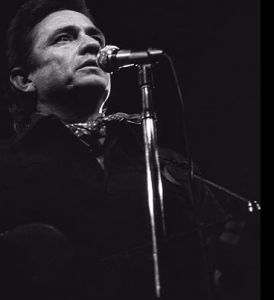 close to 11 million records by that stage, and had only just released one of his most well-known songs, ‘Ring of Fire’, five months prior to touring Ireland. He played the Man In Black’s tour of Ireland, where he played concerts in Cavan, Dundalk, Mallow, Limerick, Kilkenny, Mullingar, Athy, Galway, Rush and Dublin.
Cash was one of the most well known country singers in the world at that time. When he finally went there, this is what his son John said when he saw how beautiful it was, “He saw the history that was right there to be seen and he was connected, of course, by blood. My father has Irish blood, but by heart and by the love for a beautiful, beautiful place and a fine, kind people.”
It goes to prove if you’re Irish come into the parlor there’s a welcome on the mat. And he did. They loved him and could not get enough of him as he brought the house down where ever he performed.