Reflections by Brad Balfour
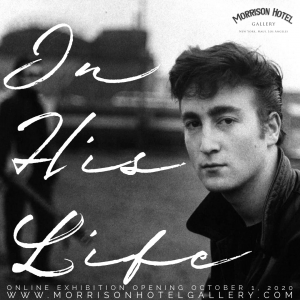
On October 9th, John Lennon, the former superstar Beatle, and genius singer/songwriter, would have been 80 years old. Born in 1940 at Liverpool Maternity Hospital to Julia and Alfred Lennon – a merchant seaman of Irish descent who was away at the time of his son’s birth – the young Lennon had an unconventional start right from the beginning.
Named John Winston Lennon after paternal grandfather John “Jack” Lennon (and Prime Minister Winston Churchill), the boy’s absent father sent regular paychecks to 9 Newcastle Road, Liverpool, where Lennon lived with his mom until February, 1944. Then the checks suddenly stopped.
Six months later, Alfred returned, but Julia — then pregnant with another man’s child — rejected him. But after her sister Mimi complained twice to Liverpool’s Social Services, Julia herself had to relinquished custody of her son to Mimi. In mid-1946, Lennon’s father visited and took his son to Blackpool, secretly intending to emigrate with him to New Zealand. Julia followed with Bobby, her partner at the time — and after a heated argument, John’s father forced the five-year-old to choose. As his mother walked away, the boy began crying and followed her.
From Dovedale Primary School, he went on to Liverpool’s Quarry Bank High School starting in 1952 to ’57. Described as a “happy-go-lucky, good-humored, easy going, lively lad,” Lennon drew comical cartoons that appeared in his own, self-made school magazine called the “Daily Howl.”
In ’56, Julia bought John his first guitar, an inexpensive Gallotone Champion acoustic, who had the instrument delivered to her house and not Mimi’s, knowing that her sister didn’t believe in his musical aspirations. Though skeptical of his claim that he would be famous one day, Julia hoped he’d grow bored with music, often telling him, “The guitar’s all very well, John, but you’ll never make a living out of it.”
Unfortunately, Julia was killed by a car on July 15th, 1958, and her death traumatized the teenaged Lennon. He drank heavily for the next two years and got into fights, consumed by “blind rage.” His mother’s memory would later serve as a major creative inspiration, prompting songs such as “Julia,” the 1968 Beatles song.
Lennon’s senior school years were marked by a behavioral shift. His teachers described him this way: “He has too many wrong ambitions and his energy is often misplaced; his work always lacks effort. He is content to drift instead of using his abilities.”
Subsequently, this misbehavior created a rift with his aunt. Though he failed his O-level exams, he got accepted into the Liverpool College of Art after his aunt and headmaster intervened. At the college he began wearing Teddy Boy clothes and was threatened with expulsion. As Cynthia Powell has reported — she was the young man’s fellow student and later his first wife — John was “thrown out of the college before his final year.”
In September 1980, the 39 year-old commented about his family and his rebellious nature: “A part of me would like to be accepted by all facets of society and not be this loudmouthed lunatic poet/musician. But I can’t be what I am not. I was the one who all the other boys’ parents — including Paul’s father — would say, ‘Keep away from him.’ The parents instinctively recognized that I was a troublemaker, meaning that I didn’t confirm and would influence their children, which I did. I did my best to disrupt every friend’s home.
Then Lennon added, “Mother just couldn’t deal with life. She was the youngest and she had a husband who ran away to sea. The war was on and she couldn’t cope with me, and I ended up living with her elder sister. Now these women were fantastic, and that was my first feminist education. I would infiltrate the other boys’ minds. I could say, “Parents are not gods because I don’t live with mine and, therefore, I know.”
Because of his frustration and rebel nature, the young Lennon was ultimately motivated to form his first band, the Quarrymen, and that led to the Beatles. The band – consisting of Lennon, Paul McCartney, George Harrison and Ringo Starr – became a massive cultural force that expanded across the globe, affecting the planet both aesthetically and philosophically.
After shaking things up with his little quartet (which lasted less than a decade), the moody but snarky singer/songwriter/guitarist moved to NYC after the dissolution of his band to develop his relationship with his paramour, the conceptual artist Yoko Ono.
During the time he spent in The City, Lennon protested the Vietnam War, formed a proto-garage band with the late David Peel, and embarked on an alternative sexual lifestyle spending time with girlfriend May Pang which was approved by his wife, Yoko. He fought immigration officials who wanted to revoke his legal status for his leftwing political views, Lennon embarked on an incredible creative period of his life while starting a rapprochement with his former band mates.
To many of my music crit associates, Lennon represented the best of the Beatles. He was the force behind its experimentation and metaphor-bending lyrics. Many of the group’s evocative, exotic and surreal sounds could be traced back to his influence. Though classics like “Yesterday” established the band’s commercial viability, Lennon brought to the quartet the many psychedelic elements found on such Beatles albums as “The Magical Mystery Tour” and “The White Album.” His experimental ideas were echoed in fellow mop-top George Harrison’s songs as well.
As the ‘80s started, Ronald Reagan became President, punk came onto the scene and Lennon was a leading voice of mainstream rock’s cutting edge. For me, he represented a kind of evolution that suited the era.
When he hit his 40th year, it was a time which suggested that Lennon was to evolve in unexpected ways. This was all cut short when Mark David Chapman gunned him down outside the Dakota, his upper West side apartment building. At 10:50 pm on December 8th, 1980, the former Beatle was shot with a Charter Arms Undercover .38 special revolver.
It’s been reported that in his twisted mind, Chapman felt somehow both betrayed and blessed by Lennon through a weird interpretation of his music, his lifestyle and a twisted reading of “Catcher in the Rye.” The murderer somehow felt that by killing the mega rock star some of Lennon’s fame and psychic power would be transferred to him. Chapman was arrested and eventually convicted of murder.
This heinous act reflected the dangers of stardom — something which had already been on the edge of fame long before the internet had intensified and exacerbated the crazy behavior of mentally disturbed fans who now can really troll their favorite obsessions. I hadn’t realized that his birthday was this month (we’re both Libras) but that fact popped up on Facebook when many pictures of Lennon appeared. While I detest the egregious, ego-driven and solipsistic aspects of social media, the Internet, Facebook and Instagram, I thankfully became aware of this important 80th anniversary through many online posts and tributes to the late, great iconic artist.
At that time the killing occurred, I was at Hurrah’s, a new-wave rock dance club and bar. It was also the place where Sid Vicious and the brother of Joey Ramone tangled, and the precursor to all the new wave rock clubs that would emerge in the city and country. I ran to the hospital where Lennon was taken. I heard that he had died and I phoned the Soho Weekly News — then the punk generation’s Village Voice — to see if they’d like my firsthand report on the experience. I ran over to the Dakota. I interviewed photographer Bob Gruen who took the iconic shot of Lennon standing before the Statue of Liberty. I wrote this story and it became added to the many that documented Lennon’s death — but few writers were as close to the scene as I had been.
Actually, Lennon has intersected my life in a number of ways. I had become friendly with May Pang who became a music publicist post Lennon, I got to know both Gruen and Allen Tannenbaum, photographers noted for their work with the star. I’ve remained in touch with them from time to time. And though I never met Lennon, I did interview McCartney during his “Wings” tour in 1976.
Later, I became friendly with Julian Lennon, John’s first son, when he hung out at the Bebop Cafe where I programmed the music and produced exhibitions, including one of Gruen’s photos. Yoko came with son Sean to the opening and that made “Page Six”. So I had my own intersection with Lennon even though I never actually met him.
Lennon had a place in my life back then, for sure. What I wonder about now is, if he were still with us today, what would he make of 2020? I doubt that he would think of these days as “Getting Better” but perhaps he’d consider them a “Long and Winding Road.” Or maybe “Helter Skelter” would make for the better background music. He might be dubious that “We Can Work It Out,” but my guess is that he’d simply say, in our current situation, we need “Help!”
Lennon Related: