
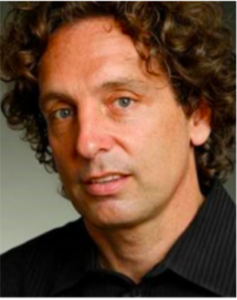
Interview by Mike Greenly
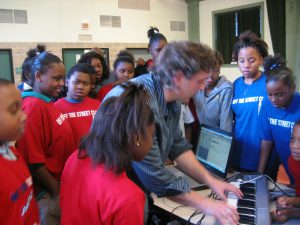
In my many years of working with musicians either as collaborators, whether for corporate projects or the public, I’ve met some major world-class talents. Jim Papoulis is one of them — respected globally for his mastery in creating and conducting choral music written for children and youth. Jim’s committed to using his talent to make a positive difference in kids’ lives. His song-writing workshops — often in schools with children from extremely low-income families — have inspired young people to stay in school, study hard and change their fortunes for the better.
When kids participate in his workshops, they often begin to realize that they can achieve far more than their current circumstances had made them assume. Their lives and futures can be significantly improved because this musical visionary’s events empower kids to express themselves and — as a result — to believe in their ability to affect their own destinies.
As he travels around the world, the New York City-based composer brings a message of hope and acceptance to all. An example is his song “Kusimama” — written in 2011 in the Swahili language of East Africa. Last summer, the award-winning talent was invited to visit Dublin where he taught the song to 400 choir directors from across the country. Each director then took the song back to their respective hometowns where they taught it to 20 other directors. In short, 6,000 choral directors across Ireland learned the ins and outs of this one particular song.
The text is about standing tall on the earth — not with anger or aggression, but with hope, strength, acceptance and positivity. And since children are smaller than grownups, they start out standing “closer” to the earth. “Kusimama” is about empowering them — including the stomps and claps specifically written into the piece. Young Irish singers from Galway, Westmeath, Wicklow, Donegal, Cavan, Longford, Leitrim, Dublin, Kilkenny, Carlow, Waterford , Kildare, Clare, Limerick, Tipperary, Laois, Mayo, and West Cork are heard singing in their own, separate concerts.
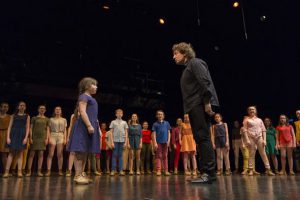 After the training was completed, the National Children’s Choir of Ireland selected 900 singers to perform the song. Papoulis returned to Ireland, rehearsed the choirs along with the Dublin Symphony — three nights in a row, 300 singers each night. “Kusimama” was performed at the National Concert in Dublin with the support of the Dublin Symphony.
I’ve known the maestro for a couple of decades and we’ve even collaborated on songs (for which I was the lyricist) with the goal of doing something positive in the world. One song, “We Can Plant a Forest,” caused over 50,000 trees to be planted in underdeveloped countries where industry has stripped forests but not replanted for the good of the planet.
After the training was completed, the National Children’s Choir of Ireland selected 900 singers to perform the song. Papoulis returned to Ireland, rehearsed the choirs along with the Dublin Symphony — three nights in a row, 300 singers each night. “Kusimama” was performed at the National Concert in Dublin with the support of the Dublin Symphony.
I’ve known the maestro for a couple of decades and we’ve even collaborated on songs (for which I was the lyricist) with the goal of doing something positive in the world. One song, “We Can Plant a Forest,” caused over 50,000 trees to be planted in underdeveloped countries where industry has stripped forests but not replanted for the good of the planet.
Another, “To Those Who Came Before Us,” is coupled with the Independence Fund — volunteers who help wounded and disabled vets returning home injured from their service. “I Know” contributed thousands of dollars to the CJD Foundation, which supports patients and their families dealing with Creutzfeldt-Jakob disease (CJD) — a rare, degenerative brain disorder which ultimately takes the lives of its patients.
Q: What made you enter the world of choral music?
JP: I started writing for children’s choirs in 1998. It seemed that everywhere I turned children were being subjected to difficult situations. With young children of my own, I saw that music and connection was a way into a world of hope and acceptance. The importance of hope and acceptance in a child’s life was so apparent that I started to explore ways that I could contribute in some way to the world of youth crying out to be heard.
Q: And why, in particular, music for kids?
JP: Every child sings. Either in a choir or by themselves. The opportunity to sing together, listen to each other and create magic together in an open and honest way, is what happens in a youth choir. There’s never any judgment. Everyone accepts each other – sharing music creates a “safe space” of accepting everyone, listening to each other and working towards a common goal. These are qualities that we all need, and I truly believe that when we help children to develop those qualities, it is like a seed of compassion and kindness that can spread in the world.
Q: You’ve worked with choirs and choral directors everywhere. Are there any honest observations you can make about the Irish – whether as performers or as audiences — in comparison to other cultures?
JP: I found in Ireland that the connection in the choral room among the individual students was remarkable. There was a selfless attitude, with all energy going not only to the music, but to the well being and development of each other.
Parent programs, family inclusion, psychological well being were all a large part of the Irish music programs, especially in economically challenged areas. I was very inspired by the “whole” child being helped, and not just great vocals for a perfect sounding choir. It struck me in Ireland — mutual respect and support — is really the most important aspect of any youth choir.
Q: One of the things you’re famous for is the Foundation for Small Voices. As you note on your website (see at end of story), your mission is to encourage the use of music, literature and art as a means to help children of all ages come to believe in themselves as capable, creative and compassionate individuals whose contributions to society make a difference. How was the Foundation created?
JP: In 1999, my wife and I were talking about how important and vital music is for a child. We also saw that programs were being cut from school curricula and wondered how we could help.
Not one hour later, we got a call from a friend of ours at Hyatt Hotels Corporate headquarters. She said it was the end of the year and that Hyatt had pledged to fund a shelter in India, but now the shelter was closing. So Hyatt needed to find a Foundation to donate money to. The deadline was three days from that moment.
We’d already been talking at home about creating the Foundation for Small Voices as a way to make a difference to the world through music, so we brainstormed on the spot. Just two days later, we presented the concept that had emerged to the president of Hyatt International in Chicago.
 We were warned in advance that he was a very busy man with only 20 minutes to hear us and that would be that. Well we began the presentation and ended up staying for two hours! At the end he brought in his counsel and that very day, he committed to fund us. Four months later, Hyatt sponsored our kick-off concert at Carnegie Hall. It was January of 2000 and we performed that historic venue’s first concert of the new millennium.
Q: I’m glad to note that you and I have a new piece of sheet music just released. Most readers will remember the tragic deaths of both students and adults at Sandy Hook Elementary School in Connecticut because of a deranged gunman. I was flattered that you turned to me for lyrics, but can you tell the story of how the song came to be?
JP: Music is often used to heal or inspire, and I got a call asking if I’d consider writing a song to address the senseless tragedy in Sandy Hook. Perhaps a positive message that in some way might have addressed the hope and healing needed after so much loss. I was working with you on some other projects at the time and, knowing you as I already did, I thought you’d relate to the project and bring resonance to it.
Q: I remember when you invited me to participate, you had the initial thought that those who had been lost were not lost from our hearts and minds. That they would always be our angels. I was struck by the beauty of the thought and, of course, we worked to reflect it in the lyrics ….
“Always My Angel”
VERSE
In my mind, I still can see you
Close my eyes, and you are here
Doesn’t matter how I lost you
Or how many tears I have cried
CHORUS:
You will always be my angel
You are always living in my heart
You have changed my life forever
You’re part of who I am … my angel
Always my angel
To listen: https://www.youtube.com/watch?v=s0lUePuFiuA
for sheet music: https://www.halleonard.com/product/48024977/always-my-angel
Q: What do you see in the future? What are your goals from here?
JP: Life is changing every week. We can only guess where life will take us through this historic time in our lives, but I do believe that through connection and kindness, we will evolve as a people. Like so many of us during the pandemic, I’ve been connecting worlds through video chat services like Zoom.
Even without being in the same physical space, these experiences can be very deep. Every week I conduct three songwriting workshops with young people from around the world. We share ideas, hopes, fears and wonders in a forum with others with whom we’d otherwise not be connecting.
We use the “chat” feature, which enables the students to share their thoughts without speaking, which has turned out to be a fascinating look into the minds of the future. It’s a remarkable opportunity for me — as a composer and as a human – to connect in a deep way with faces on a screen from many countries and states.
Each week I evolve with the experience. I’m a true believer that, as we find new ways to connect, the resonance we feel can be a positive outcome for us all.
Hopefully in the future, we’ll remember that turning to each other, connecting with each other and exploring our inner worlds can be the answer to many of the problems we face in the world.